Gauhati HC Upholds Penalties on Alleged Fake ITC Network; Section 122(1A) Applicable to Beneficiaries of Fraud

High Court upholds penalties on individuals accused of orchestrating fraudulent ITC invoice networks.

Individuals Benefiting From Fake ITC Schemes Remain Personally Liable

Meetu Kumari | Jun 10, 2026 |

Gauhati HC Upholds Penalties on Alleged Fake ITC Network; Section 122(1A) Applicable to Beneficiaries of Fraud

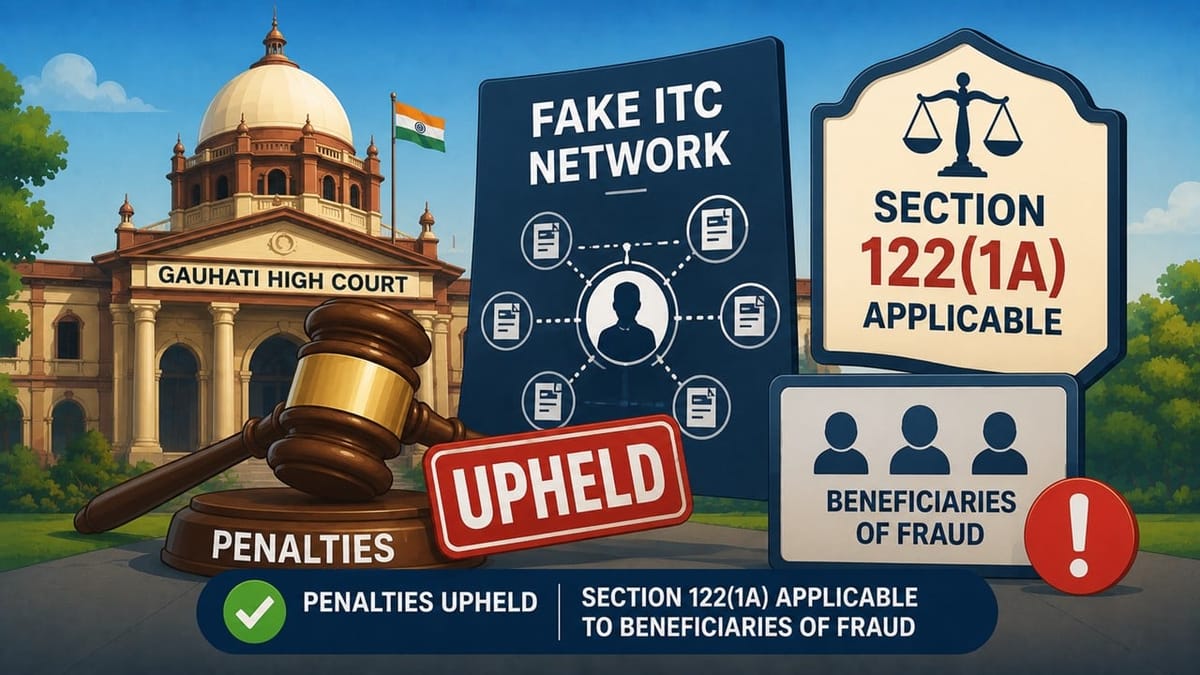
Gauhati HC Upholds Penalties on Alleged Fake ITC Network; Section 122(1A) Applicable to Beneficiaries of Fraud

The case arose from action taken by DGGI and CGST authorities against Mayank Bansal, a partner of Quantum Infratech (Assam), and several other persons alleged to have operated a network for passing fraudulent Input Tax Credit (ITC) through invoices issued without any actual supply of goods.

The authorities concluded that the entities were involved in generating and utilizing fake invoices to facilitate wrongful ITC claims and consequently imposed substantial penalties. The penalties were later affirmed by the Commissioner (Appeals).

Before the Gauhati High Court, the petitioners challenged the penalty orders through writ petitions under Article 226 of the Constitution. Their principal contention was that Section 122(1A) of the CGST Act, which imposes penalty on persons who retain the benefit of certain fraudulent transactions, was inserted later and therefore could not be invoked for transactions that had taken place before the provision came into force.

The High Court rejected the challenge and held that the petitioners could not avoid liability merely because Section 122(1A) was introduced subsequently. The Court observed that the underlying acts—such as issuing invoices without supply of goods, availing or passing on fake ITC, and facilitating fraudulent transactions—were already offences punishable under Section 122(1) of the CGST Act.

According to the Court, Section 122(1A) was introduced to ensure that the actual beneficiaries and persons controlling such fraudulent arrangements could also be proceeded against and could not escape liability by operating through corporate entities or intermediaries.

The Bench further declined to re-examine the factual findings recorded by the Proper Officer and affirmed by the appellate authority. It noted that disputed questions relating to evidence and factual appreciation fall within the jurisdiction of the GST Appellate Tribunal and are not ordinarily suitable for adjudication in writ proceedings.

While dismissing the writ petitions, the Court granted the petitioners liberty to file appeals before the GST Appellate Tribunal within 30 days. It directed that such appeals be considered on their merits without raising objections regarding limitations. The Court also continued the interim protection against coercive recovery measures until the Tribunal takes up and considers the stay applications, provided the appeals are filed within the prescribed 30-day period.

To Read Full Judgment, Download PDF Given Below.

StudyCafe Membership

Join StudyCafe Membership. For More details about Membership Click Join Membership Button
Join Membership

In case of any Doubt regarding Membership you can mail us at [email protected]

Join Studycafe's WhatsApp Group or Telegram Channel for Latest Updates on Government Job, Sarkari Naukri, Private Jobs, Income Tax, GST, Companies Act, Judgements and CA, CS, ICWA, and MUCH MORE!"





Author Bio
My Recent Articles
Reversed ITC Cannot Be Reclaimed Under Section 16(5): AAR GST Fraud: High Court Grants Bail in Rs 30 Crore Fake ITC Case, Notes 60 Days of Custody and No Complaint Filed Gauhati HC Upholds Penalties on Alleged Fake ITC Network; Section 122(1A) Applicable to Beneficiaries of Fraud ITAT Quashes Assessment for Violating Mandatory Section 144C Procedure ITAT Quashes Reassessment Notice Issued Beyond Limitation for AY 2015-16View All Posts