ITAT rejects goodwill depreciation after finding transfer agreement unenforceable, unsigned, and legally deficient.
Meetu Kumari | Jun 12, 2026 |
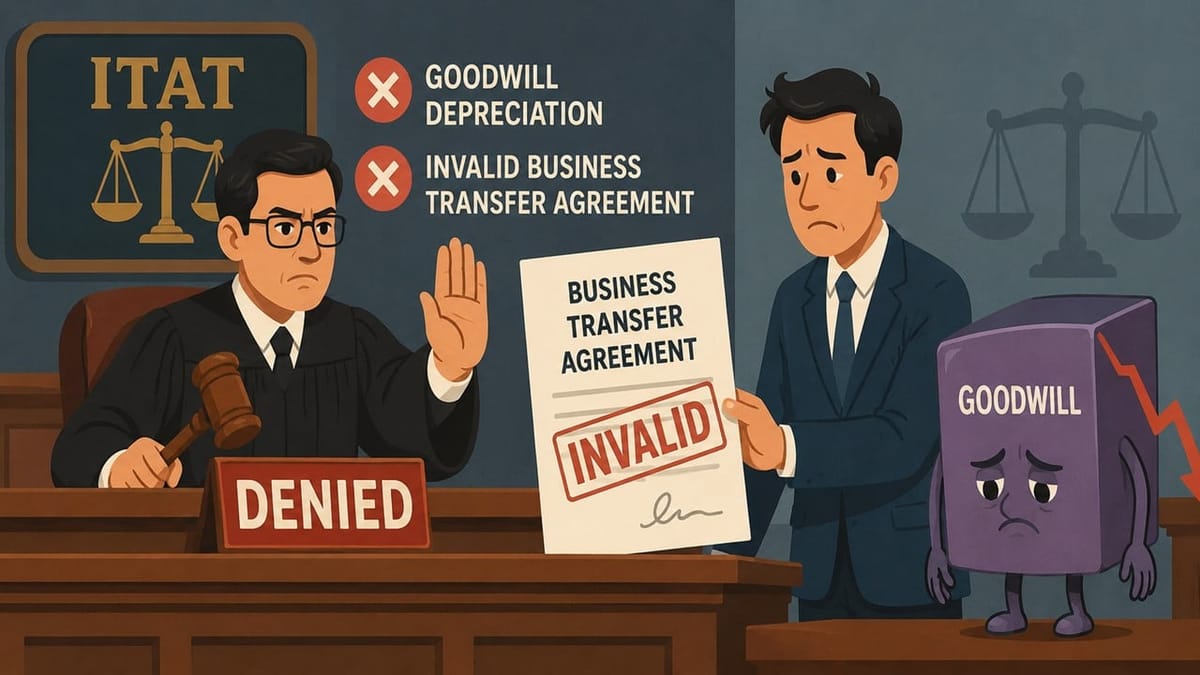

ITAT Denies Goodwill Depreciation Based on Invalid Business Transfer Agreement
The assessee, an LLP engaged in the business of dental implants, prosthetics and regenerative products, claimed depreciation of Rs.16.16 crore on goodwill arising from the acquisition of the business of M/s Equinox Sales India (ESI), a sole proprietorship concern of one of its designated partners, Dr. Shavir S. Nooryezdan. Under the Business Transfer Agreement dated 23 August 2016, the LLP acquired the business for about Rs.134.51 crore, of which approximately Rs.129.28 crore was attributed to goodwill and other business and commercial rights.
During assessment proceedings, the Assessing Officer observed that the goodwill did not exist in the books of the proprietor concern and had a nil value before the transfer. Relying on the provisions of Section 32 and related depreciation provisions, the Assessing Officer held that the opening written down value of the goodwill in the hands of the successor could not exceed that in the hands of the predecessor and therefore disallowed the entire depreciation claim of Rs.16.16 crore. The CIT(A) affirmed the disallowance.

Before the Tribunal, the assessee argued that the goodwill represented valuable business and commercial rights acquired under the Business Transfer Agreement and that depreciation was allowable in light of judicial precedents, including the Supreme Court’s ruling in Smifs Securities. However, on examining the record, the Tribunal found several serious defects in the transaction documents. It noted that the Business Transfer Agreement relied upon by the assessee was neither registered nor properly executed. More importantly, the agreement was unsigned on behalf of the purchaser.
The Tribunal also observed that the agreement had been entered into before the LLP came into existence and that the transaction was effectively between related parties because the proprietor of ESI later became a designated partner of the LLP.
The Tribunal further took note of the assessee’s written submissions claiming that there was no relationship between the buyer and seller, a statement which it found contrary to the documentary record. Referring to the decisions of the Punjab & Haryana High Court and the Supreme Court, the Tribunal held that an unsigned and unregistered agreement lacks legal enforceability and carries no evidentiary value. According to the Bench, such a document is merely an “anonymous piece of paper” without legal sanctity.

Since the goodwill itself originated from a transaction evidenced only by this defective agreement, the Tribunal concluded that the goodwill had no legally sustainable value. Consequently, the depreciation claim based on such goodwill could not be allowed.
The ITAT upheld the disallowance of ₹16.16 crore claimed as depreciation on goodwill and dismissed the assessee’s appeal.
To Read Full Order, Download PDF Given Below.

In case of any Doubt regarding Membership you can mail us at [email protected]
Join Studycafe's WhatsApp Group or Telegram Channel for Latest Updates on Government Job, Sarkari Naukri, Private Jobs, Income Tax, GST, Companies Act, Judgements and CA, CS, ICWA, and MUCH MORE!"






![Govt bars vehicle to get more than 200 Litre Diesel [Read Notification]](/cdn-cgi/image/width=320,height=195,fit=contain,format=webp,gravity=auto,metadata=none,quality=75/wp-content/uploads/2026/06/Centre-Restricts-Bulk-Diesel-Purchases-at-Petrol-Pumps-Amid-Global-Fuel-Supply-Concerns.jpg)