Tribunal holds genuine long-term family land lease cannot be taxed as capital gains.
Meetu Kumari | Jun 23, 2026 |
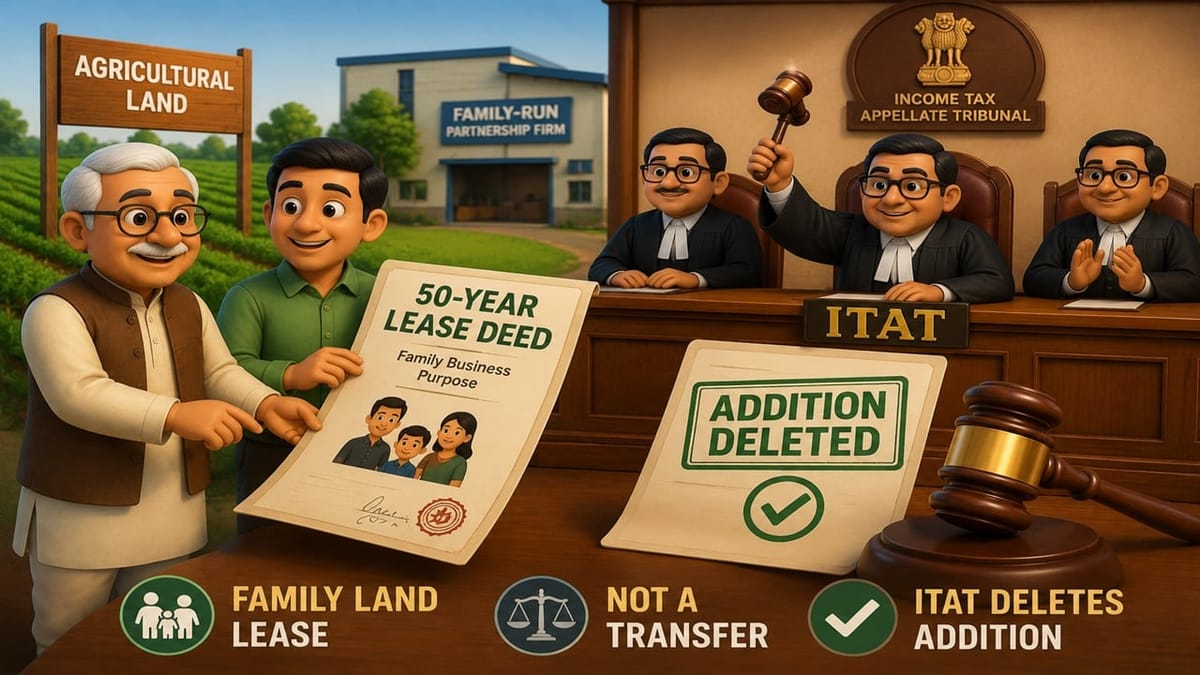

ITAT Deletes Capital Gains Addition on 50-Year Family Land Lease
The Nagpur Bench of the Income Tax Appellate Tribunal (ITAT) has held that a long-term lease of agricultural land in favour of a family-run partnership firm cannot automatically be treated as a transfer of a capital asset for the purpose of capital gains taxation. Consequently, the Tribunal deleted the addition made by the Assessing Officer by invoking Sections 269UA(f), 2(47) and 50C of the Income-tax Act.

The assessee, Shri Manoharlal Jiwandas Sachani, along with his son, was a co-owner of agricultural land that had been leased to M/s Kisan Sampada Food Park Industries, a partnership firm. During assessment proceedings for AY 2018-19, the Assessing Officer treated the 50-year lease as a deemed transfer of immovable property and applied Section 50C to adopt the stamp duty value of the property as consideration for computing capital gains. The addition was subsequently upheld by the CIT(A).
Before the Tribunal, the assessee contended that the transaction was merely a lease arrangement and not a perpetual transfer of ownership rights. It was argued that the authorities had wrongly invoked the deeming provisions and incorrectly equated the lease deed with an agreement to sell.
The Tribunal observed that the CIT(A) himself had accepted that the transaction did not fall within Section 2(47)(v), which deals with transfers covered by Section 53A of the Transfer of Property Act. However, the CIT(A) proceeded to invoke Section 2(47)(vi) on the ground that the lease period of 50 years effectively amounted to a transfer.

Rejecting this approach, the Tribunal noted that Section 53A applies only where there is an agreement to sell property and part performance of such agreement. In the present case, there was no agreement to sell; the document was a lease deed duly stamped as a lease under Article 36 of the Maharashtra Stamp Act. Therefore, the authorities were wrong in presuming that the lease arrangement was equivalent to a sale transaction.
The Tribunal further emphasized that a long duration of lease, by itself, does not convert a lease into a transfer under Section 2(47)(vi). Deeming provisions can be invoked only where the surrounding facts indicate that a lease, family settlement, memorandum of understanding, joint venture or similar arrangement has been structured to disguise an actual transfer and avoid capital gains tax.
Examining the facts, the Tribunal found that the land was jointly owned by the assessee and his son, while the lessee partnership firm consisted of family members, including the son as a partner. The lease deed itself recorded that the arrangement was intended for establishing a family business. These circumstances did not suggest any intention to permanently alienate ownership rights in favour of an outsider or to camouflage a transfer of the property.
Holding that the lease deed did not fall within the definition of “transfer” under Section 2(47), the Tribunal concluded that the capital gains computation based on stamp duty valuation was unsustainable. Accordingly, the addition made by the Assessing Officer and sustained by the CIT(A) was deleted and the assessee’s appeal was allowed.
To Read Full Order, Download PDF Given Below.

In case of any Doubt regarding Membership you can mail us at [email protected]
Join Studycafe's WhatsApp Group or Telegram Channel for Latest Updates on Government Job, Sarkari Naukri, Private Jobs, Income Tax, GST, Companies Act, Judgements and CA, CS, ICWA, and MUCH MORE!"