Meetu Kumari | Jun 24, 2026 |
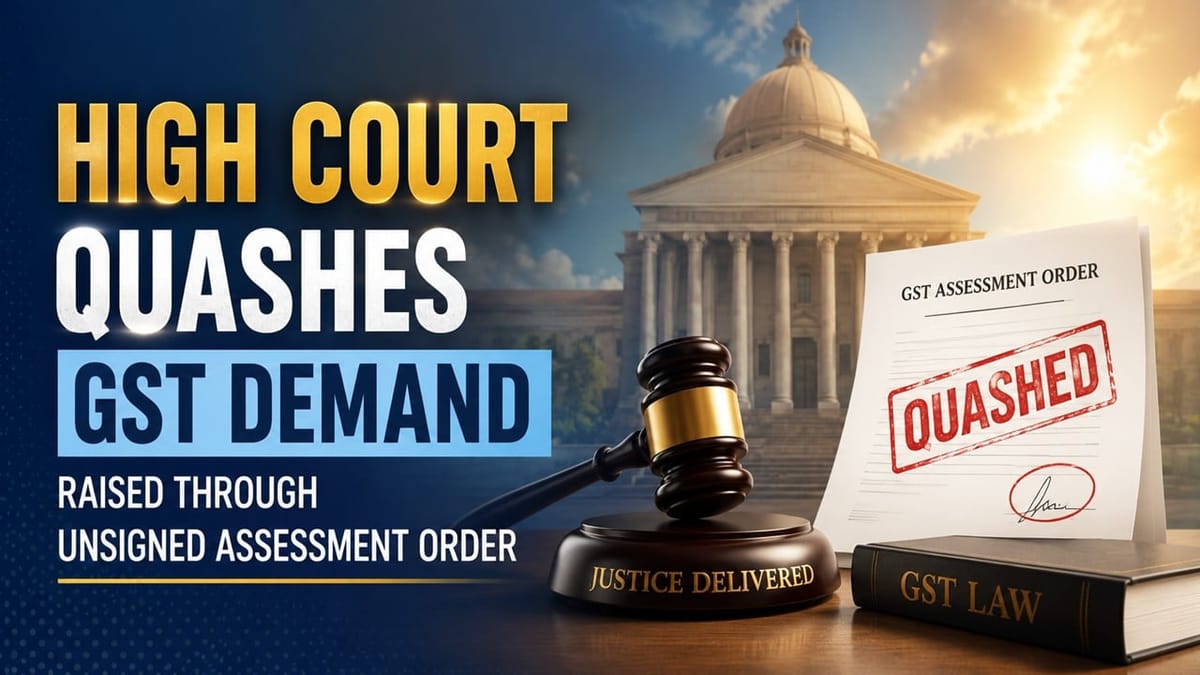

High Court Quashes GST Demand Raised Through Unsigned Assessment Order
In a significant ruling, the Andhra Pradesh High Court set aside a GST assessment order issued against the Nominee Works Committee, Kalavalla, holding that the absence of the assessing officer’s signature rendered the order invalid. The Court remanded the matter back to the Assessing Officer for fresh adjudication after providing the assessee an opportunity of hearing.
The petitioner had challenged Form GST DRC-07 dated 25.07.2023 and consequential recovery proceedings in Form GST DRC-16 dated 17.02.2026. Apart from disputing the levy of GST at 18% on works contracts executed for a State Government department, the petitioner contended that the assessment order itself was unenforceable as it was issued without the signature of the assessing authority.

The Division Bench comprising Justice R. Raghunandan Rao and Justice T.C.D. Sekhar noted that earlier decisions of the Court, including A.V. Bhanoji Row v. Assistant Commissioner (ST), SRK Enterprises v. Assistant Commissioner and SRS Traders v. Assistant Commissioner (ST), had consistently held that a signature on an assessment order is mandatory and that such a defect cannot be cured through Sections 160 or 169 of the CGST Act.
The Revenue opposed the petition on the ground of delay, arguing that the assessment order had been served by uploading it on the GST portal as permitted under Section 169(1)(d) of the GST Act. However, the Court observed that numerous taxpayers have faced practical difficulties in accessing portal-based communications and that such issues have become common under the GST regime. While ordinarily ignorance or failure to access the portal would not justify delay, the Court considered the present case exceptional because the impugned order suffered from a patent and fundamental defect.

Balancing the interests of taxpayers and tax administration, the Court held that delayed writ petitions challenging orders containing such inherent defects may be entertained subject to the taxpayer depositing 20% of the disputed tax amount. Following this approach, the Court set aside the assessment order and remanded the matter for fresh consideration.
The Court directed the petitioner to deposit 20% of the disputed tax within six weeks, while clarifying that any payments already made after the assessment order would be adjusted towards this requirement. It further ordered that the period during which the writ petition remained pending would be excluded for limitation purposes and left all issues open for adjudication before the Assessing Officer.
Thus, the writ petition was disposed of without any order as to costs.

In case of any Doubt regarding Membership you can mail us at [email protected]
Join Studycafe's WhatsApp Group or Telegram Channel for Latest Updates on Government Job, Sarkari Naukri, Private Jobs, Income Tax, GST, Companies Act, Judgements and CA, CS, ICWA, and MUCH MORE!"