A complete guide to the Section 87A rebate for AY 2026-27, covering eligibility, tax-free income limits, marginal relief, special income rules, and practical tax-saving examples.
Khush Dharmeshkumar Trivedi | Jun 24, 2026 |
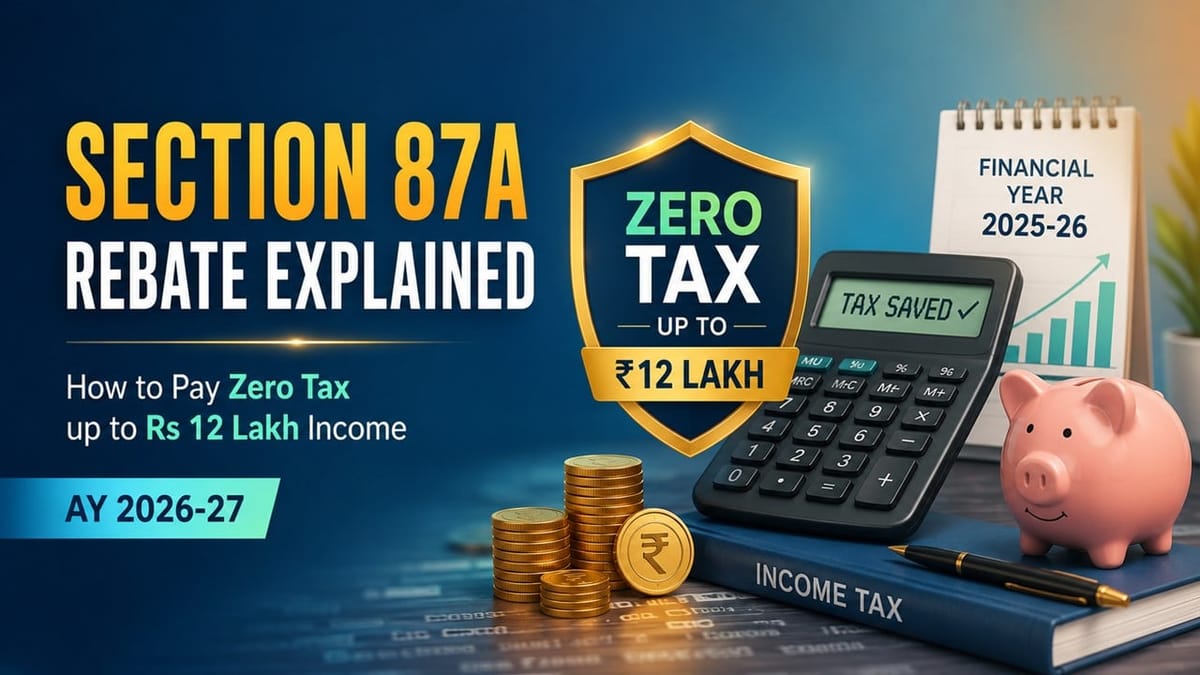

Section 87A Rebate Explained: How to Pay Zero Tax up to Rs 12 Lakh Income in AY 2026-27
Budget 2025 comes with the biggest tax relief for middle-class families, which was brought through a rebate under Section 87A and through slab rates.
If you file an income tax return for F.Y 2025-26 (A.Y 2026-27), then understanding of this section is necessary to minimise the tax liability.

What is Section 87A?
Section 87A allows a resident individual taxpayer to claim a rebate (a direct deduction) on their tax liability, provided their total taxable income stays within a specified limit. It does not reduce your total income, but it reduces tax liability fully or partially.

The rebate is applicable on the total tax liability as per slabs, but before adding 4% health and education cess.
Who Can Claim It?
Rebate Limits for FY 2025-26 (AY 2026-27)
| Regime | Income Limit | Maximum Rebate | Marginal Relief |
| New tax Regime | Up to 12,00,000 | Up to 60,000 | YES |
| Old Tax Regime | Up to 5,00,000 | Up to 12,500 | NO |
Important exclusion: The rebate does not apply to income, which taxed at special rates i.e short-term capital gain under 111A and long-term capital gain under 112A or any special rate income.
It only applies to income, which is taxed at normal rates.
However, the unexhausted basic exemption limit can be set off against these special rate incomes.
Note: You can claim the benefit of a rebate against the special rate income by opting for the old regime.
How to Calculate It – Step by Step
Example 1: New Tax Regime: Income within Limit
Mr Chaitanya, a salaried resident, earns Rs 12,75,000 in FY 2025-26 and opts for the new regime.
Tax payable: Rs 0
This is why you will often hear “income up to Rs 12.75 lakh is tax-free” for salaried individuals: the standard deduction plus the rebate combines to nil out tax entirely.
Example 2: New Tax Regime — Income Slightly Above Rs 12 Lakh (Marginal Relief)
Mr. Khush has taxable income of Rs 12,10,000 (new regime, no standard deduction in this case say it’s business income).
Without marginal relief, crossing Rs 12 lakh by even Rs 1 would disqualify her from the entire rebate, creating a tax jump far bigger than the extra income. Marginal relief fixes this:
In effect, he pays tax only equal to the amount by which her income exceeds Rs 12 lakh, not the full slab-rate tax. Marginal relief under the new regime phases out by around Rs 12.75 lakh of income beyond that; full slab rates apply with no relief.
Note: Such a marginal relief benefit is not available under the old regime; hence, if you cross Rs 5 lakh by a small amount & you won’t be eligible for a rebate.
Example 3: Income Includes Special Rate Income
Ms Maitry has a salary income of Rs 6,50,000 and short-term capital gains (STCG) under Section 111A of Rs 1,00,000, taking total income to Rs 7,50,000, under the new regime.
Even though his slab-rate income (Rs 6,50,000) is within Rs 12 lakh.
More importantly, the rebate cannot be applied against the tax on the STCG portion, only against tax on the Rs 6,50,000 taxed at slab rates.
Tax payable:

In case of any Doubt regarding Membership you can mail us at [email protected]
Join Studycafe's WhatsApp Group or Telegram Channel for Latest Updates on Government Job, Sarkari Naukri, Private Jobs, Income Tax, GST, Companies Act, Judgements and CA, CS, ICWA, and MUCH MORE!"