The Income Tax Department has identified nearly 15,000 to 20,000 cases where taxpayers allegedly reduced their tax liability by claiming deductions and exemptions under incorrect provisions of the Income-tax Act.
Saima | Jun 26, 2026 |
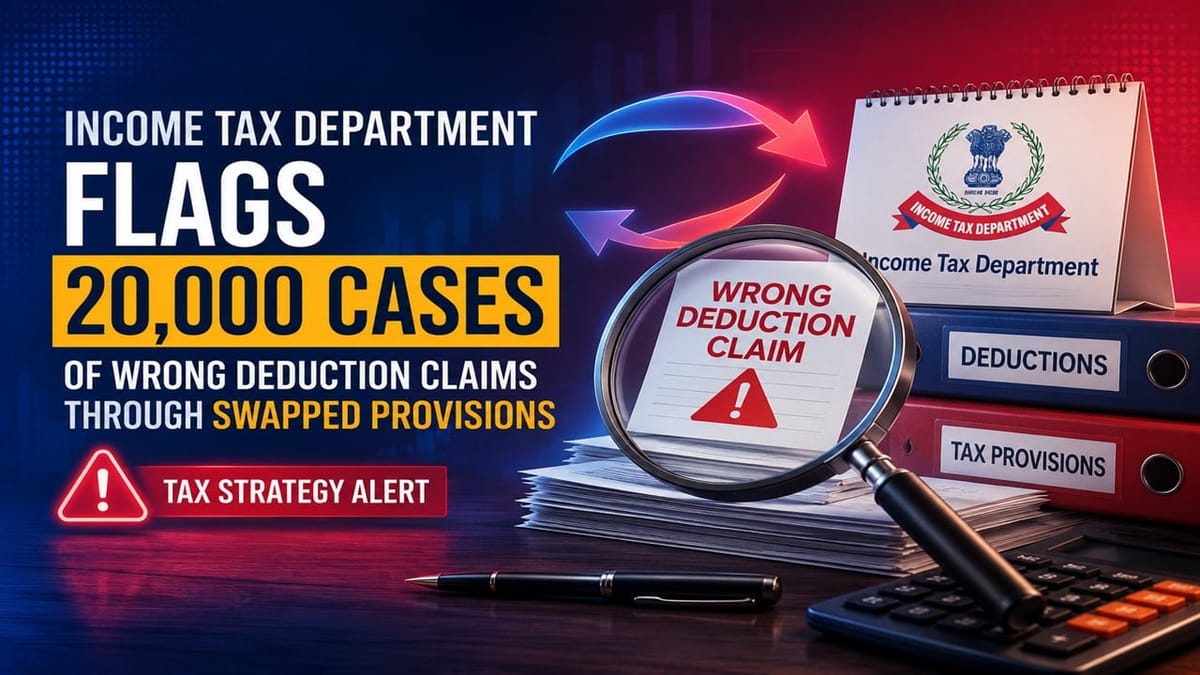

Income Tax Department Flags 20,000 Cases of Wrong Deduction Claims Through Swapped Provisions Tax Strategy
The Income Tax Department has identified approximately 15,000 to 20,000 cases where taxpayers used a “swapped provisions” strategy to lower their tax liability by claiming deductions or exemptions under provisions for which they were not legally eligible. The cases were detected through the Department’s data analytics systems and risk management framework.
According to the tax authorities, the practice generally involves interchanging or wrongly claiming benefits available under different provisions of the Income tax Act, which reduces taxable income and generates excess refunds or lower tax liability than permissible under law. Such claims, though reflected in filed returns, are not supported by the statutory conditions prescribed for availing those deductions or exemptions. The Department has adopted technology-driven verification mechanisms to identify mistakes between income disclosures, deduction claims, third-party information, employer filings, Annual Information Statements (AIS), and other financial records.

The Department found that several taxpayers had claimed benefits under provisions for which they did not satisfy the statutory eligibility requirements. These claims resulted in understatement of taxable income and a reduction in tax liability. The irregularities were identified through data-driven analysis and cross-verification of taxpayer information available with the Department.
Instead of immediately initiating enforcement proceedings in every case, the Department has advised taxpayers to review their returns themselves and rectify any incorrect claims. Taxpayers who have deliberately claimed deductions or exemptions under incorrect provisions may file revised or updated returns, as applicable, and discharge the correct tax liability. Failure to do so may expose taxpayers to interest, penalties, detailed scrutiny, and other proceedings under the Income-tax Act, 1961.
The Income Tax Department has reportedly identified nearly 15,000 to 20,000 cases where taxpayers may have modified deduction or exemption claims while filing revised or updated income tax returns. According to reports, tax authorities observed a pattern where taxpayers will withdraw one deduction or exemption claim and then substitute it with another while revising their returns. The Department is examining whether such changes were made in accordance with the provisions of the Income-tax Act.

One of the instances highlighted involves salaried taxpayers who initially claimed exemption for House Rent Allowance (HRA) but later withdrew the claim and sought exemption under Section 10(14), which relates to specified allowances such as conveyance allowance, children’s education allowance, and allowances granted for working in remote or hilly regions. In some instances, deductions originally claimed for contributions to political parties were later replaced with claims relating to donations made to approved research institutions.
Also, tax authorities have approached employers and requested them to review inconsistencies in Form 24Q, the quarterly statement filed for tax deducted at source (TDS) on salary payments. The exercise forms part of the Department’s broader effort to improve tax compliance and ensure accurate reporting of income and deductions.

In case of any Doubt regarding Membership you can mail us at [email protected]
Join Studycafe's WhatsApp Group or Telegram Channel for Latest Updates on Government Job, Sarkari Naukri, Private Jobs, Income Tax, GST, Companies Act, Judgements and CA, CS, ICWA, and MUCH MORE!"