Amendments Introduced in ITR Form-3 for AY 2025–26 as Compared to Previous AY 2024-25:
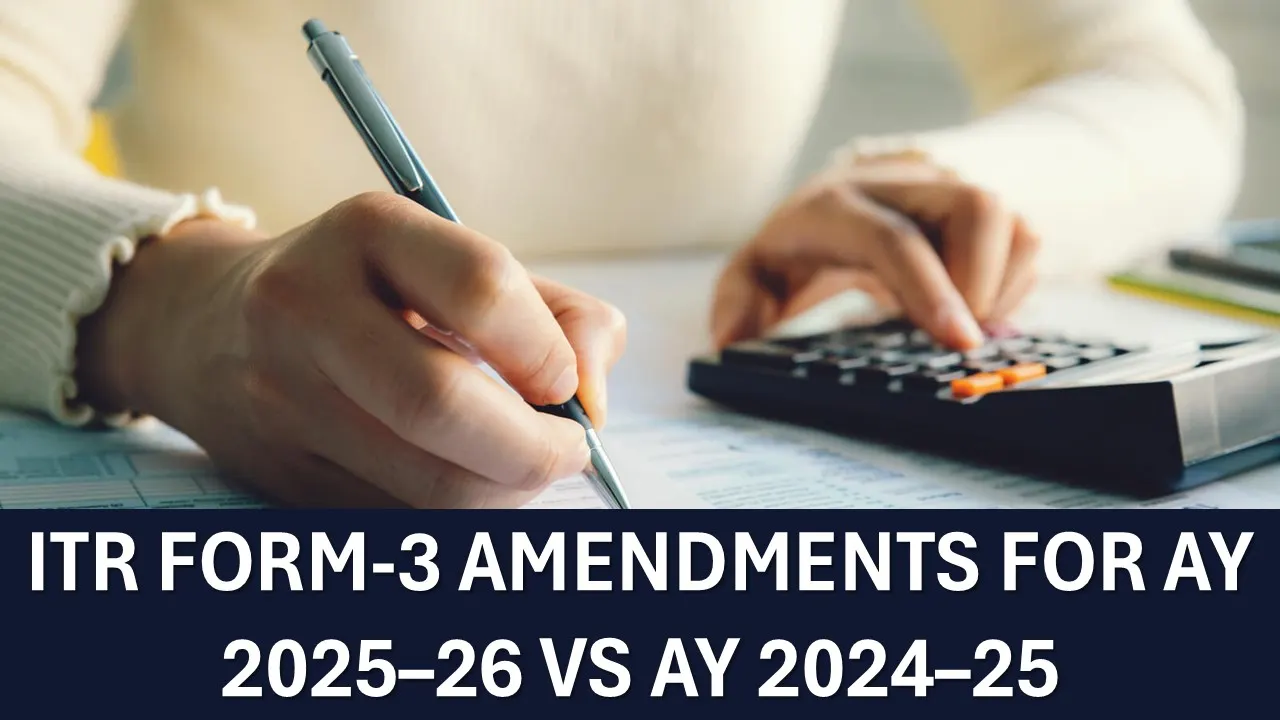
The Income Tax Return (ITR) Form-3 for Assessment Year (AY) 2025–26 has introduced a number of significant amendments compared to the previous assessment year 2024-25.
Key Changes in ITR Form-3 for AY 2025–26 Under Finance Act 2024
 Saloni Kumari
 May 2, 2025
Amendments Introduced in ITR Form-3 for AY 2025–26 as Compared to Previous AY 2024-25
The Income Tax Return (ITR) Form-3 for Assessment Year (AY) 2025–26 has introduced a number of significant amendments compared to the previous assessment year 2024-25, reflecting the updates in the Finance Act 2024 and enhancing compliance, traceability, and transparency.
1. Option to Opt-Out of the New Regime (Section 115BAC(6))
- The new ITR Form-3 gives explicit details for opting out of the new tax regime. It now includes the Form 10-IEA requirement, acknowledgement number, dropdown logic, and continuity checks for multiple assessment years.
- The previous version of the form only provided a basic Yes/No option without a detailed validation structure.
- Disclosures have been expanded in the new ITR Form-3, for foreign travel expenses of more than Rs. 2 lakh, electricity bills exceeding Rs. 1 lakh, and current account deposits above Rs. 1 crore. A new dropdown for clause (iv) has also been added.
- Earlier, the ITR-3 form was less structured and also had no dropdown logic.
- The threshold for reporting asset and liability information has been increased. Only persons with an overall income of more than Rs. 1 crore are now required to provide these details.
- Earlier, this limit was Rs. 50 lakh in the assessment year 2024-25.
- A new optional field for PAN/Aadhaar has been introduced in the ITR-3 form for AY 2025–26 for some selective individuals, such as spouse and minor children.
- Previously, PAN fields were not structured/optional in the ITR-3 form.
- This section now includes segmentation for long-term and short-term capital gains (LTCG/STCG) made before and after July 23, 2024. Post this date, listed securities are taxed at 20% (general) or 12.5% (special cases), aligning with the Finance Act’s revised capital gain tax structure.
- Earlier, long-term and short-term capital gain (LTCG/STCG) rates were uniform.
- A new long-term capital gain (LTCG) slab has been introduced with 12.5% for gains on listed securities after July 23, 2024, under Section 112(1).
- Previously, the uniform rate was 20% long-term capital gain (LTCG) for the mentioned securities.
- Modifications have been made to include adjustments for new income heads, carry-forward AMT details, and segregation of IFSC units.
- Earlier forms provided only a generic AMT computation.
- Detailed reporting for ESOPs is now being asked in ITR Form-3, including deferment, payment timelines, employer name, sale of shares, and tax amounts by assessment year.
- This was not available in earlier versions of ITR Form-3.
- Now, ITR Form-3 needs an extra requirement of location-wise disclosure of agricultural land and state-wise income if agricultural income exceeds Rs. 5 lakh.
- This was not required in the previous ITR Form-3.
- Outward supply value must now be reported mandatorily as per GST returns per GSTIN.
- Previously, this was optional or limited.
- The section now includes an explicit reference to Section 92CD, covering modified returns under Advance Pricing Agreements (APA), and has added a “capacity” field for the declarant.
- Earlier, in ITR Form-3, only a general declaration was needed.
About Author


Saloni Kumari
Content Writer
Saloni is a Content Writer with 2+ years of experience at studycafe.in. She writes legal, taxation, and finance related content including GST, Income Tax etc. Skilled in translating complex judicial pronouncements and regulatory developments into clear, and reader-friendly articles. Experienced in covering judgements of ITAT, High Court, GSTAT, and news related to Income Tax, GST, and corporate law. She can be reached at [email protected].
Saloni is a Content Writer with 2+ years of experience at studycafe.in. She writes legal, taxation, and finance related content including GST, Income Tax etc. Skilled in translating complex judicial pronouncements and regulatory developments into clear, and reader-friendly articles. Experienced in covering judgements of ITAT, High Court, GSTAT, and news related to Income Tax, GST, and corporate law. She can be reached at [email protected].
 StudyCafe
 Delhi, Delhi, India
 2949
2949My Recent Articles
- ITAT Remands LTCG Dispute After Senior Citizen Misses Online Notices Due to Lack of Digital Knowledge
- Maharashtra Govt Eases Registration of Jointly Owned Land Sales, ‘KA’ Copy Can Replace Co-Owners’ NOC
- No Separate Section 69C Unexplained Expenditure Addition Allowed After Accepting Section 44AD Income Without Supporting Evidence: ITAT
- RBI Imposes Restrictions on Puducherry Co-operative Urban Bank for Six Months, Caps Cash Withdrawals at Rs 5,000
- ICAI Opens Application Window for Empanelment of Members to Act as Observer at CA January 2027 Exams
Up Next
Loading suggestions…


Recent Posts



All Posts


Tags
No tags yet.
Recent Posts
All Posts
Tags
No tags yet.