CBDT Eliminates Arrest and Detention Provisions From Income-tax Recovery Rules With Retrospective Effect:
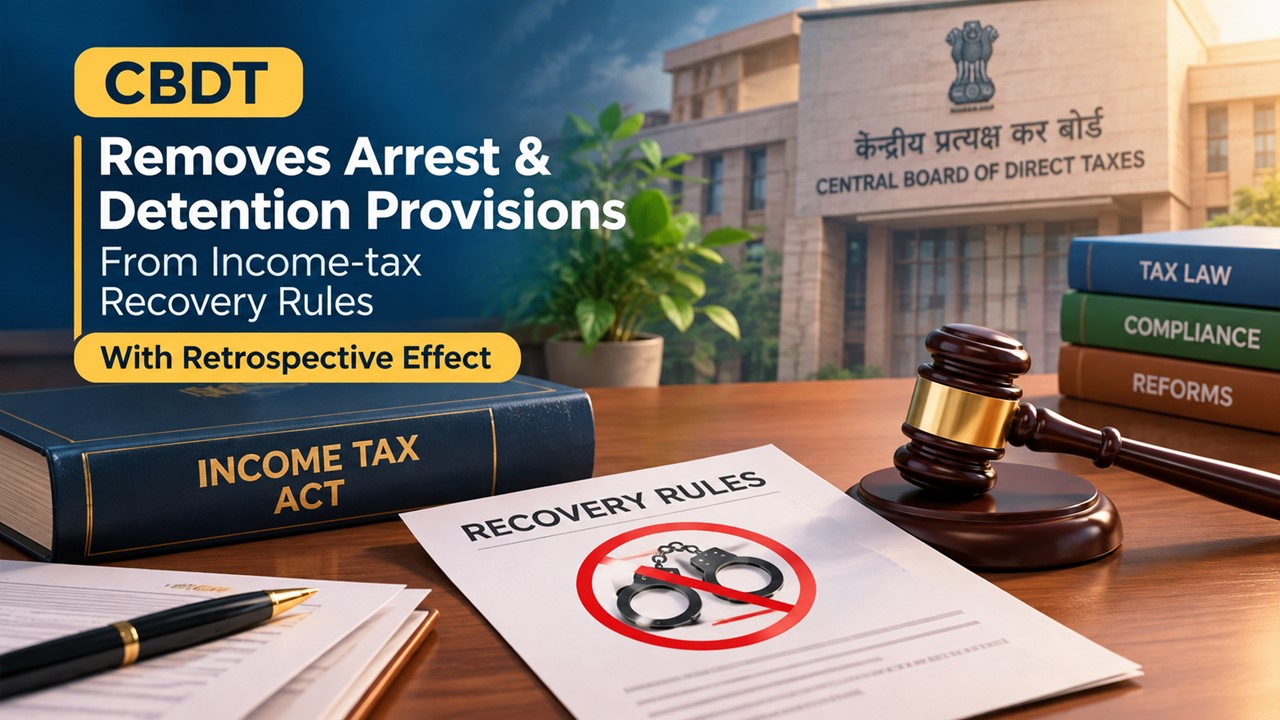
CBDT has removed arrest and detention provisions from tax recovery rules with retrospective effect from April 1, 2026.
Govt Grants Six-Month Extension for Valuer and Tax Practitioner Registration
 Saloni Kumari
 Sep 19, 2026
The Central Board of Direct Taxes (CBDT) under the Ministry of Finance has introduced the Income-tax (Fourth Amendment) Rules, 2026, after completely eliminating the provisions of arrest and detention from the tax recovery rules in case when the defaulter is no longer alive, with retrospective effect from April 01, 2026. The board has directed the tax officials not to undertake any arrest.
The aforementioned decision has been officially announced vide a Notification dated September 17, 2026. The said amendment has been introduced in accordance with the Budget 2026-27 announcement of decriminalisation of technical defaults such as non-production of books of account and documents, and payment of TDS.

The Union Budget presented on February 01, 2026, had explicitly mentioned that minor offences will attract a penalty and not prosecution. Now, the board has introduced an amendment in Rule 225 of the Income-tax Rules, 2026, which concerns recovery of tax arrears, specifically through the attachment and sale of movable and immovable property.
The already existing valuers and authorised income-tax practitioners have been granted an additional time limit of six months (till March 31, 2027) to complete their registration under the new Income-tax Act, 2025 framework.

Form 169 is used to seek registration as valuers under Section 514 of the Income-tax Act, 2025. To complete the registration process, details such as PAN, contact details, educational qualifications, professional certifications, relevant valuation experience and the class of assets. Similarly, Form 171 is used to seek registration as authorised income-tax practitioners under Section 515 of the Income-tax Act, 2025.
About Author


Saloni Kumari
Content Writer
 StudyCafe
 Delhi, Delhi, India
 2886
2886My Recent Articles
- Dreamfolks Services Faces Rs 1.58 Crore IGST Demand Over ITC Availment on Invoices Issued by GST-Cancelled Supplier
- ITAT Restores Taxpayer's Appeal In Interest of Natural Justice After CIT(A)'s Failure to Decide Appeal on Merits
- ITAT Restores Income Tax Appeal to CIT(A) After Condoning 115-Day Delay Due to COVID-19 Genuine Hardship
- ITAT Quashes Reassessment Order Against Geecee Ventures Over Lack of Section 151 Approval From Specified Authority
- ITAT Sets Aside Rs 3.47 Crore Addition, Reopening Beyond 4 Years Without PCIT Approval Is Legally Invalid
Loading suggestions…


Recent Posts
All Posts
Recent Posts
All Posts