CBIC Introduces Fresh Guidelines for GST Proceedings, Emphasises Taxpayer Rights, Detailed Notices, Fair Adjudication and Reduction of Unnecessary Litigation:
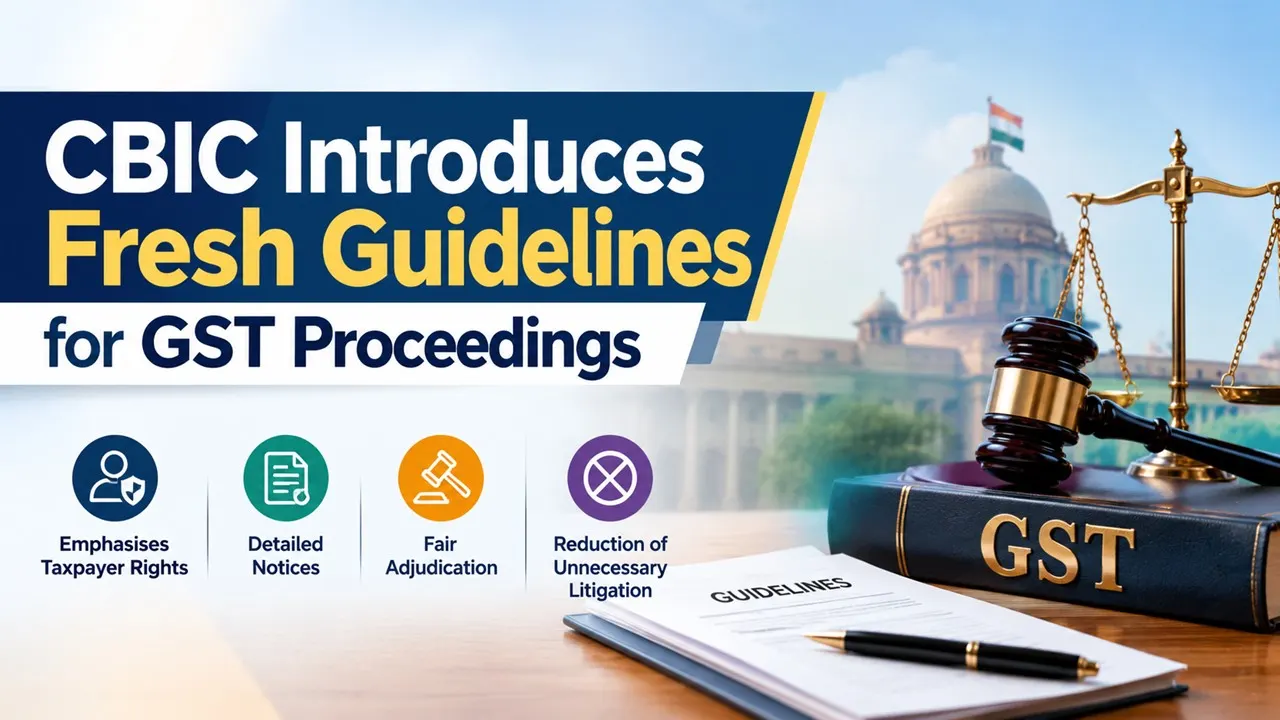
CBIC issues new GST guidelines to ensure clear demand notices, evidence-based fraud allegations, fair adjudication and reasoned orders to protect taxpayers and reduce unnecessary litigation.
CBIC Issues New GST Guidelines
 Vanshika verma
 Oct 28, 2026
Table of Contents

The Central Board of Indirect Taxes and Customs (CBIC) has issued fresh guidelines to improve the handling of GST demand notices, adjudication proceedings and appeals. In a circular dated October 26, 2026, the Board had directed tax officers to ensure that notices and orders are clear, detailed and supported by facts, evidence and relevant legal provisions. The guidelines are meant to protect taxpayers’ rights, enhance transparency and minimize unnecessary litigation.
The circular was issued after representations highlighted cases in which adjudication and appellate orders failed to properly consider taxpayers' submissions and supporting documents. According to the Board, vague or poorly reasoned orders can lead to avoidable disputes, appeals and cases being sent back for fresh decisions. The new guidelines provide a common framework for officers to follow while handling GST-related proceedings.

Pre-show cause notice intimation encouraged
The CBIC has encouraged tax officers to issue a pre-show cause notice intimation, wherever feasible, before issuing a formal show cause notice (SCN). Under Rule 142(1A) of the CGST Rules, taxpayers may be informed about the tax assessed as payable through Part A of Form GST DRC-01A. This gives businesses an opportunity to explain their position before formal proceedings begin and may help resolve discrepancies without issuing a show cause notice.
Show cause notices must be clearly detailed
The Board has stressed that the show cause notice should mention the allegations made against the taxpayer and the grounds for proposing action. A notice should not be a mere reproduction of legal provisions without stating the facts of the case. It must be sufficiently informative to allow the taxpayer to understand the charges and to respond knowledgeably.
According to the guidelines, the notice should correctly contain name of the taxpayer, GSTIN or Temporary ID, details of business, registration status, jurisdiction and the tax periods involved.

Tax officers should objectively examine the documents and evidence supporting the allegations. The notice should identify the alleged irregularities, explain the relevant legal provisions and establish a clear connection between the facts and the alleged violations. Where multiple taxpayers or persons are involved, the role of each person should be separately explained.
The notice should also contain a concise statement of charges, the proposed demand and its calculation, preferably with a year-wise breakup where multiple financial years are covered. It must specify the authority responsible for adjudication, the deadline for submitting a reply and the consequences of failing to respond.
Fraud and suppression allegations need supporting evidence
One of the key points in the circular is that tax officers cannot invoke provisions relating to fraud, wilful misstatement or suppression of facts merely because GST has not been paid or a discrepancy has been detected.
The Board has said that such allegations must be supported by specific facts and evidence showing an intention to evade tax. Simply using terms such as “fraud”, “wilful misstatement” or “suppression of facts” in a notice is not sufficient. The notice must explain what conduct led the officer to make these allegations.
The circular also clarifies that an incorrect statement does not automatically amount to wilful misstatementSimilarly, an omission to supply information is not necessarily suppression unless it is deliberate and intended to evade tax. “The tax officers have to go into the facts and on the basis of evidence create the intention which is required.
The guidelines refer to judicial pronouncements including Supreme Court judgment in G.R. Infra Project Ltd. v. State of Madhya Pradesh dated 19th August, 2026 as referred in the circular. The Board has emphasised that essential allegations and supporting particulars must be included in the notice itself and cannot simply be added later to cure deficiencies.
The circular further states that issuing a second notice on the same facts and grounds for a subsequent period, again alleging fraud or suppression, is generally not legally valid unless new and independent grounds exist. In appropriate cases, subsequent proceedings should instead follow the provisions applicable to cases without such allegations.
For complete information refer to the following circular-
About Author


Vanshika verma
Content Writer
 Studycafe
 Delhi, Delhi, India
 2139
My Recent Articles
- Share India Securities Discloses Rs 1.18 Lakh Penalty for MWPL Violation, Says No Material Business Impact
- CBIC Clarifies GST Input Tax Credit Rules for Banks, FIs and NBFCs Under Section 17(4)
- IT Department Urges Select Taxpayers to Disclose Undeclared Overseas Assets Under FAST-DS
- IRCON International Approaches Uttarakhand HC Over Rs 72.41 Crore GST ITC Dispute, Court Seeks Dept’s Response
- Airlines Eligible for GST Refund on Cancelled Tickets if Fare and Tax Are Returned to Passengers, Rules GSTAT
Loading suggestions…


Recent Posts

All Posts


Recent Posts
All Posts