CFA vs Other Finance Credentials (CA, FRM, CFP, MBA): Which One Is Right for Your Career?:
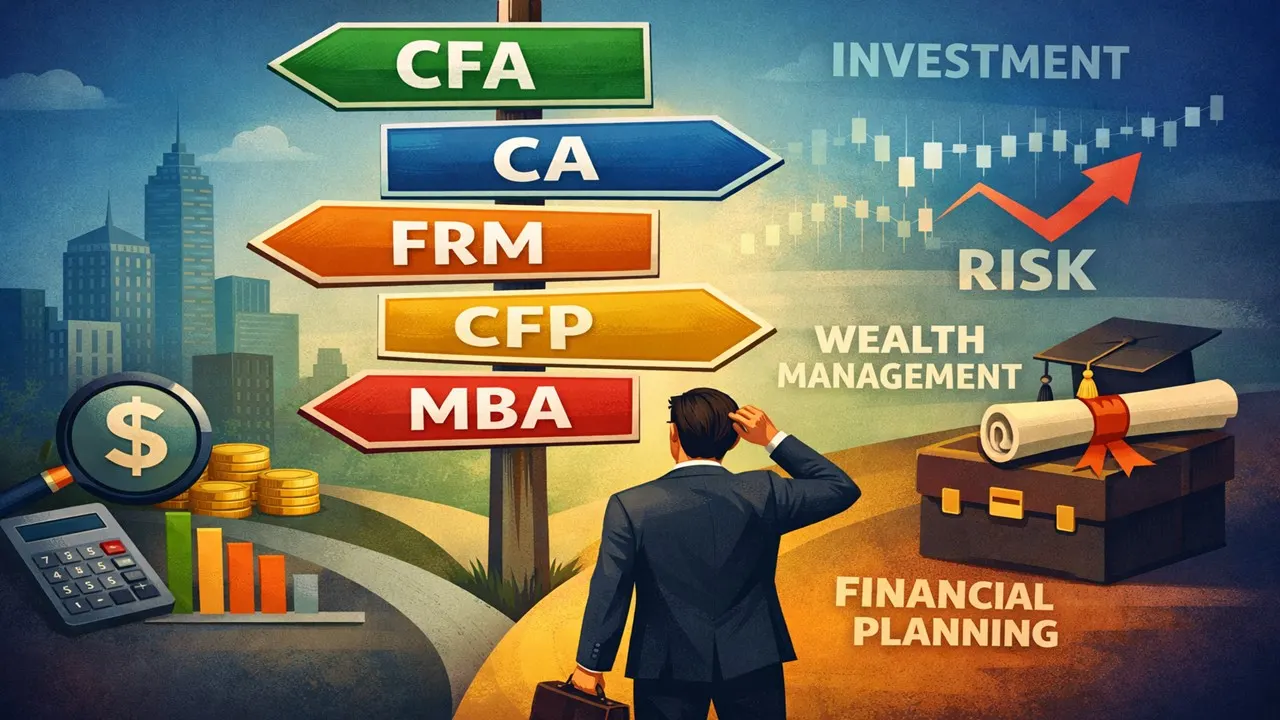
Know the real differences, career outcomes, and limitations of CFA, CA, FRM, CFP, and MBA to help you make an informed decision.
Comparison Between CFA and Other Finance Credentials
 Aswini Bajaj
 Jan 24, 2026
Table of Contents

CFA vs Other Finance Credentials (CA, FRM, CFP, MBA): Which One Is Right for Your Career?
Choosing the right professional credential in finance can become confusing. With options like CFA, CA, FRM, CFP, and MBA, many students and professionals struggle to understand how these qualifications actually differ and which one is most suitable for their career goals.
Each credential fulfills a unique role, leads to different career paths, and demands a different kind of commitment. There is no universally “best” qualification, only the one that fits your career direction, strengths, and long-term plans. This article breaks down the real differences, career outcomes, and limitations of each credential to help you make an informed decision.
A Quick Comparison: CFA vs CA vs FRM vs CFP vs MBA
|
Factor |
CFA | CA | FRM | CFP |
MBA |
|
Core Focus |
Investment analysis & portfolio management | Accounting, audit, taxation | Financial risk management | Personal finance & wealth planning | Business & leadership |
| Typical Roles | Equity research, asset management, IB | Auditor, tax consultant, CFO track | Risk analyst, treasury, compliance | Financial planner, wealth advisor |
Manager, consultant, leadership roles |
|
Global Recognition |
Very high | High (India-focused) | High (niche) | Moderate | Depends on institution |
| Time Required | 2.5-4 years | 4-5 years | 1.5-2 years | 1-2 years |
1-2 years |
|
Cost (Indicative) |
Medium | Low | Medium | Low-Medium | High |
| Self-Study Intensity | High | High | Very high | Moderate |
Moderate |
|
Career Switching Power |
Medium | Low | Medium | High (advisory) |
High |
Exploring Each Credential
Chartered Financial Analyst (CFA)
The CFA Program focuses on investment analysis, portfolio management, financial reporting, valuation, ethics, and capital markets. It is structured across multiple levels, with a strong focus on investment analysis, ethics, and portfolio management. Candidates should clearly understand the syllabus and exam structure before committing to the program. Moreover, CFA is globally recognized and highly respected in roles in investment and finance. Best suited for:- Equity research and asset management
- Investment banking and corporate finance
- Portfolio management and institutional investing
- CFA does not guarantee a job
- Requires strong self-discipline and long-term commitment
- Practical skills (Excel, modeling, data analysis) are often required alongside the charter
Chartered Accountant (CA)
The CA qualification is centered on accounting, auditing, taxation, as well as regulatory compliance. Before opting for this path, candidates should be comfortable with its long duration, structured articleship requirements, and largely India-centric career outcomes. Best suited for:- Audit and taxation
- Corporate accounting and finance leadership
- Regulatory and compliance roles
- Limited relevance for capital markets and investment roles
- Global mobility is lower compared to CFA
- Career paths are more structured and less flexible
Financial Risk Manager (FRM)
The FRM certification specializes in quantitative and qualitative risk management, including market risk, credit risk, operational risk, and financial compliance standards. It is focused on understanding and supervising financial risk across markets, institutions, and governance environments. Given its heavy quantitative orientation and narrow role focus, candidates should evaluate whether they are interested in risk-centric careers before pursuing the program. Best suited for:- Risk management and treasury roles
- Banking, compliance, and regulatory positions
- Professionals already working in risk-related functions
- Narrower role scope compared to CFA
- Less relevant for equity research and valuation-focused roles
Certified Financial Planner (CFP)
The CFP certification focuses on personal finance, retirement planning, insurance, tax planning, and wealth management for individuals. It is designed for professionals who work closely with individual clients on personal finance decisions, such as investments, retirement planning, and insurance. Those considering CFP should be clear that it primarily prepares for advisory and relationship-driven roles rather than for corporate or institutional finance careers. Best suited for:- Financial advisors and relationship managers
- Wealth management and personal finance practices
- Client-facing advisory roles
- Limited application in corporate or institutional finance
- Not designed for investment banking or research careers
Master of Business Administration (MBA – Finance)
An MBA provides broad business education, covering strategy, leadership, marketing, operations, and finance. However, the outcomes depend heavily on the institution's quality and reputation. Candidates should assess the institute’s reputation, placement track record, and overall return on investment before committing to the degree. Best suited for:- Career switchers
- Aspiring managers and consultants
- Strategic and leadership roles
- Very high cost at top institutions
- ROI varies considerably based on the institute's ranking
- Finance depth may be lower than specialized certifications
Career Outcomes: What Do These Credentials Actually Lead To?
Investment & Capital Markets
- Best fit: CFA
- Secondary: MBA (top-tier institutes)
Accounting, Audit & Taxation
- Best fit: CA
- Secondary: MBA (finance/accounting focus)
Risk Management & Compliance
- Best fit: FRM
- Secondary: CFA
Wealth Management & Advisory
- Best fit: CFP
- Secondary: CFA (with client exposure)
Leadership & General Management
- Best fit: MBA
- Secondary: CFA + experience
When CFA Makes Sense and When It Doesn’t
CFA makes sense if:- You aim to work in investments or capital markets
- You are comfortable with self-study (if you do not opt for coaching)
- You want global career mobility
- You expect immediate job placement
- You are targeting accounting or taxation roles
Combining Credentials Strategically
Many professionals choose to combine credentials rather than rely on a single qualification. When done right, combining certifications can broaden skill sets, improve role flexibility, and strengthen long-term career positioning. However, not all combinations add meaningful value, and the benefit depends largely on how well the credentials complement each other in real-life scenarios and roles. Some common combinations seen in practice include:- CA + CFA: Accounting strength + investment expertise
- FRM + CFA: Risk management + valuation and portfolio skills
- MBA + CFA: Strategic leadership + deep finance knowledge
- CFP + CFA: Advisory roles with strong investment credibility
Credentials Alone Are Not Enough
While professional credentials can signal commitment and core knowledge, they are no longer sufficient on their own in today’s finance job market. Employers increasingly look for candidates who can apply concepts in real-life situations, communicate insights clearly, and work with data and tools used in modern finance roles. Across all finance roles, employers now expect:- Advanced Excel and financial modeling
- Data skills (Python, SQL, BI tools-role dependent)
- Communication and presentation skills
- Awareness of current financial and economic developments
How to Choose the Right Credential
Ask yourself:- Do I want technical depth or managerial breadth?
- Am I targeting global roles or India-centric careers?
- Can I commit to long-term self-study?
- What is my budget, and what is my opportunity cost?
- Am I switching careers or deepening an existing one?
Conclusion
There is no single “best” finance credential. CFA, CA, FRM, CFP, and MBA each are designed for different career paths and professional outcomes. The right choice depends on an individual’s interests, strengths, and long-term career goals. When chosen thoughtfully, a credential can support steady career progression when combined with necessary skills and experience. When chosen poorly, it can lead to misaligned expectations and lost time, efforts, and money. Therefore, making an informed decision early can strongly affect long-term career outcomes.Sources
- https://www.cfainstitute.org
- https://www.icai.org
- https://www.garp.org
- https://www.fpsb.org
- https://www.mba.com
- https://www.investopedia.com
- https://www.shiksha.com
- https://www.careers360.com
About Author


Aswini Bajaj
Finance Trainer
 Aswini Bajaj Classes
 Kolkata, West Bengal, India
 1
1Up Next
Loading suggestions…


Recent Posts



All Posts


Recent Posts
All Posts