NCLT Rejects Shikhar Dhawan’s Insolvency Plea Over Unpaid Legends League Fee:
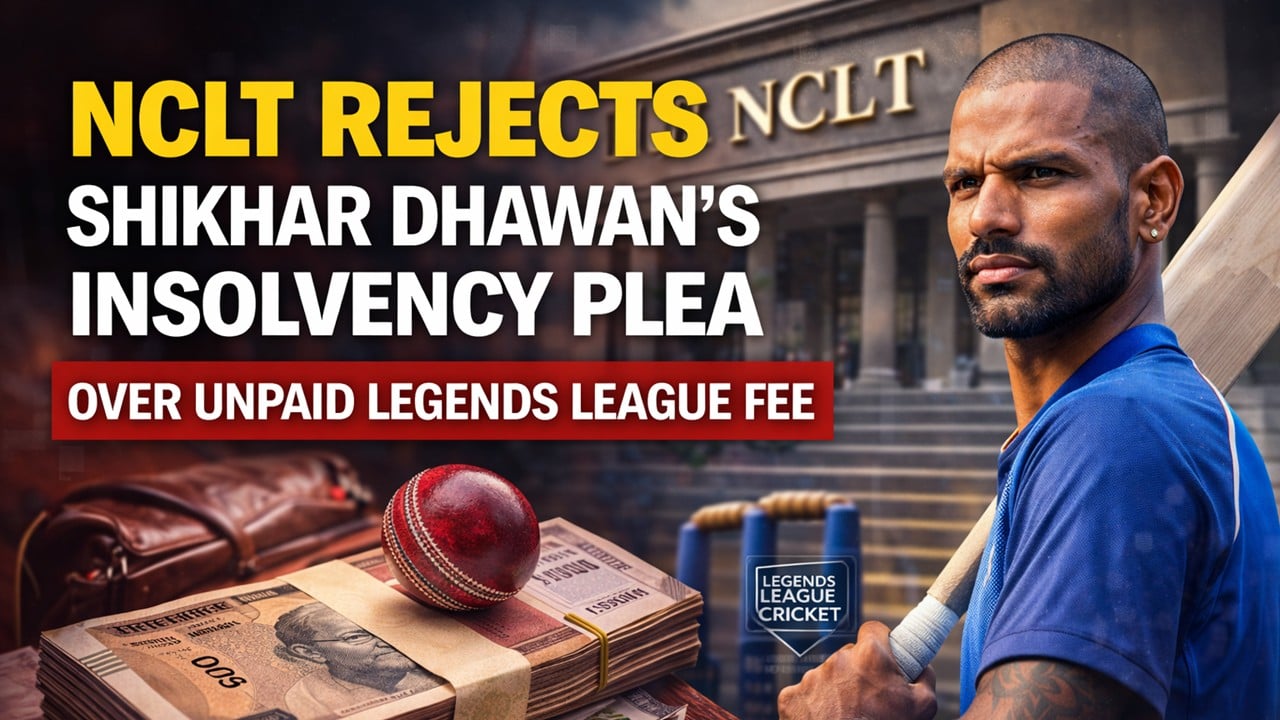
NCLT Says Player Agreement Dispute Requires Civil Adjudication as Operational Debt not Established; IBC Does Not Apply
Player Fee Dispute Not Fit for IBC Proceedings, Rules NCLT
 Meetu Kumari
 Mar 12, 2026
NCLT Rejects Shikhar Dhawan’s Insolvency Plea Over Unpaid Legends League Fee
The application was filed by cricketer Shikhar Dhawan under Section 9 of the Insolvency and Bankruptcy Code, 2016 seeking initiation of Corporate Insolvency Resolution Process against Absolute Legends Sports Private Limited, the operator of the Legends League Cricket. The claim arose from alleged non-payment of the player fee payable under a Player Agreement dated 10.09.2024 executed for Dhawan’s participation in the third season of the league held between September and October 2024. The Operational Creditor claimed that an amount of Rs. 1,24,50,459 remained unpaid, comprising a principal sum of Rs. 1,13,62,500 and interest calculated at 19.15% per annum.
The application held that the Corporate Debtor had agreed to pay a total player fee of Rs. 2,65,50,000 and had released only partial payments aggregating to Rs. 1,51,87,500. Despite repeated reminders and issuance of a demand notice under Section 8 of the IBC, the balance amount was allegedly not paid.
Thus, the applicant (Shikhar Dhawan) had to initiate insolvency proceedings against the Corporate Debtor.
Issue Raised Before Tribunal: Whether the alleged unpaid player fee arising from a Player Agreement for participation in Legends League Cricket constituted a clear operational debt under the Insolvency and Bankruptcy Code, warranting initiation of CIRP against the Corporate Debtor.
NCLT’s Order: The NCLT Bench dismissed the Section 9 application after examining the Player Agreement and the material placed on record. The Tribunal observed that the Agreement contained several ambiguities, particularly regarding the date of execution and allocation of liability between the League Owner and the Franchise Holder. Although the Applicant relied upon Clauses 3.2 and 9.2 to contend that the Corporate Debtor was solely liable to pay the player fee even in the absence or default of the franchise holder, the Tribunal held that these provisions appeared uncertain and required deeper contractual scrutiny. The Tribunal also noted that the invoice relied upon by the Applicant had been raised prior to the stated execution date of the Agreement, which, prima facie raised doubts regarding the authenticity and reliability of the contractual arrangement.
The Tribunal further found that the structure of the Player Agreement contemplated payment linked to promotional and match-related obligations, yet no material had been placed on record to conclusively establish that the Operational Creditor had fully discharged such obligations or completed the league in accordance with the contractual terms. In view of these deficiencies, the Tribunal held that the Applicant had failed to demonstrate that a definite operational debt had become due and payable. Thus, the petition was held not maintainable under Section 9 of the IBC and was disposed of, while granting liberty to the Applicant to pursue appropriate remedies before a civil court or any other competent forum.
To Read Full Judgment, Download PDF Given Below
About Author


Meetu Kumari
Content Manager
Meetu Kumari is an Experienced Advocate and Content Writer with 4+ years of demonstrated history of working in the law practice industry. Skilled in Developing Content, Researching, and Drafting. Strong professional with a Bachelor of Science (B.Sc.) focused on Law from Gujarat National Law University.
Meetu Kumari is an Experienced Advocate and Content Writer with 4+ years of demonstrated history of working in the law practice industry. Skilled in Developing Content, Researching, and Drafting. Strong professional with a Bachelor of Science (B.Sc.) focused on Law from Gujarat National Law University.
 Studycafe
 Jodhpur, Rajasthan, India
 2264
2264My Recent Articles
- ITAT Condones 302-Day Delay, Restores Salary Assessment for Fresh VerificationPremium
- ITAT Condones Delay After Tax Consultant's Death, Restores Appeals for Fresh HearingPremium
- ITAT Remands Salary Addition, Says Taxability Depends on Salary Becoming Due, Not Mere ReceiptPremium
- ITAT Deletes TP Royalty Adjustment, Orders Fresh Review of Commission BenchmarkingPremium
- ITAT Quashes Reassessment Over Unsigned Section 148 Notice Issued to AssesseePremium
Up Next
Loading suggestions…


Recent Posts
All Posts
Recent Posts
All Posts