Crypto F&O Losses: How to Report Crypto F&O Losses in Your Income Tax Return (ITR)?:
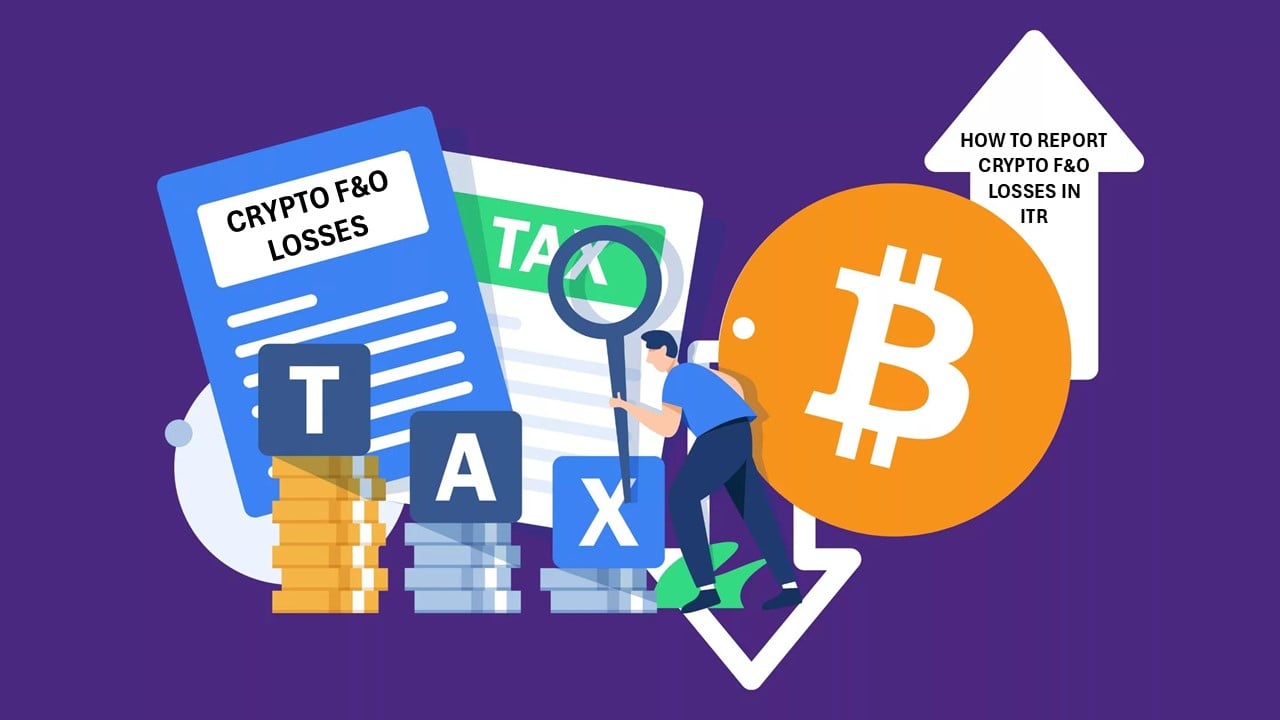
Learn how to correctly report and carry forward losses from Crypto Futures & Options (F&O) trading under Indian income tax laws.
Understanding Tax Rules for Crypto F&O Losses in India
 Saloni Kumari
 Aug 26, 2025
Crypto F&O Losses: How to Report Crypto F&O Losses in Your Income Tax Return (ITR)?
With the rising popularity of cryptocurrency trading, especially in Futures & Options (F&O), several taxpayers and professionals have a common query in their minds about how to report profits or losses from trading in Crypto Futures & Options (F&O) and whether they can be carried forward under the Income-tax Act, 1961. Below is the detailed breakdown.
Step 1: Speculative Transaction: Section 43(5) of the Income Tax Act, 1961
In accordance with Section 43(5) of the Income Tax Act, a speculative transaction is one where the contract is settled without actual delivery of the asset.
Now, when you trade in F&O (Futures & Options), the transaction is usually settled in cash, without actually buying or selling the underlying asset, so, on the face of it, this would be treated as speculative.
However, there is an exemption in this: if you are trading in F&O of stocks or commodities through a recognised stock exchange (like NSE or BSE), and if the proper tax rules are followed (like STT being paid), then such F&O trading is not treated as speculative.
Step 2: Are Crypto Exchanges Recognised Stock Exchanges?
This is where the actual problem starts; the term “recognised stock exchange” is defined under a different law, the Securities Contracts (Regulation) Act, 1956 (SCRA). Currently, crypto exchanges are not recognised under this law in India. Therefore, even if you are doing F&O trading in crypto, since it is not on a recognised stock exchange, the exception does not apply here. Hence, Crypto F&O is considered a speculative business under Indian tax laws.
Step 3: How Are Crypto F&O Losses Treated? (Section 73)
If your activity is treated as a speculative business, then the losses you make from Crypto F&O are also called speculative losses.
Under Section 73 of the Income Tax Act, speculative losses can only be set off against speculative profits, not against regular business income or salary income. These losses can be carried forward to the next 4 assessment years. However, in those years, too, you can only set them off against speculative income.
Hence, while you can carry forward Crypto F&O losses, you need to make sure they are correctly reported as speculative losses in your ITR.
Where to Report in ITR?
In your ITR form, there’s a section called “Schedule P&L”, which has a part for reporting speculative business income or loss. That is exactly where Crypto F&O gains or losses should be shown.
Common Mistakes to Avoid
Maximum individuals are making mistakes by wrongly showing Crypto F&O under “ordinary business” or under 115BBH (VDAs). Here's what they are doing wrong:
Several individuals report it as ordinary business income; this is incorrect because it's speculative in nature. While some report it under Section 115BBH, which deals with Virtual Digital Assets (VDAs) like Bitcoin, NFTs, etc., this section applies only to spot trading, not F&O.
Therefore remember,
- Section 115BBH = Spot Crypto Trades
- Section 73 (Speculative Business) = Crypto F&O Trades

About Author


Saloni Kumari
Content Writer
Saloni is a Content Writer with 2+ years of experience at studycafe.in. She writes legal, taxation, and finance related content including GST, Income Tax etc. Skilled in translating complex judicial pronouncements and regulatory developments into clear, and reader-friendly articles. Experienced in covering judgements of ITAT, High Court, GSTAT, and news related to Income Tax, GST, and corporate law. She can be reached at [email protected].
Saloni is a Content Writer with 2+ years of experience at studycafe.in. She writes legal, taxation, and finance related content including GST, Income Tax etc. Skilled in translating complex judicial pronouncements and regulatory developments into clear, and reader-friendly articles. Experienced in covering judgements of ITAT, High Court, GSTAT, and news related to Income Tax, GST, and corporate law. She can be reached at [email protected].
 StudyCafe
 Delhi, Delhi, India
 2924
2924My Recent Articles
- Major Relief in Arbitration Case: MCIA Denies Rs 908 Crore Statement Claim Made by Allied Silica Against Tata Chemicals
- MCA and ICSI to Hold User Awareness Session on Form AOC-4 Filing Amid Glitches on MCA-21 Version-3 Portal
- GSTN Introduces New E-Invoicing Facility for Self-Invoices Under Reverse Charge Mechanism
- Flexi Cap vs Multi Cap Funds: What's the Real Difference?
- IBA Recommends Public Sector Banks to Reduce Ambit of Physical Branch Audits to 50% of Total Business
Up Next
Loading suggestions…


Recent Posts


All Posts


Tags
No tags yet.
Recent Posts
All Posts
Tags
No tags yet.