Employee not liable if TDS Deducted not deposited by Employer: HC:
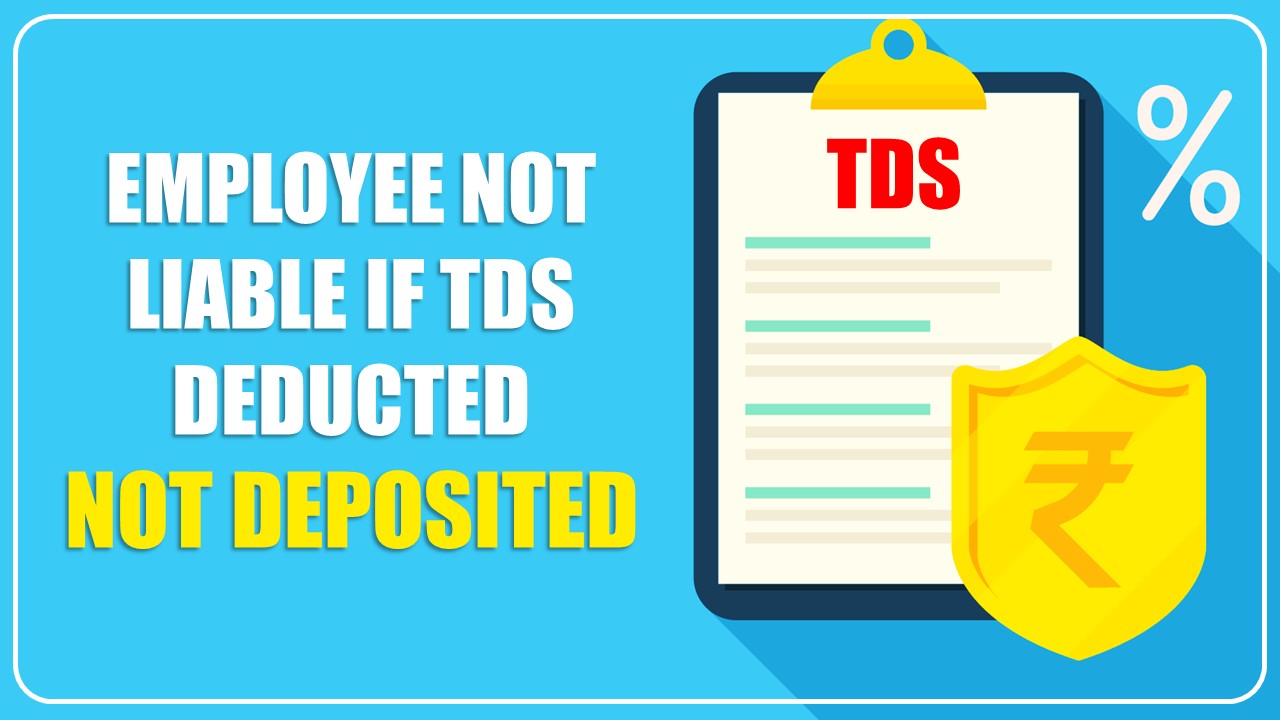
The Delhi High Court has issued an order that Employee is not liable if TDS Deducted is not deposited by Employer.
Employee not liable if TDS Deducted
 Priyanka Kumari
 Nov 30, 2023
“5. Mr Sanjay Kumar, learned senior standing counsel, who appears on behalf of the respondents/revenue, says that the credit for withholding tax can only be given in terms of Section 199 of the Act, when the amount is received in the Central Government account.
5.1 It is, therefore, his submission that while no coercive measure can be taken against the petitioner, the demand will remain outstanding and cannot, thus, be effaced.
6. Heard the counsel for the parties.

7. According to us, Section 205 read with instruction dated 01.06.2015, clearly point in the direction that the deductee/assessee cannot be called upon to pay tax, which has been deducted at source from his income. The plain language of Section 205 of the Act points in this direction. For the sake of convenience, Section 205 is extracted hereafter:
“Section 205 Bar against direct demand on assessee. Where tax is deductible at the source under the foregoing provisions of this Chapter, the assessee shall not be called upon to pay the tax himself to the extent to which tax has been deducted from that income.”
8. The instruction dated 01.06.2015 is aligned with the aforesaid provision of Act inasmuch as it clearly provides in paragraph 2 that since the Act places a bar on a direct demand qua the deductee assessee, the same cannot be enforced coercively. For the sake of convenience, paragraph 2 of the said Instruction is extracted hereafter:

“…2. As per Section 199 of the Act credit of Tax Deducted at Source is given to the person only if it is paid to the Central Government Account. However, as per Section 205 of the Act the assessee shall not be called upon to pay the tax to the extent tax has been deducted from his income where the tax is deductible at source under the provisions of Chapter XVII. Thus the Act puts a bar on direct demand against the assessee in such cases and the demand on account of tax credit mismatch cannot be enforced coercively…”
9. The question, therefore, which comes to fore, is as to whether the respondents/revenue can do indirectly what they cannot do directly.
9.1 The adjustment of demand against future refund amounts to an indirect recovery of tax, which is barred under Section 205 of the Act.
9.2 The fact that the instruction merely provides that no coercive measure will be taken against the assessee, in our view, falls short of what is put in place by the legislature via Section 205 of the Act.
10. Therefore, in our view, the petitioner is right inasmuch as neither can the demand qua the tax withheld by the deductor/employer be recovered from him, nor can the same amount be adjusted against the future refund, if any, payable to him.”
On behalf of revenue, it was contended that no credit for tax can be given to the petitioner, since in view of the provisions under Section 199 of the Income Tax Act the credit can be given only when the tax which was deducted at source is paid to the Central Government and in the present case, admittedly the tax deducted from salary of the petitioner has not been deposited by his employer. This contention was raised also in the case of Sanjay Sudan (supra) but not accepted by this court. The petitioner having accepted the salary after deduction of income tax at source had no further control over it in the sense that thereafter it was the duty of his employer acting as tax collecting agent of the revenue under Chapter XVII of the Act to pay the deducted tax amount to the Central Government in accordance with law. The employer of the petitioner having failed to perform his duty to deposit the deducted tax with the revenue, petitioner cannot be penalized. It would always be open for revenue to proceed against employer of the petitioner for recovery of the deducted tax. In view of the aforesaid, the petition, as well as the interim relief application (CM APPL 6192/2022), are allowed, thereby setting aside the intimations/communications dated 21.03.2011 pertaining to Assessment Year 2009-10; dated 23.10.2012 pertaining to Assessment Year 2011-12; and dated 16.01.2014 pertaining to Assessment Year 2012-13, all intimations/communications issued by respondent no. 3 under Section 143 of the Act raising demands of tax and interest against the petitioner and consequently, restraining the respondents from carrying out any recovery proceedings pertaining to the said intimations/communications; and also directing the respondents to refund to the petitioner within four weeks from receipt of this order a sum of Rs.3,88,209 which was wrongly adjusted by the respondents against the impugned demands pertaining to the above mentioned Assessment Years. However, it is clarified that in case the petitioner is able to obtain any amount of money towards tax deducted from his income at source for the Assessment Years 2009-10, 2011-12 and 2012- 13 from his employer, the same shall be deposited by him with the revenue forthwith. For Official Judgment Download the PDF Given Below:About Author


Priyanka Kumari
Content Writer
 Studycafe
 Faridabad, Haryana, India
 324
324My Recent Articles
- MSME Sector contributes 29.1% Gross Value Added in India's GDP
- NFRA imposes Penalty of Rs.3 Lakh and 3 Year Ban on CA and CA Firm w.r.t. Statutory Audit
- Zomato shares drop by 5% amid Rs. 402 crore GST tax notice
- Govt notifies Central Goods and Services Tax (Second Amendment) Act, 2023
- 10% GST pre-deposit obligation is confined to contested tax quantum excluding penalty, fee and interest [Read Judgement]
Loading suggestions…


Recent Posts

All Posts


Tags
Recent Posts
All Posts