Ex-ICAI President Kamlesh Vikamsey Flags Delays in Income Tax Rectification, Seeks CBDT Accountability:
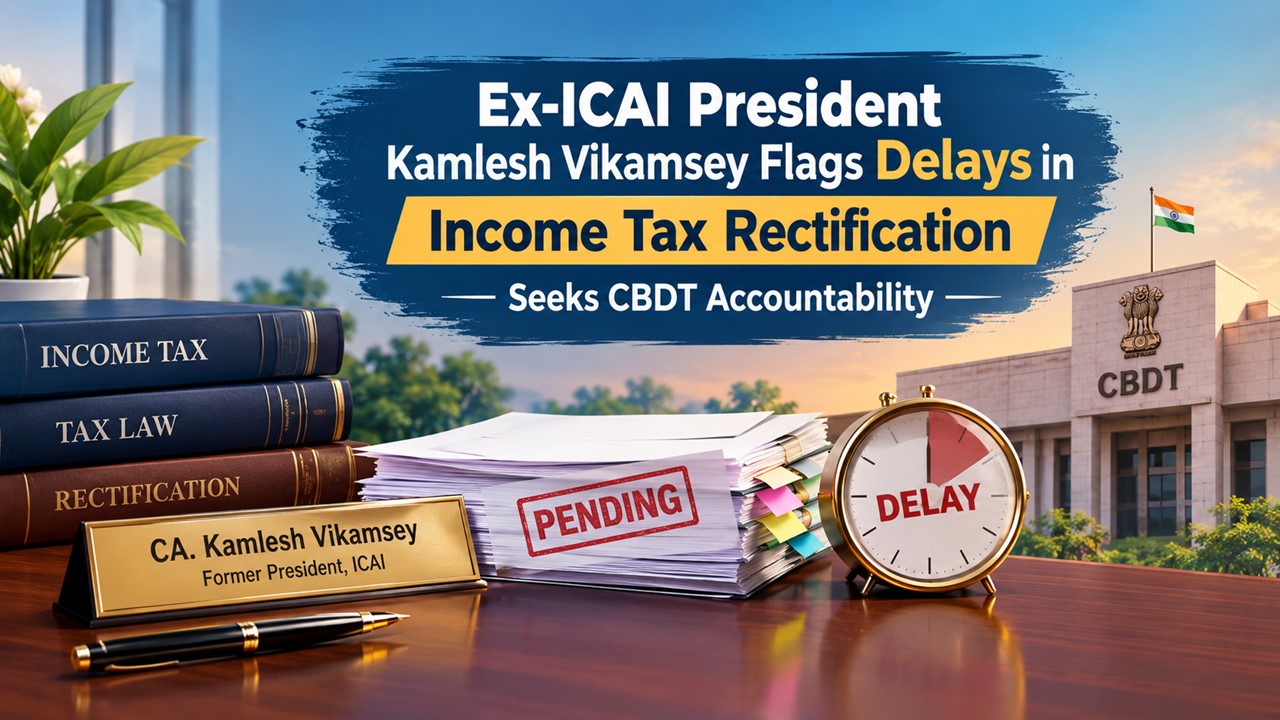
Former ICAI President Kamlesh Vikamsey has urged the government to address prolonged Section 154 rectification delays and strengthen accountability in e-Nivaran grievance disposal.
Ex-ICAI Chief Flags 11-Month Delays in Section 154 Rectification
 Saloni Kumari
 Oct 7, 2026
The former President of the Institute of Chartered Accountants of India (ICAI), CA Kamlesh Vikamsey, has written a formal representation dated October 05, 2026, addressed to the Honourable Prime Minister Narendra Modi, Union Finance Minister Nirmala Sitharaman and CBDT Chairman Ravi Agrawal, highlighting delays in the disposal of income tax rectification applications and issues concerning the handling of taxpayer grievances by Jurisdictional Assessing Officers (JAOs).
In the representation, Vikamsey wrote, "I submit this representation in my capacity as a practicing Chartered Accountant and as a Past President of the Institute of Chartered Accountants of India (ICAI). Over several decades of active professional practice, I have witnessed the evolving direct tax landscape firsthand and have consistently supported the visionary structural reforms championed by this Government. The implementation of faceless assessments, automated return processing by the CPC, and comprehensive digital platforms represent remarkable strides toward transparency and reducing unnecessary friction."

Vikamsey has flagged the legal requirement under Section 154(8) of the Income Tax Act, 1961, corresponding to Section 287(9) of the Income Tax Act, 2025, which mandates disposal of rectification applications within six months from the end of the month in which the application is received. He further highlighted that even after this requirement, applications can remain pending for several months, including cases where the error is apparent or an appellate order has already been passed.
In line with the representation, the online filing for Section 154 applications was introduced to improve transparency and accountability. However, Vikamsey said that digital filing has, in some cases, merely shifted the problem from physical files to online records, with applications remaining pending for more than 11 months. He also raised concerns about the limited impact of concurrent rectification powers given to the Centralised Processing Centre (CPC).

The representation also highlighted concerns regarding e-Nivaran grievances. Vikamsey alleged that some grievances are being marked as “Fully Resolved” using standard remarks such as "incomplete documents" or "matters being under verification", even when taxpayers have submitted relevant official records. He cited a case involving a charitable trust where a department-issued order giving effect had deleted a penalty, but an erroneous demand of Rs 1.48 lakh continued to appear on the portal. The related grievance was allegedly closed despite the order being attached.
Vikamsey stated that such delays can block legitimate refunds, leave incorrect demands outstanding and result in subsequent refunds being adjusted against disputed dues. He also expressed concern that taxpayers may hesitate to escalate grievances due to fear of adverse administrative consequences.
As corrective measures, he proposed a centralised dashboard to monitor Section 154 applications, automatic alerts for cases pending beyond 60 days, stronger accountability for delays beyond the statutory period, and greater use of CPC rectification powers. He also recommended that e-Nivaran closures should contain reasoned speaking orders instead of generic remarks and that independent audits should review grievances marked as “Fully Resolved".
Vikamsey concluded that digital tax reforms can deliver genuine ease of doing business only when administrative execution matches statutory requirements and taxpayers receive timely, substantive resolution of legitimate grievances.
Past President ICAI Kamlesh Vikamsey ji has written a very important representation letter to @PMOIndia and @nsitharaman over the bottlenecks in the #Faceless assessment system under the #Incometax. These points are practical difficulties faced by all and self explanatory. Hope @FinMinIndia takes action and streamline this on priority. @kamleshvikamsey
— October 7, 2026
About Author


Saloni Kumari
Content Writer
 StudyCafe
 Delhi, Delhi, India
 2869
2869My Recent Articles
- HCL Infotech Faces Setback as Muzaffarpur Court Allows UBGB’s Objection to Rs 13.41 Crore Arbitral Award
- ITAT Sets Aside Rs 18.17 Lakh Penalty under Section 271(1)(c) Based on Non-Final Transfer Pricing Adjustment
- ITAT Sets Aside Rs 59.84 Lakh LTCG Addition, Orders De Novo Assessment
- Digisol Systems Receives Rs 1.76 Crore GST Show Cause Notice Over Excess ITC Availment, Return Discrepancies
- H.G. Infra Engineering Wins Major GST Relief as Karnataka Tax Authority Drops Entire Rs 94 Crore Demand
Loading suggestions…


Recent Posts
All Posts
Tags
Recent Posts
All Posts