Government Extends NOC Validity for Imported Alcoholic Beverages to 1 Year:
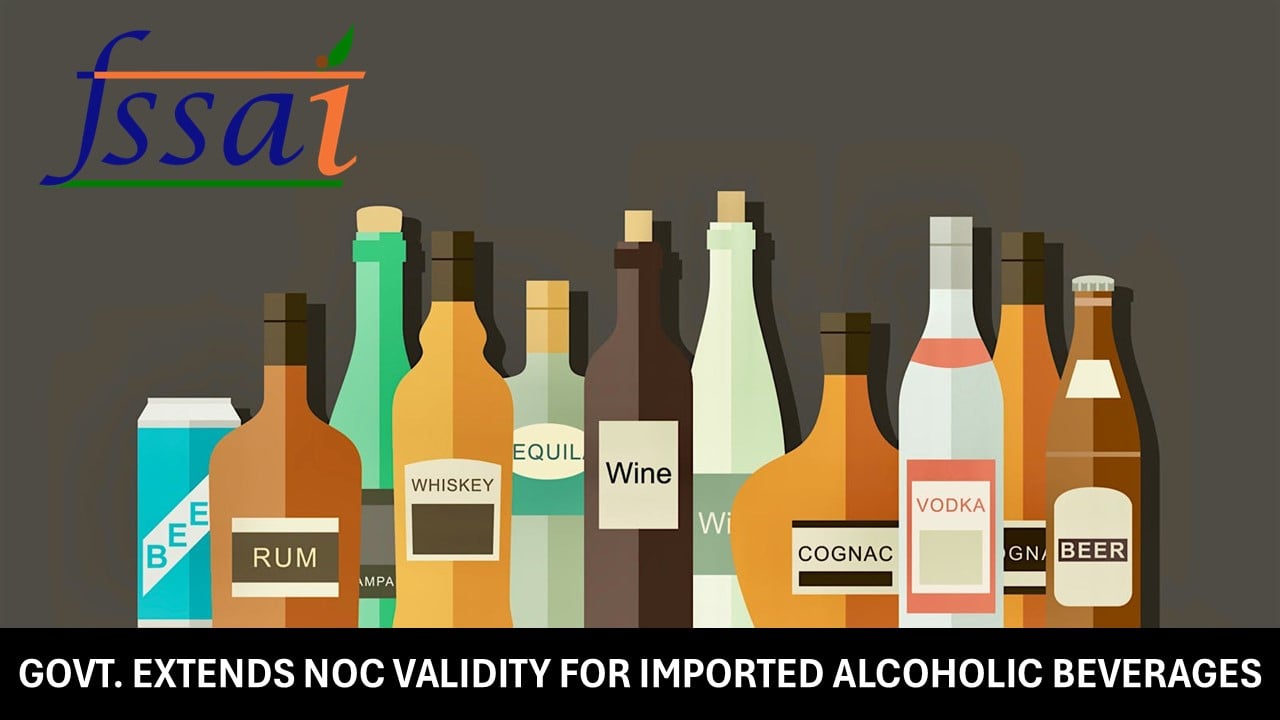
The Government of India has extended the NOC validity for imported alcoholic beverages to one year, simplifying the import process while ensuring food safety compliance.
India Relaxes NOC Rules for Alcohol Imports
 Saloni Kumari
 Jun 25, 2025
Government Extends NOC Validity for Imported Alcoholic Beverages to 1 Year
The Government of India has introduced a significant amendment to assist businesses engaged in the import of alcoholic beverages into the country. The new update has been issued by both the Central Board of Indirect Taxes and Customs (CBIC) and the Food Safety and Standards Authority of India (FSSAI) to extend the validity of the No Objection Certificate (NOC) for certain alcoholic products.
The duty of the Standards Authority of India (FSSAI) is to verify the product (alcohol) safety when imported in India under the Food Safety and Standards (Import) Regulations, 2017. FSSAI releases a No Objection Certificate (NOC) after completing inspection and confirming that the imported goods are safe and as per the Indian food safety standards. NOC is considered a clearance certificate. Without this document, the products cannot be legally sold or distributed in the country.
Previously, the NOC for alcoholic drinks (whether bottled at the source or brought in bulk) either didn’t have a clear expiry date or was valid for a shorter time. However, now, a new order has been issued by the FSSAI on June 13, 2025, that officially clears:
- For alcoholic beverages containing more than 10% alcohol and even without any expiry date, the NOC will now be valid for 1 full year (365 days) from the date it is given.
- If the product, i.e., alcohol, remains in the Customs area, such as at the ports, for more than one year, a visual check can be requested by the importer by paying a small fee.
- This verification will help renew the expired NOC without needing full testing again.
- This amendment makes the import process easier and faster, while still keeping safety rules in place.
- FSSAI: The authority that regulates food imports and issues the NOCs.
- CBIC (under the Ministry of Finance): Specifically, the Customs officials at ports who deal with imports and NOC compliance.
- Authorised Officers of FSSAI: Situated at various ports, responsible for inspection and compliance.
- Importers: Companies or individuals importing alcoholic beverages into India.
- Make customs officers inform and train those under their jurisdiction about this new rule.
- Make sure the extended NOC validity is properly implemented and applicable at ports and customs areas.
- Sort out any issues or difficulties faced by officers or importers because of this update, and report them to the main office if needed.
- Decreasing the burden on importers who earlier had to get a new NOC or deal with delays for older shipments.
- Giving more flexibility while still keeping food safety in check, especially for alcoholic drinks that don’t expire because of their high alcohol content.
About Author


Saloni Kumari
Content Writer
Saloni is a Content Writer with 2+ years of experience at studycafe.in. She writes legal, taxation, and finance related content including GST, Income Tax etc. Skilled in translating complex judicial pronouncements and regulatory developments into clear, and reader-friendly articles. Experienced in covering judgements of ITAT, High Court, GSTAT, and news related to Income Tax, GST, and corporate law. She can be reached at [email protected].
Saloni is a Content Writer with 2+ years of experience at studycafe.in. She writes legal, taxation, and finance related content including GST, Income Tax etc. Skilled in translating complex judicial pronouncements and regulatory developments into clear, and reader-friendly articles. Experienced in covering judgements of ITAT, High Court, GSTAT, and news related to Income Tax, GST, and corporate law. She can be reached at [email protected].
 StudyCafe
 Delhi, Delhi, India
 2924
2924My Recent Articles
- Major Relief in Arbitration Case: MCIA Denies Rs 908 Crore Statement Claim Made by Allied Silica Against Tata Chemicals
- MCA and ICSI to Hold User Awareness Session on Form AOC-4 Filing Amid Glitches on MCA-21 Version-3 Portal
- GSTN Introduces New E-Invoicing Facility for Self-Invoices Under Reverse Charge Mechanism
- Flexi Cap vs Multi Cap Funds: What's the Real Difference?
- IBA Recommends Public Sector Banks to Reduce Ambit of Physical Branch Audits to 50% of Total Business
Up Next
Loading suggestions…


Recent Posts
All Posts
Tags
Recent Posts
All Posts