Govt Notifies Promotion and Regulation of Online Gaming Rules 2026; Effective May 2026:
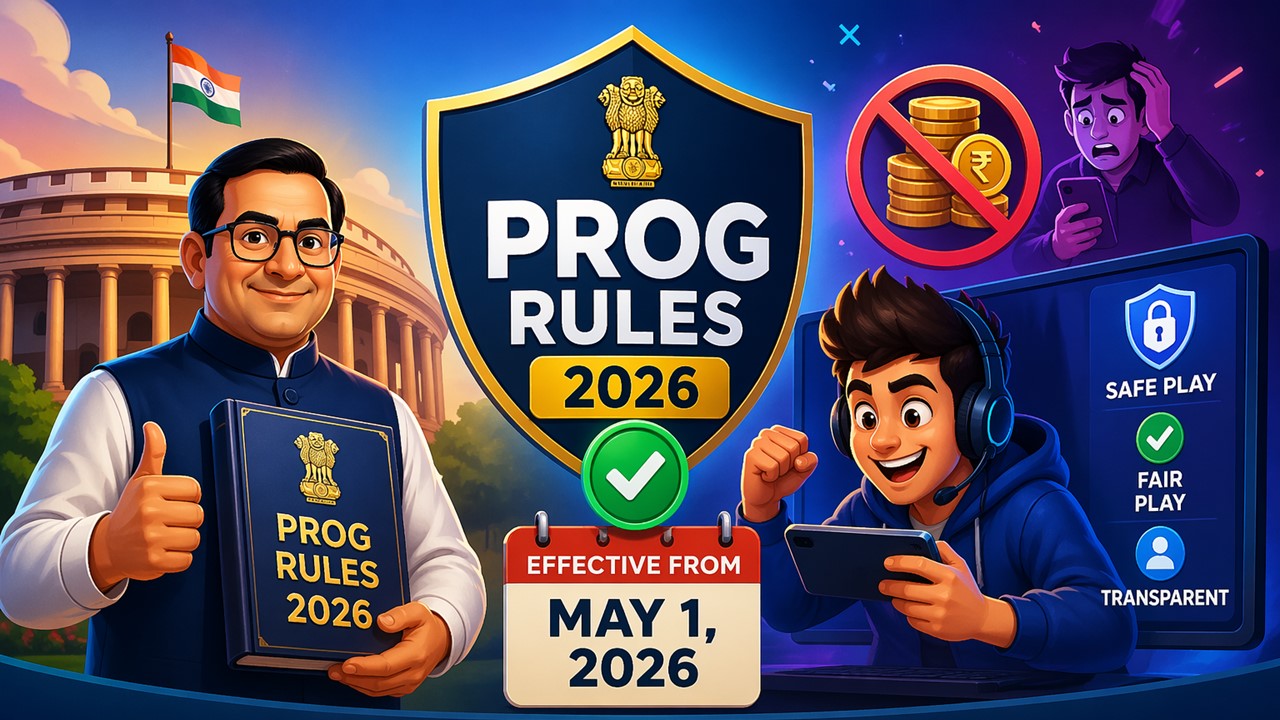
The government of India has introduced PROG Rules 2026, to regulate online gaming, curb money gaming risks, and ensure safer, transparent gameplay from May 1, 2026.
India Tightens Grip on Online Gaming
 Saloni Kumari
 Apr 23, 2026
Govt Introduces Promotion and Regulation of Online Gaming Rules 2026; Effective May 2026
The Government of India, through its Ministry of Electronics and Information Technology (MeitY), has developed the Promotion and Regulation of Online Gaming Rules (PROG Rules), 2026, pursuant to the newly enacted Promotion and Regulation of Online Gaming Act (PROG Act), 2025, which parliament enacted in August 2025. The PROG Rules are set to take effect on May 1, 2026.
The rules for this purpose have been decided through inter-ministerial consultations and have been finally approved by the Department of Legal Affairs. The main intent of these rules is to protect the general public from the increasing threat of Online Money Gaming; at the same time, they also create conditions for the safe development of competitive e-sports and casual/social gaming in India along with providing general protection to the citizens of the country from the many adverse effects (financial, psychological, and social) caused by the predatory nature of it.
Most of these rules will define basically how the law is actually going to function in practice. They lay down a systematic way to classify whether a game is a money game (and therefore, potentially to be banned) or an entertainment/social game or an e-game. To regulate the sector, a new regulatory authority, the Online Gaming Authority of India, will be established for the purpose of monitoring complaints and ensuring compliance with the rules.
The Authority will be able to review all games whether they initiate contact with the developers themselves or whether they receive requests for review from the gaming developers. It looks at things like entry costs, possibilities of winning a cash prize and how players can claim their prizes. In most cases, the Authority will determine whether or not a game can be used within 90 days. There are a few games, particularly the e-sports-related ones, which will need to be registered through the official application and registration process. The registration will be valid for ten years.
Gamers need safeguards. There should be features to protect gamers, such as: Gaming age limits, time limits, parental controls, and complaint procedures. Players are permitted to submit complaints to the game developer and, following the resolution of such a complaint, they may also submit the complaint to the Authority. In case that players have still not been satisfied after filing their appeal(s) with both the Authority and the Developer/Maker of the game, then players can submit a complaint to the Ministry.
To ensure the safety of the players on these Gaming platforms, the Gaming Operators are required to install protective systems, including age checks, time restrictions, parental control, complaint management software, etc. Players are allowed to first submit a complaint to the Gaming Operators; and if unaddressed, can reach out to the Authority and finally to the Ministry.
The rules will also emphasise strict enforcement. Penalties will vary depending upon the level of harm caused to users or repeated violations. The rules are designed as a means of ensuring that users are protected while at the same time allowing the industry to grow in India. The result will be that there will be a safer and more transparent online gaming experience available in the country.
Download Rules

About Author


Saloni Kumari
Content Writer
Saloni is a Content Writer with 2+ years of experience at studycafe.in. She writes legal, taxation, and finance related content including GST, Income Tax etc. Skilled in translating complex judicial pronouncements and regulatory developments into clear, and reader-friendly articles. Experienced in covering judgements of ITAT, High Court, GSTAT, and news related to Income Tax, GST, and corporate law. She can be reached at [email protected].
Saloni is a Content Writer with 2+ years of experience at studycafe.in. She writes legal, taxation, and finance related content including GST, Income Tax etc. Skilled in translating complex judicial pronouncements and regulatory developments into clear, and reader-friendly articles. Experienced in covering judgements of ITAT, High Court, GSTAT, and news related to Income Tax, GST, and corporate law. She can be reached at [email protected].
 StudyCafe
 Delhi, Delhi, India
 2919
2919My Recent Articles
- ITAT Directs AO to Reconsider Rs 16.44 Lakh Capital Gains and Rs 25.87 Lakh Stamp Duty Value Addition
- ITAT Remands Rs 3.33 Crore Demonetisation Cash Deposit Case to AO, Directs Rs 10,000 Relief Fund Payment
- Income Tax Dept Increases Scope for Saksham Nudge Initiative to Further Include Professional Insuring Timely Compliance
- Vedanta Subsidiary ESL Steel Receives GST SCN for Rs. 2.76 Lakh IGST Demand Over Alleged RCM Short Payment
- Good News! ICAI Opens One-Day Window for Submission of MEF Form 2026-27 at meficai.org
Up Next
Loading suggestions…


Recent Posts
All Posts
Tags
Recent Posts
All Posts