GST on Metal Scrap: Government Clarifies TDS, RCM and Registration Rules:
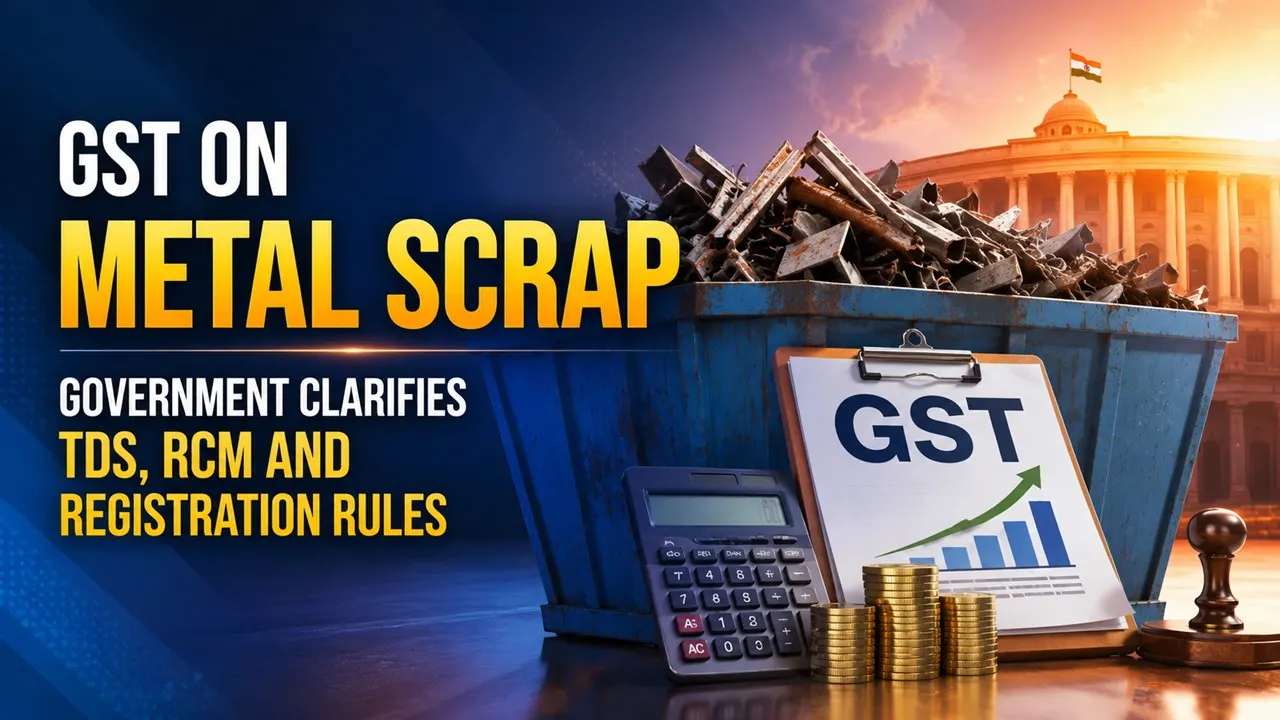
The government has clarified GST rules on TDS, reverse charge, and registration for metal scrap transactions.
GST Rules for Metal Scrap
 Vanshika verma
 Jul 23, 2026
Table of Contents

The government has clarified the rules on GST for transactions of metal scrap, giving much-needed clarity to businesses on their tax obligations.
What You Should Know About Metal Scrap Buyers.
If you are a registered scrap dealer under GST, your tax liability will depend on whether you are buying from a registered seller or an unregistered seller.

Purchase from a GST-registered supplier:
If the value of the contract is above Rs 2.5 lakh, then you have to deduct 2% TDS (Tax Deducted at Source).
Buy from an unregistered supplier (like a local scrap collector or kabadiwala):
You are liable to pay 18% GST under Reverse Charge Mechanism(RCM). This GST can be claimed as Input Tax Credit (ITC) later on, if all the conditions of GST are met.
The government has also clarified that unregistered suppliers of metal scrap are not automatically exempt from GST registration just because the buyer pays tax under the Reverse Charge Mechanism (RCM). The requirement to register under GST depends on whether the supply is made within the same state or across states.

For intra-state supplies of metal scrap, the supplier must obtain GST registration only after crossing the prescribed turnover threshold. The limit is Rs 40 lakh for suppliers dealing only in goods and Rs 20 lakh in cases where the applicable threshold is Rs 20 lakh.
But, for inter-state supplies of metal scrap, GST registration is compulsory irrespective of the turnover of the supplier. This means that even if the turnover of the supplier is less than the threshold limit, the registration is mandatory if the metal scrap is supplied to another state.
Clarification is issued on the basis of Section 22(1) and Section 24(i) of CGST Act, 2017 read with Notification No. 24/2024-Central Tax dated 09.10.2024.
About Author


Vanshika verma
Content Writer
 Studycafe
 Delhi, Delhi, India
 2120
2120My Recent Articles
- SEBI Warns Investors Against Fake WhatsApp Groups Offering Stock Tips, Trading Advice and False Profit Claims
- Indo Amines Limited Under GST Department Scrutiny as Maharashtra Tax Officials Initiate Search and Inspection at Registered Office
- Park Medi World Says Income Tax Department’s Verification at Company-Linked Premises Had No Impact on Operations or Expansion Plans
- Rajasthan Launches Statewide GST Crackdown, Uncovers Suspected Tax Irregularities Worth Rs 2.85 Crore
- Centre to Invite Public Feedback on Revised GST Return Forms From November 1, Aims to Reduce Errors and Tax Notices
Loading suggestions…


Recent Posts

All Posts
Recent Posts
All Posts