GSTAT Upholds Penalty for Transporting Goods Under Expired E-Way Bill:
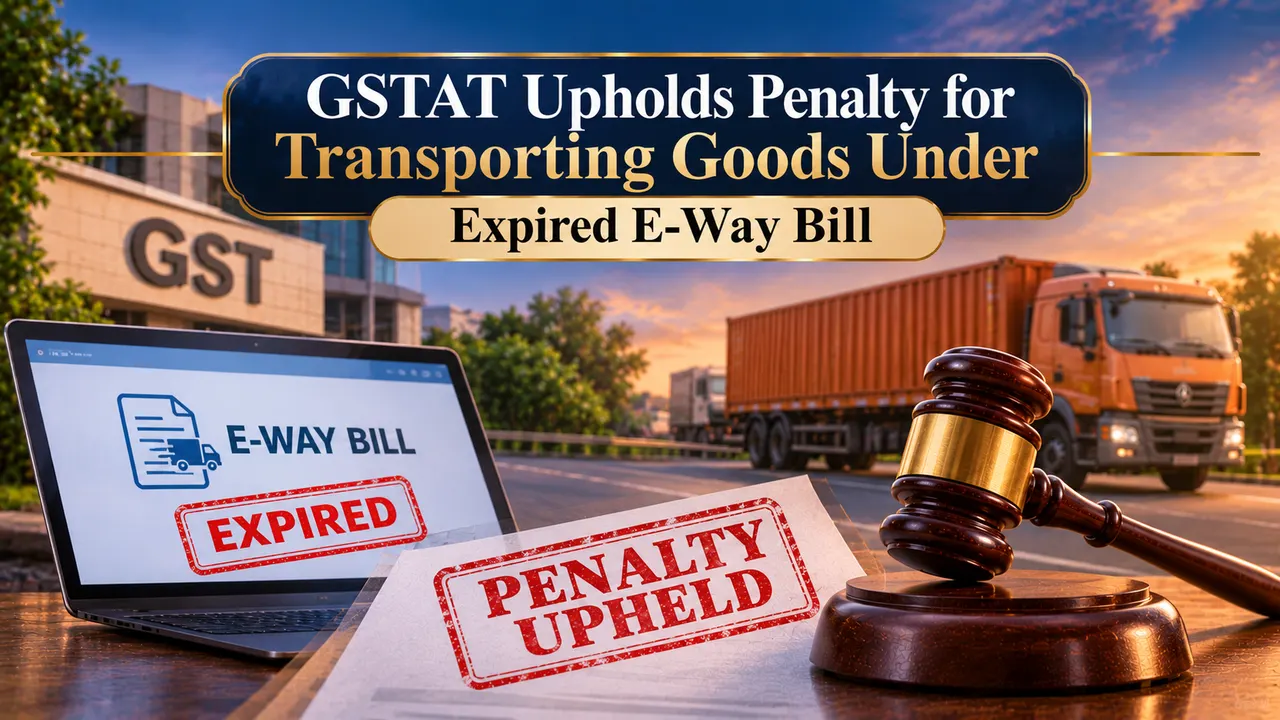
The GSTAT holds proof of tax evasion not necessary for imposing penalty under Section 129 of the GST Act.
GSTAT Upholds Rs 5.96 Lakh Penalty
 Saima
 Oct 19, 2026

Mangal Sponge and Steel Private Limited transported MS billets valued at Rs 16,56,675 from Bilha, Bilaspur, to JTL Industries Limited, Raipur, on 12 September 2025. The goods were accompanied by an invoice, transport bilty and e-way bills. On 16 September 2025, the State Tax Officer intercepted the vehicle at Metal Park, Rawabhata, and found that the e-way bill had expired on 13 September 2025. Consequently, proceedings were initiated under Section 129(1)(a) of the GST Act, resulting in a penalty of Rs 2,98,202 each under the CGST and SGST Acts, aggregating to Rs 5,96,404. The appellant deposited the penalty to secure the release of the vehicle.
The appellant challenged the order before the Appellate Authority, which dismissed the appeal on 19 January 2026. Aggrieved by the decision, the appellant approached the GSTAT. The appellant contended that the e-way bill had expired because the vehicle allegedly suffered three breakdowns between 12 and 14 September 2025. It argued that the delay was beyond its control and that there was no intention to evade tax. The Department argued that the vehicle was found transporting goods nearly three days after the e-way bill had expired, in violation of Rule 138(10) of the CGST Rules, 2017.

The Tribunal held that proof of intention to evade tax is not a mandatory requirement for invoking Section 129(1) of the GST Act or imposing a penalty under the provision. It observed that Section 129 does not expressly prescribe such a requirement, unlike the relevant provisions of Section 130.

The Tribunal distinguished the judicial precedents relied upon by the appellant, including Assistant Commissioner (ST) Vs Satyam Shivam Papers Private Limited Case, on the ground that they involved materially different factual circumstances. It also observed that decisions of another State's appellate authority were not binding upon it. Accordingly, the Tribunal answered the question of law in favour of the Department and held that the penalty imposed under Section 129(1)(a) was legally sustainable.
About Author


Saima
Content Writer
 StudyCafe
 Delhi, Delhi, India
 649
My Recent Articles
- ITAT Deletes Addition in Protective Assessment After Tax Paid in Substantive Assessment
- Universal Unity Trust Withdraws Appeals Against CIT(E) Order
- ITAT Holds AO Should Have Invoked Sections 147 And 148A After April 2021 Amendment
- ITAT Holds Handmade Production Through Karigars Eligible
- ITAT Quashes Assessment Under Section 143(3) Where Search-Related Information Mandated Reassessment
Loading suggestions…


Recent Posts
All Posts

Recent Posts
All Posts