Intent to Evade Tax Not Necessary for Penalty Under Section 129 for Expired E-Way Bills, Holds GSTAT:
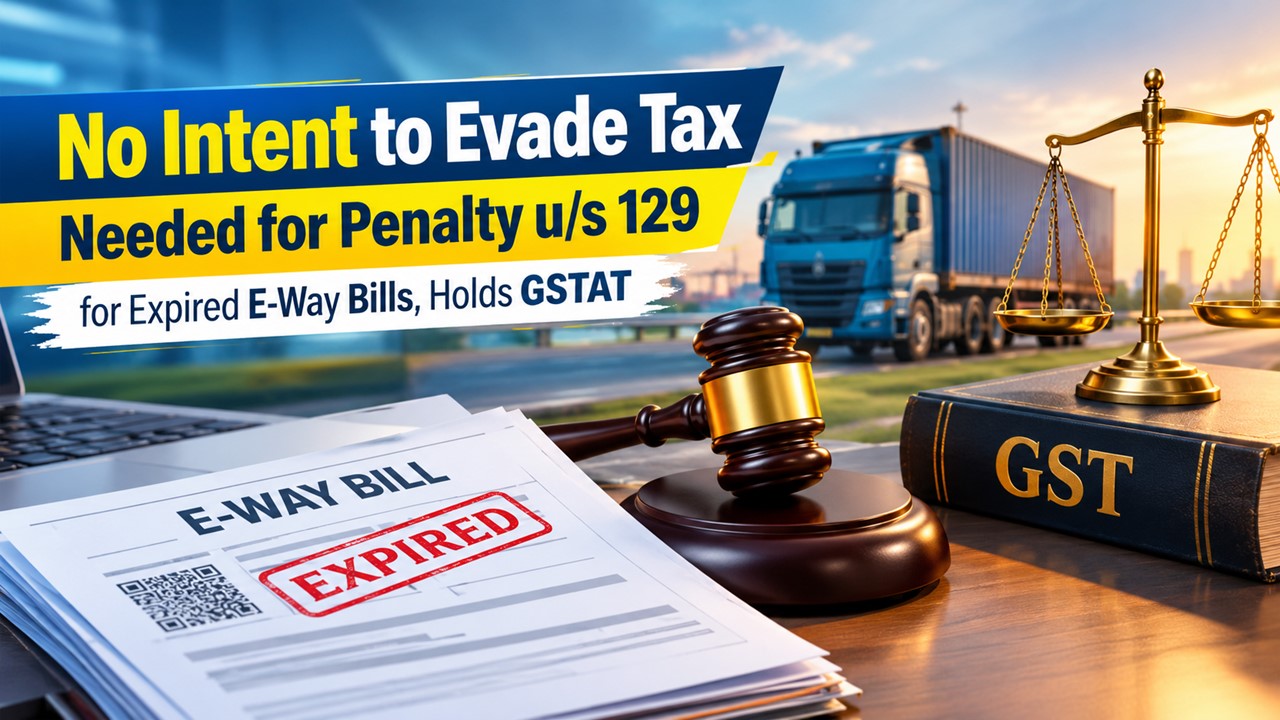
The GSTAT dismissed appeals and upheld penalties of Rs 1.81 lakh and Rs 2.47 lakh for transporting goods under expired e-way bills, ruling that proof of intent to evade tax is not mandatory under Section 129 of the CGST/SGST Act, 2017.
GSTAT Raipur Rejects Vehicle Breakdown Plea
 Saloni Kumari
 Oct 17, 2026
The GST Appellate Tribunal (GSTAT), State Bench Raipur, upheld penalties imposed under Section 129(1)(a) of the CGST/SGST Act, 2017, for transporting goods under expired e-way bills. The Tribunal held that proof of intent to evade tax is not mandatory for invoking Section 129 when goods are transported under an expired e-way bill, thereby dismissing the appeals of ASAT Logistics Private Limited (appellant).
The dispute began when two vehicles pertaining to the appellant were confiscated on September 20, 2024. According to the officials, the vehicles were involved in transporting goods under e-way bills that had expired on September 14, 2024 (six days before the transportation). Consequently, the concerned tax authorities levied penalties amounting to Rs 1.81 lakh and Rs 2.47 lakh, respectively, on the appellant under Section 129(1)(a) of the CGST/SGST Act, 2017.

The appellant contended that the expiry of e-way bills was due to vehicle breakdowns and that the goods were transferred between registrations of the same company. The appellant further claimed that there was no intention to evade tax.
The aggrieved appellant filed an appeal before the Goods and Services Tax Appellate Tribunal (GSTAT). When the tribunal analysed the facts, it rejected the appellant's arguments, citing Section 129, which does not expressly require proof of mens rea or an intention to evade tax. It distinguished Section 130, which expressly refers to such intent in specified circumstances, and relied on judicial precedents concerning civil penalties.

The tribunal further noted that the appellant had failed to produce repair bills or other documentary evidence proving the breakdowns of the disputed vehicles. Further, neither the supplier, recipient nor transporter had tried to extend the e-way bills despite their prolonged expiry. It held that stock transfers between separate GST registrations of the same legal entity must comply with applicable documentation requirements.
The tribunal also referenced a CBIC Circular No. 64/38/2018-GST dated September 14, 2018, and ruled that the circular did not protect the appellant because the circumstances involving expired e-way bills were not covered by the specified minor-error exceptions.
"The learned Chartered Accountant has also placed reliance upon Circular No. 64 dated 14.09.2018 issued by the C.B.I.C. but it is not given any assistance to appellant because in this circular it is not mentioned that where e way bill has been expired no proceeding under section 129 of GST Act be initiated. In para number 5 of this circular, there are some exceptions in which the proceeding under section 129 shall not be initiated, where a valid e way bill is accompanied with consignment of goods. The cases of appellants did not cover in any above exception because there was no valid e way bills with vehicles."
Consequently, based on the aforementioned findings, the tribunal dismissed both the appeals and sustained the impugned orders, holding that transporting goods under expired e-way bills without sufficient justification attracts a penalty under Section 129, even without proof of an intention to evade tax.
About Author


Saloni Kumari
Content Writer
 StudyCafe
 Delhi, Delhi, India
 2925
2925My Recent Articles
- Major Relief in Arbitration Case: MCIA Denies Rs 908 Crore Statement Claim Made by Allied Silica Against Tata Chemicals
- MCA and ICSI to Hold User Awareness Session on Form AOC-4 Filing Amid Glitches on MCA-21 Version-3 Portal
- GSTN Introduces New E-Invoicing Facility for Self-Invoices Under Reverse Charge Mechanism
- Flexi Cap vs Multi Cap Funds: What's the Real Difference?
- IBA Recommends Public Sector Banks to Reduce Ambit of Physical Branch Audits to 50% of Total Business
Loading suggestions…


Recent Posts

All Posts

Recent Posts
All Posts