Gujarat High Court Sustains Arrest in Alleged Fake ITC Racket Case:
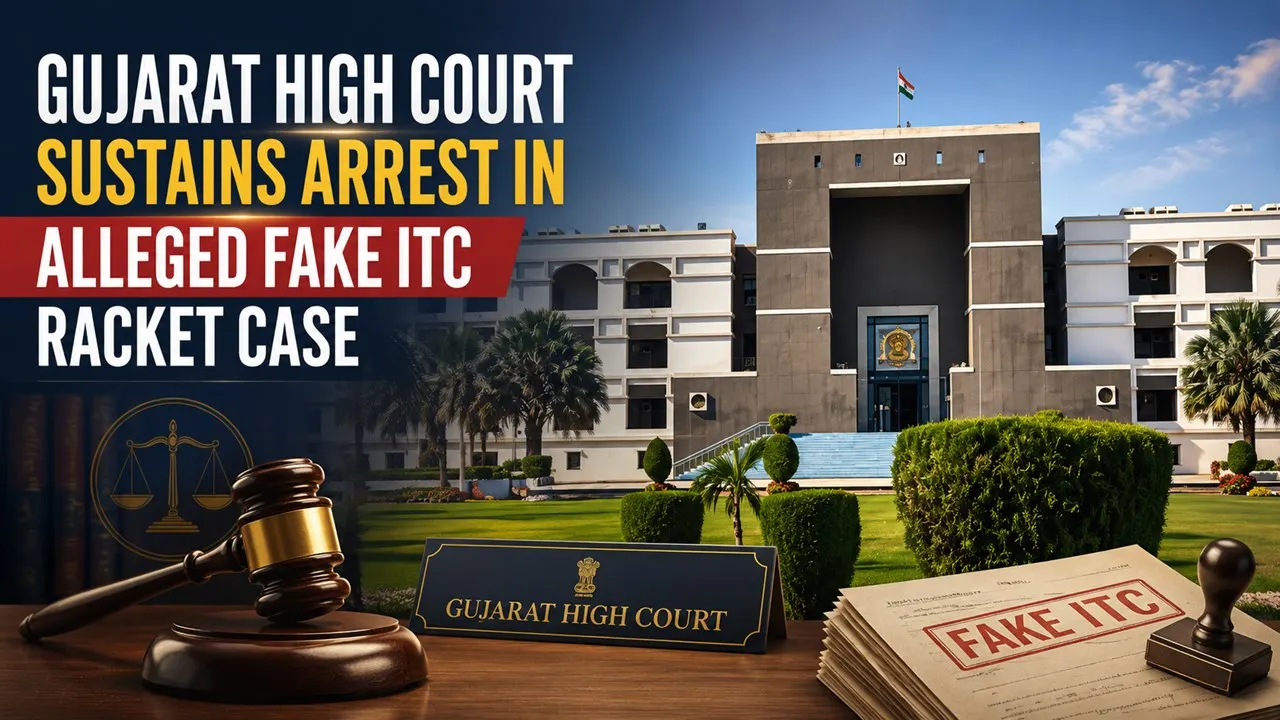
Gujarat High Court holds substantive communication of arrest grounds sufficient under Section 69 requirements.
Section 69 does not prescribe specific format for communicating arrest grounds
 Meetu Kumari
 May 20, 2026
The High Court of Gujarat at Ahmedabad, in Keyur Jayendrabhai Patel Through Jalpa Jayendrabhai Patel vs. State of Gujarat & Ors. (Special Criminal Application (Habeas Corpus) No. 4428 of 2026), delivered its judgment on May 7, 2026. The Division Bench held that the validity of an arrest under Section 69 of the CGST Act, 2017 does not depend upon furnishing a verbatim signed copy of internal e-office notings, so long as the substantive “reasons to believe” are effectively communicated to the arrestee.
A Bench comprising Justice Sangeeta K. Vishen and Justice D. M. Vyas dismissed the habeas corpus petition filed against the arrest carried out by the Directorate General of GST Intelligence (DGGI) in connection with an alleged fake Input Tax Credit (ITC) racket involving more than Rs. 14 crore. The Court highlighted that

“The mandatory statutory requirement is the furnishing of reasons so as to make the arrestee aware about the grounds of arrest and enable him to challenge the same before the competent court.”
The petitioner was alleged to be the mastermind behind two firms, M/s AAI Metalics and M/s Shakti International, which were allegedly used for passing fraudulent ITC without actual supply of goods. According to the investigation, fake ITC worth Rs. 10.39 crore was passed on, while wrongful ITC of Rs. 4.03 crore was availed, resulting in total alleged tax evasion of approximately Rs. 14.01 crore.
The DGGI authorities recorded “reasons to believe” in the department’s internal electronic file before authorising the arrest under Section 69(1) of the Act for alleged offences punishable under Sections 132(1)(b) and 132(1)(c). The petitioner challenged the arrest primarily on the ground that the department did not provide a verbatim signed copy of the exact e-office notings recorded by the competent authority.

Before the Court, the Revenue produced the original e-office records for verification. Upon comparison, the Bench found that the contents of the internal file and the grounds supplied to the petitioner were substantially identical.
“Neither Section 69 of the Act nor any judicial precedent prescribes any specific format or mode in which the reasons are required to be supplied.”
The Court observed that procedural validity cannot be questioned merely because the supplied document was not an exact reproduction of the internal electronic note-sheet. It held that the substance of communication carries greater importance than the external format or manner in which the grounds are furnished.
Finding no illegality or arbitrariness in the arrest procedure or the subsequent remand proceedings, the High Court discharged the rule and dismissed the habeas corpus petition.
To Read Full Judgment, Download PDF Given Below.
About Author


Meetu Kumari
Content Manager
 Studycafe
 Jodhpur, Rajasthan, India
 2264
2264My Recent Articles
- ITAT Condones 302-Day Delay, Restores Salary Assessment for Fresh VerificationPremium
- ITAT Condones Delay After Tax Consultant's Death, Restores Appeals for Fresh HearingPremium
- ITAT Remands Salary Addition, Says Taxability Depends on Salary Becoming Due, Not Mere ReceiptPremium
- ITAT Deletes TP Royalty Adjustment, Orders Fresh Review of Commission BenchmarkingPremium
- ITAT Quashes Reassessment Over Unsigned Section 148 Notice Issued to AssesseePremium
Loading suggestions…


Recent Posts


All Posts

Recent Posts
All Posts