HC Clarifies Buyback Transactions Outside Deemed Income Provisions:
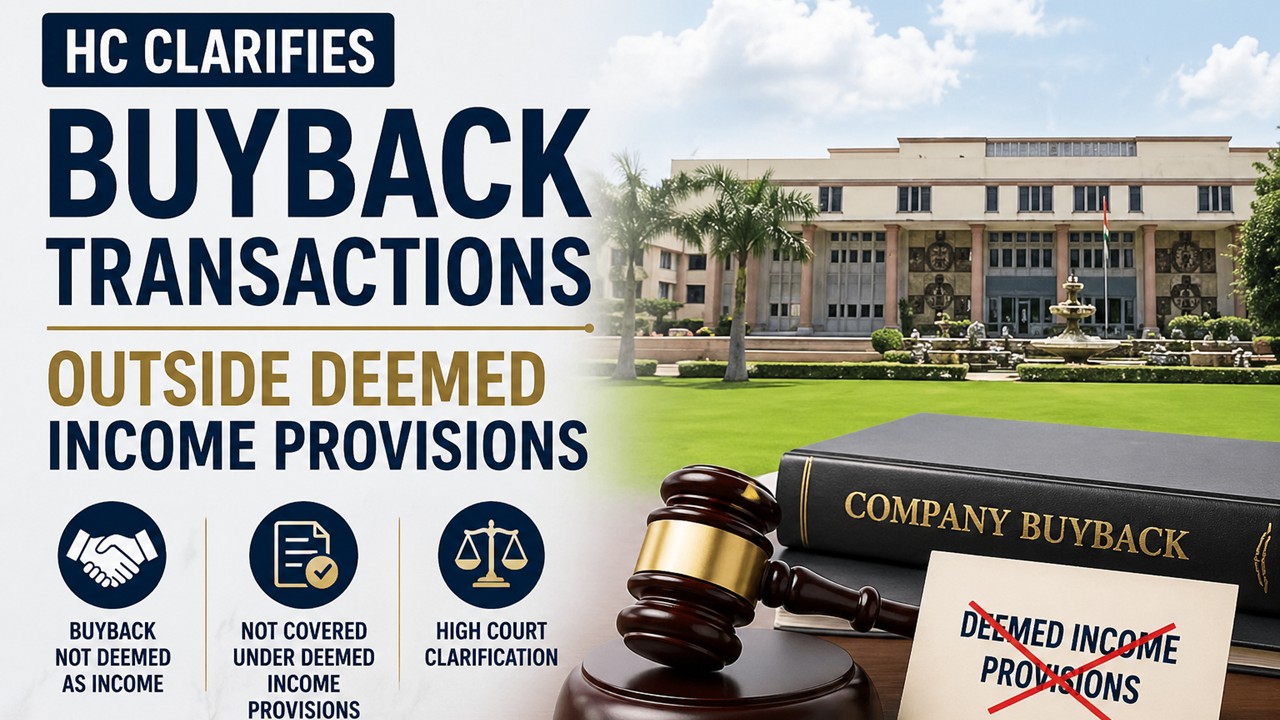
Court rules share buyback is capital reduction, not property receipt under undervaluation provisions.
HC Holds Buyback is Capital Reduction, Not Property Transfer; No Tax
 Meetu Kumari
 Apr 28, 2026
HC Clarifies Buyback Transactions Outside Deemed Income Provisions
The Revenue challenged the order of the ITAT, which had upheld the deletion of the addition made under Section 56(2)(x) in the hands of the assessee, a share broking company engaged in clearing trades. During AY 2018–19, the assessee undertook a buyback of 28.62 lakh shares at Rs. 313.40 per share. The Assessing Officer compared this with the fair market value (Rs.370.46 per share under Rule 11UA) and treated the difference of Rs. 16.33 crore as taxable income under Section 56(2)(x), alleging that the company had acquired “property” below fair value. The CIT(A) deleted the addition, holding that the buyback of own shares is not an acquisition of property but a capital reduction exercise. The ITAT affirmed this view, leading to the Revenue’s appeal before the High Court.
Issue Before Court: Whether buyback of a company’s own shares constitutes “receipt of property” at undervalue so as to attract Section 56(2)(x) of the Income Tax Act ?
HC's Decision: The Delhi High Court dismissed the Revenue’s appeal and upheld the deletion of the addition, ruling that buyback of own shares cannot be treated as purchase of property under Section 56(2)(x). The Court observed that: Buyback is governed by Section 68 of the Companies Act, 2013 and fundamentally represents a reduction of share capital, not acquisition of an asset.
Once shares are bought back, they are extinguished and destroyed, meaning no “property” survives in the company's hands.The entire premise of Section 56(2)(x)—taxing acquisition of property at less than fair value—fails in such a situation.
The Court categorically held that buyback is the antithesis of property acquisition, and treating it as such would be legally flawed.It further noted that although Section 56(2)(x) has a wide scope, it cannot be stretched to cover transactions that are structurally different in nature, such as capital restructuring.While the Court acknowledged that the ITAT’s reliance on a decision under Section 56(2)(viia) was technically misplaced, it clarified that the ultimate conclusion remained correct in law.
To Read Full Judgment, Download PDF Given Below.
About Author


Meetu Kumari
Content Manager
Meetu Kumari is an Experienced Advocate and Content Writer with 4+ years of demonstrated history of working in the law practice industry. Skilled in Developing Content, Researching, and Drafting. Strong professional with a Bachelor of Science (B.Sc.) focused on Law from Gujarat National Law University.
Meetu Kumari is an Experienced Advocate and Content Writer with 4+ years of demonstrated history of working in the law practice industry. Skilled in Developing Content, Researching, and Drafting. Strong professional with a Bachelor of Science (B.Sc.) focused on Law from Gujarat National Law University.
 Studycafe
 Jodhpur, Rajasthan, India
 2264
2264My Recent Articles
- ITAT Condones 302-Day Delay, Restores Salary Assessment for Fresh VerificationPremium
- ITAT Condones Delay After Tax Consultant's Death, Restores Appeals for Fresh HearingPremium
- ITAT Remands Salary Addition, Says Taxability Depends on Salary Becoming Due, Not Mere ReceiptPremium
- ITAT Deletes TP Royalty Adjustment, Orders Fresh Review of Commission BenchmarkingPremium
- ITAT Quashes Reassessment Over Unsigned Section 148 Notice Issued to AssesseePremium
Up Next
Loading suggestions…


Recent Posts
All Posts


Recent Posts
All Posts