High Court Bars Mechanical ITC Reversal Against Genuine Buyers:
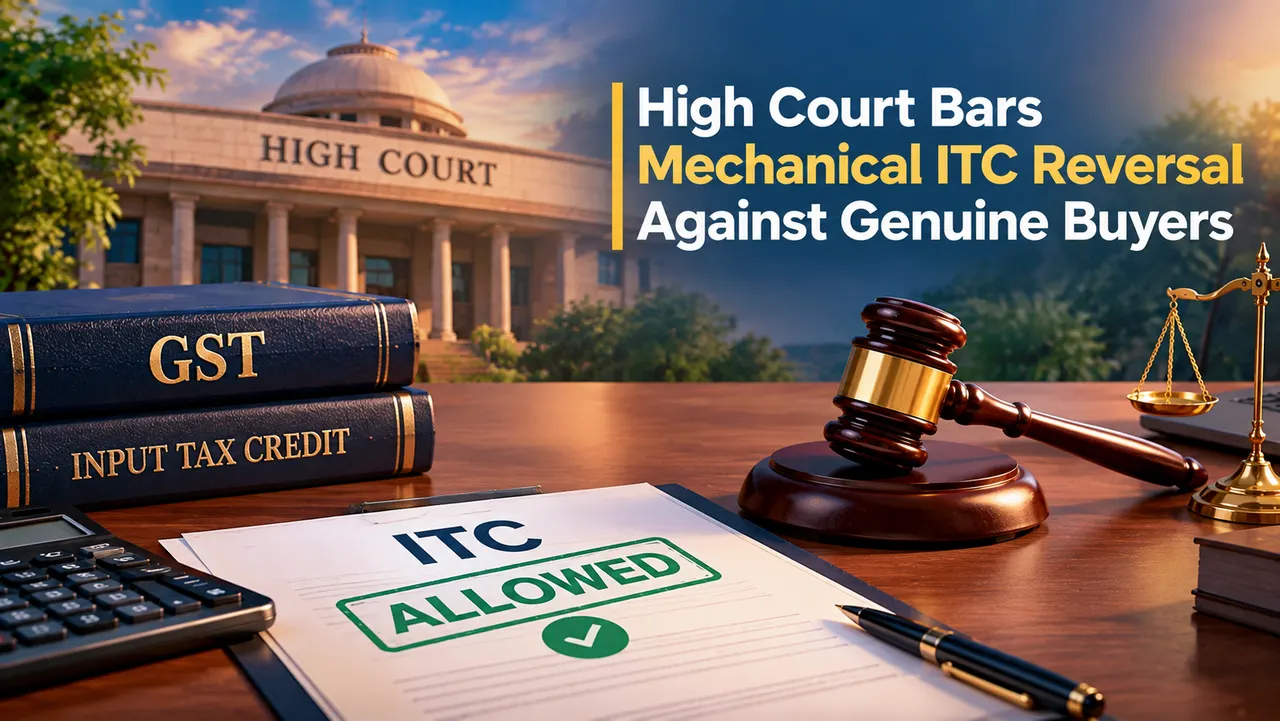
The Punjab & Haryana High Court directs Proper Officers to verify supplier default, transaction genuineness and buyer’s link before denying ITC.
High Court Upholds Section 16(2)(c) of CGST Act
 Saima
Saima Oct 3, 2026
The batch of writ petitions before the Punjab and Haryana High Court concerned denial or reversal of Input Tax Credit under Section 16(2)(c) of the CGST Act, 2017, particularly in cases where the selling dealer had failed to discharge the tax liability or where the supplier’s GST registration was subsequently cancelled, including retrospectively.
The petitioners submitted that a genuine purchasing dealer could not reasonably be expected to ensure that tax collected by the supplier was ultimately deposited with the Government. It was argued that retrospective cancellation of a supplier’s registration could adversely affect the entire chain of transactions and result in denial of ITC to purchasers who had themselves complied with the statutory requirements. The petitioners also challenged Section 16(2)(c), read with Section 155, as being violative of Articles 14 and 19 of the Constitution.

The Court, however, declined to read down or invalidate Section 16(2)(c). It observed that the provision operates as part of an integrated statutory scheme comprising Section 16(2), Section 41, Sections 73, 74, 75(12), 76, 79 and 155 of the CGST Act, along with Rules 36, 37A and 88C of the CGST Rules. The Court specifically held that subsequent cancellation, including retrospective cancellation, of the supplier’s registration, a nil or short tax liability reported by the supplier, or an alert or complaint received from another source may constitute a starting point for inquiry but cannot, by themselves, form the basis for denial or reversal of ITC.
Before issuing a show cause notice under Section 16(2)(c), the proper officer must examine the available material and record satisfaction regarding the supplier, invoices, tax periods, amount of ITC involved, nature of the supplier’s default, circumstances of non-payment and proceedings undertaken against the supplier for recovery of the tax. The Court further directed that investigation leading to a show cause notice should establish a direct link between the purchasing dealer and the suppliers where violation of the conditions of Section 16(2) is alleged.

Where denial of ITC is based upon retrospective cancellation of the supplier’s registration, the proper officer must examine the grounds and effective date of cancellation and determine whether those circumstances have any bearing on the genuineness of the particular supply made to the purchasing dealer. The High Court directed that Section 16(2)(c) shall be invoked in accordance with the statutory scheme and laid down certain safeguards.
The High Court accordingly upheld Section 16(2)(c), while prescribing procedural and evidentiary safeguards for its enforcement and directing reconsideration of the connected proceedings in accordance with those guidelines.
About Author


Saima
Content Writer
 StudyCafe
 Delhi, Delhi, India
 569
569My Recent Articles
- ITAT Deletes Penalty for Misreporting Income on Political Donation Deduction Under Section 80GGC
- ITAT Restores Ex-Parte Assessment for Fresh Adjudication After Condoning 1,131-Day Delay
- ITAT Upholds Disallowance of Rs 8.50 Lakh Political Donation Deduction Under Section 80GGC
- ITAT Remands Assessment for Fresh Verification of Property Investment and Section 80C Deduction
- ITAT Quashes Assessment for Non-Service of Section 143(2) Notice
Loading suggestions…


Recent Posts

All Posts
Recent Posts
All Posts