High Court Declines Writ Against GST Demand; Directs Assessee to Avail Statutory Appeal Remedy:
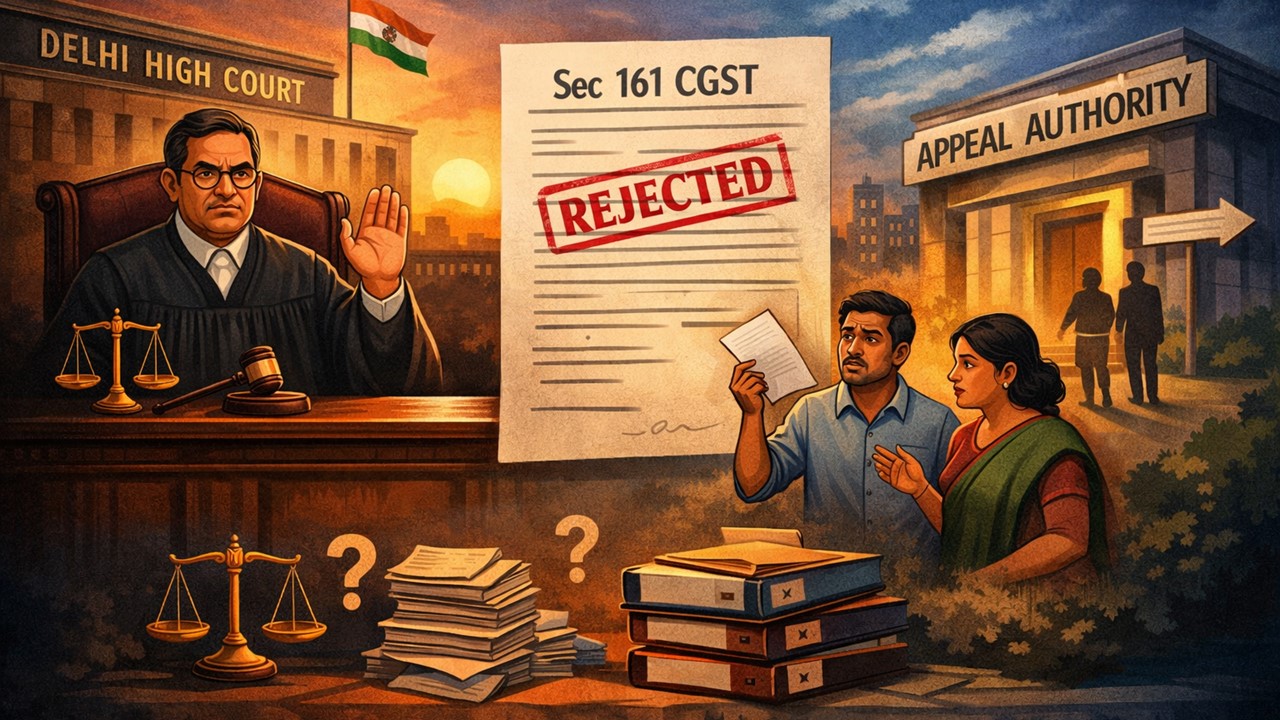
Court refuses to examine the corrigendum under Section 161 of the CGST Act in writ jurisdiction; it holds disputed factual issues must be raised before the appellate authority.
HC Rejects Writ Against GST Demand, Cites Alternate Remedy Under Section 107
 Meetu Kumari
 Apr 20, 2026
High Court Declines Writ Against GST Demand; Directs Assessee to Avail Statutory Appeal Remedy
The petitioner, Manpar Icon Technologies, challenged a show cause notice issued under Section 74 of the CGST Act dated 28.06.2025, a corrigendum dated 22.12.2025, and the Order-in-Original dated 29.12.2025 confirming a demand of Rs. 42.66 lakh. The proceedings arose from an alert regarding fraudulent availment of input tax credit (ITC) through a non-existent entity, M/s Advanta Sales.
The show cause notice pertained only to FY 2018-19, but later through a corrigendum issued after the personal hearing, the department expanded the period to include FY 2019-20. The petitioner argued that no transactions existed in FY 2018-19 and that the corrigendum unlawfully widened the scope of the notice beyond permissible limits, effectively initiating fresh proceedings after the limitation had expired.
Issue Before Court: Whether a corrigendum expanding the scope of a show cause notice can be challenged directly under writ jurisdiction, and whether such a correction amounts to initiation of fresh proceedings beyond limitation.
HC's Ruling: The High Court dismissed the writ petition, declining to interfere under Article 226.
The Court held that where an effective alternative statutory remedy exists, such as an appeal under Section 107 of the CGST Act, the writ court should ordinarily refrain from exercising jurisdiction unless exceptional circumstances are demonstrated. The petitioner failed to establish any such exception, such as a violation of natural justice, a lack of jurisdiction, or a breach of fundamental rights.
The Court observed that determining whether the corrigendum amounted to a mere rectification or an impermissible expansion of the show cause notice would require a detailed examination of facts and records. Such an exercise falls outside the limited scope of certiorari jurisdiction.
The Court emphasised that writ jurisdiction is supervisory and not appellate in nature, and cannot be invoked merely due to disagreement with findings of the adjudicating authority. Since the statute provides a complete mechanism for redressal through appeal, the petitioner must pursue that remedy.
Thus, the writ petition was dismissed with liberty to the petitioner to avail statutory appellate remedies. No decision was given on the merits.
To Read Full Judgment, Download PDF Given Below
About Author


Meetu Kumari
Content Manager
Meetu Kumari is an Experienced Advocate and Content Writer with 4+ years of demonstrated history of working in the law practice industry. Skilled in Developing Content, Researching, and Drafting. Strong professional with a Bachelor of Science (B.Sc.) focused on Law from Gujarat National Law University.
Meetu Kumari is an Experienced Advocate and Content Writer with 4+ years of demonstrated history of working in the law practice industry. Skilled in Developing Content, Researching, and Drafting. Strong professional with a Bachelor of Science (B.Sc.) focused on Law from Gujarat National Law University.
 Studycafe
 Jodhpur, Rajasthan, India
 2264
2264My Recent Articles
- ITAT Condones 302-Day Delay, Restores Salary Assessment for Fresh VerificationPremium
- ITAT Condones Delay After Tax Consultant's Death, Restores Appeals for Fresh HearingPremium
- ITAT Remands Salary Addition, Says Taxability Depends on Salary Becoming Due, Not Mere ReceiptPremium
- ITAT Deletes TP Royalty Adjustment, Orders Fresh Review of Commission BenchmarkingPremium
- ITAT Quashes Reassessment Over Unsigned Section 148 Notice Issued to AssesseePremium
Up Next
Loading suggestions…


Recent Posts

All Posts


Recent Posts
All Posts