High Court Quashes GST Show Cause Notice as Time-Barred Due to Delayed Portal Upload:
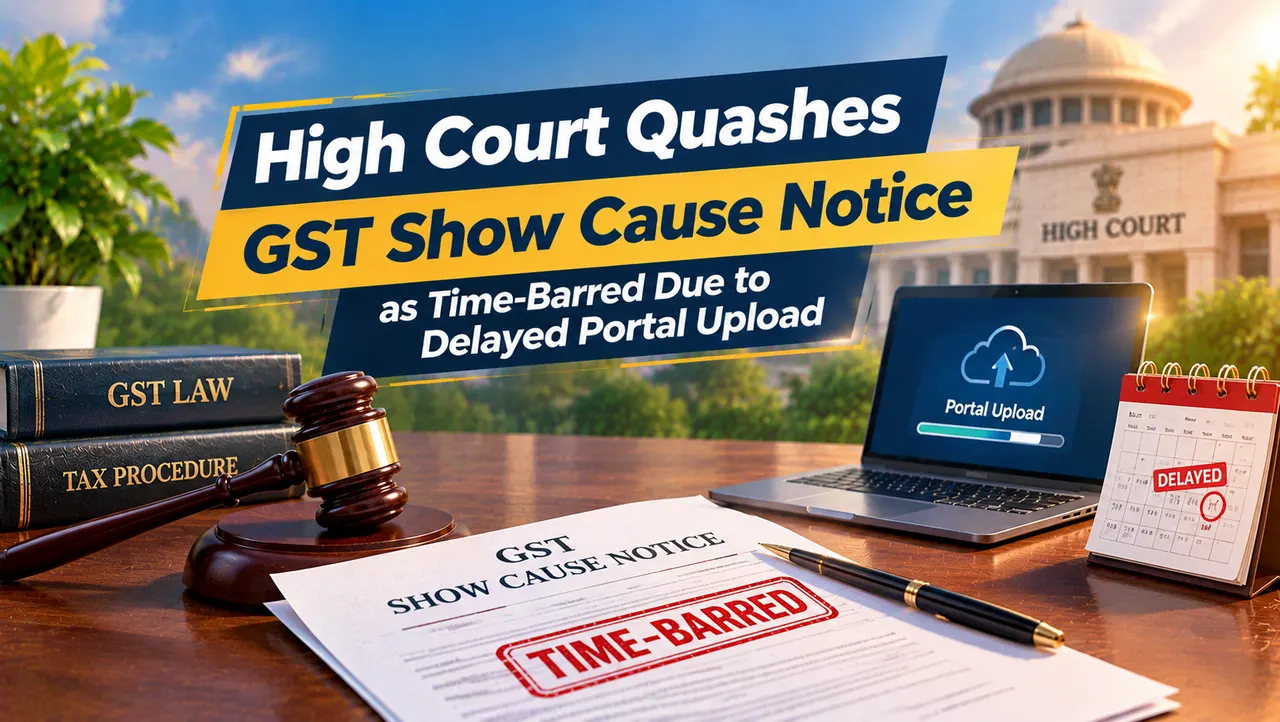
The Delhi High Court held that technical glitch in GST Portal cannot extend statutory limitation.
High Court Set Aside Order
 Saima
 Nov 3, 2026

The petitioner is M/s. Sikka Motors Pvt. Ltd. Which is engaged in the business of Hyundai car dealership, was registered under the GST Act in 2017. During scrutiny of its GST returns for FY 2019-20, the department alleged that the petitioner had wrongly availed Input Tax Credit (ITC) of Rs. 10,57,392 from suppliers whose registrations had been cancelled retrospectively and Rs. 5,57,720 from suppliers who had not furnished their GSTR-3B returns. The department also raised allegations concerning an outstanding late fee of Rs. 1,03,100 for delayed filing of GSTR-1 and non-payment of interest amounting to Rs. 3,39,603 on account of delayed GST payment.
The department communicated the discrepancies through Form ASMT-10 dated 29/02/2024 and subsequently granted personal hearing opportunities on 12/07/2024, 22/07/2024 and 31/07/2024. Thereafter, the department issued the Show Cause Notice, followed by the Order-in-Original. Aggrieved by the proceedings, the petitioner approached the Delhi High Court, contending that the Show Cause Notice was issued beyond the prescribed statutory limitation period.

After examining the submissions and relevant statutory provisions, the High Court observed that Section 73(10) of the CGST Act prescribes the outer time limit for passing an adjudication order, whereas Section 73(2) mandates that the Show Cause Notice must be issued at least three months before the expiry of that period.
The Court noted that under Notification No. 56/2023-Central Tax dated 28/12/2023, the limitation period for passing an order under Section 73(10) for FY 2019-20 had been extended up to 31/08/2024. Consequently, the Show Cause Notice was required to be issued on or before 31/05/2024. However, the notice was made available to the petitioner on the GST portal only on 08/08/2024, well beyond the prescribed deadline. The Court rejected the department's defence that the notice had been generated within time on its internal AIO system but could not be integrated with the GST portal due to a technical glitch.

Importantly, the Court noted that Section 169(1) provides several alternative modes of serving notices, including registered post, speed post and email. Despite being aware of the technical glitch, the department had made no attempt to serve the notice through any alternative statutory mode. The department could not take shelter behind a technical failure of its own system, as administrative lapses cannot be used to prejudice taxpayers or enlarge a limitation period prescribed by Parliament.
Therefore, the petitioner's alleged failure to respond to ASMT-10 or participate in personal hearings was irrelevant to the question of limitation. Such non-response neither waived the statutory limitation requirement nor relieved the department of its obligation to issue the notice within the prescribed period. Accordingly, the Court held the Show Cause Notice to be time-barred and declared that the Order-in-Original dated 23/08/2024 could not be sustained in law. The High Court therefore set aside and quashed both the Show Cause Notice and the consequential Order-in-Original and allowed the writ petition.
About Author


Saima
Content Writer
 StudyCafe
 Delhi, Delhi, India
 610
My Recent Articles
- ITAT Directs DSIR to Explain Exclusion of Expenses
- ITAT Restricts Addition Made Under Section 69A to Rs. 5 Lakh
- ITAT Upholds Fresh Assessment in Rs. 43.50 Lakh Gift Case
- High Court Sets Aside Rejection of Condonation Applications for Revised Returns for Five Assessment Years
- ITAT Holds EPR Income Must Be Treated as Operating Income While Computing Transfer Pricing Margin
Loading suggestions…


Recent Posts


All Posts

Recent Posts
All Posts