Income Tax: Surcharge and Marginal Relief; Know How to Calculate?:
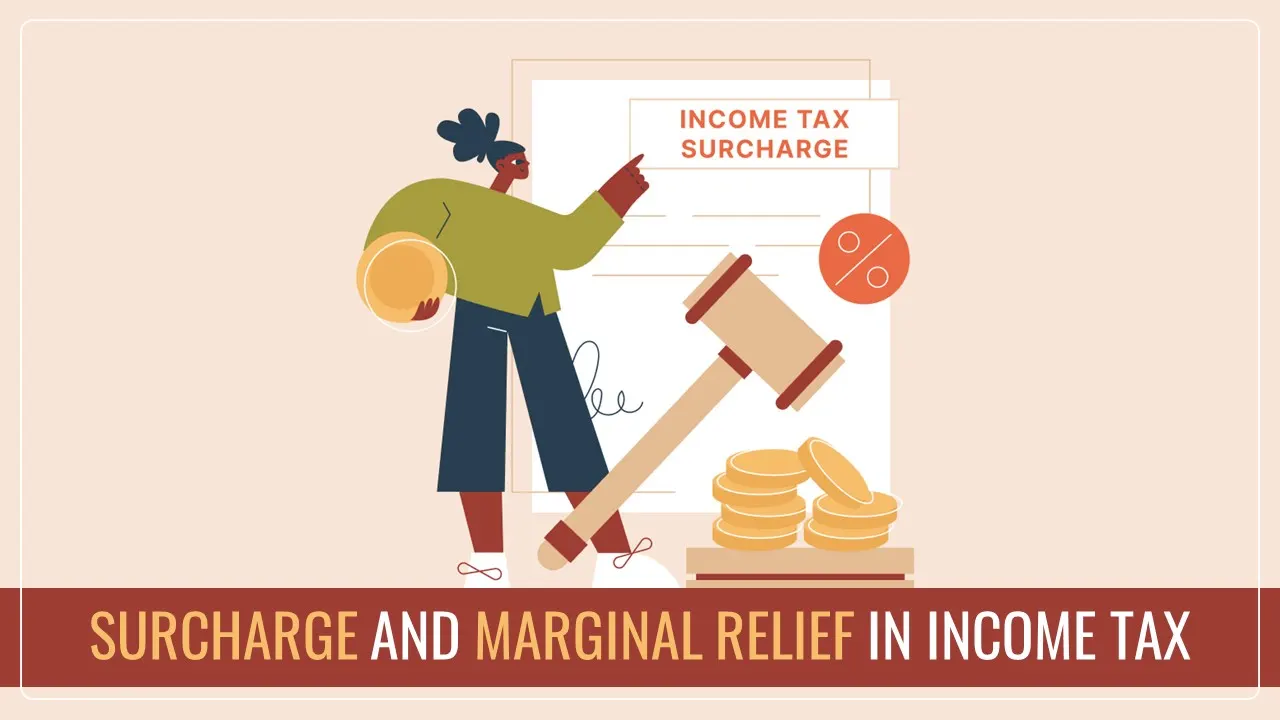
If your income crosses a certain limit, you might be charged an extra amount, known as a ‘surcharge,’ which increases your overall tax bill.
Surcharge and Marginal Relief in Income Tax
 Nidhi
Nidhi Mar 15, 2025
Table of Contents

Income Tax: Surcharge and Marginal Relief; Know How to Calculate?
If your income crosses a certain limit, you might be charged an extra amount, known as a ‘surcharge,’ which increases your overall tax bill. This surcharge is imposed on the taxable income amount before the cess is levied. As per income tax laws, a surcharge is applicable if an individual's taxable income crosses Rs.50 lakh. The government modified the surcharge rates under the new tax regime in FY 2023-24. The following surcharge rates were applicable from April 1, 2023.Surcharge rates under the new tax regime in FY 2023-24
| Income Range | Surcharge Rate |
| Up to Rs.50 lakh | Nil |
| More than Rs.50 lakh but up to Rs.1 crore | 10% |
| More than Rs.1 crore but up to Rs.2 crore | 15% |
| More than Rs.2 crore | 25% |
Surcharge Rates under the old tax regime in FY 2024-25
| Income Range | Surcharge Rate |
| Up to Rs.50 lakh | Nil |
| More than Rs.50 lakh but up to Rs.1 crore | 10% |
| More than Rs.1 crore but up to Rs.2 crore | 15% |
| More than Rs.2 crore but up to Rs.5 crore | 25% |
| More than Rs.5 crore | 37% |
Understanding the Importance of Marginal Relief
While learning about surcharge rates, it’s also important to understand 'marginal relief.' Marginal relief applies when the extra tax (surcharge) is higher than the increase in income over a certain limit. Assume you have a net taxable income of Rs.51 lakh. As mentioned earlier, a surcharge of 10% is imposed when the income exceeds Rs.50 lakh. The tax payable on Rs.51 lakh, excluding the surcharge, is Rs.13,42,500. The surcharge amount will become Rs.1,34,250. Here, the additional income of Rs.1,00,000 is less than the surcharge amount imposed in case the income is 51 lakh. This sounds very unfair. That is when marginal relief is applied to make sure taxpayers are not taxed unfairly. Without the marginal relief, someone earning a little more than the limit might face a huge jump in taxes, even though their income didn’t increase much.How to Calculate Marginal Relief and Surcharge?
1. First, calculate the income tax payable on Rs.50 lakh, i.e., Rs.13,12,500. 2. Now add the additional income (Income above 50 lakh) of Rs. 1,00,000 to the income tax payable amount. The tax payable under marginal relief will be Rs.14,12,500. 3. To calculate the surcharge amount, subtract the normal tax liability before surcharge and cess (Rs.13,42,500) from the tax liability after marginal relief before cess (Rs.14,12,500):Rs.14,12,500 - Rs.13,42,500 = Rs. 70,000
4. The tax payable amount will be as follows:| Particulars | Amount (Rs) |
| Tax Payable Amount | 13,42,500 |
| Add: Surcharge | 70,000 |
| Add: Cess (4% on Rs 14,12,500) | 56,500 |
| Total Tax Payable | 14,69,000 |
About Author


Nidhi
Content Writer
Nidhi is a skilled content writer specializing in personal finance. She creates clear, engaging articles on mutual funds, investments, insurance, and wealth-building strategies. With a passion for simplifying complex financial topics, Nidhi helps readers make informed money decisions with confidence. She can be reached at [email protected]
Nidhi is a skilled content writer specializing in personal finance. She creates clear, engaging articles on mutual funds, investments, insurance, and wealth-building strategies. With a passion for simplifying complex financial topics, Nidhi helps readers make informed money decisions with confidence. She can be reached at [email protected]
 Studycafe
 New Delhi, Delhi, India
 1832
1832My Recent Articles
- Karnataka High Court Gives Another Chance in GST Matter Due to Lack of Hearing
- Delay Should Be Condoned if Explanation is Unrefuted: ITAT
- Non-Service of Income Tax Notice, Ill health of taxpayer, ITAT condones Appeal filing delay
- Books of Accounts Cannot be Rejected Without Any Specific Defect: ITAT Kolkata
- Karnataka High Court Sends ITC Matter Back to GST Authorities for Reconsideration
Up Next
Loading suggestions…


Recent Posts


All Posts


Tags
No tags yet.
Recent Posts
All Posts
Tags
No tags yet.