ITAT Deletes Section 14A Disallowance for Failure to Record Mandatory Satisfaction Before Invoking Rule 8D:
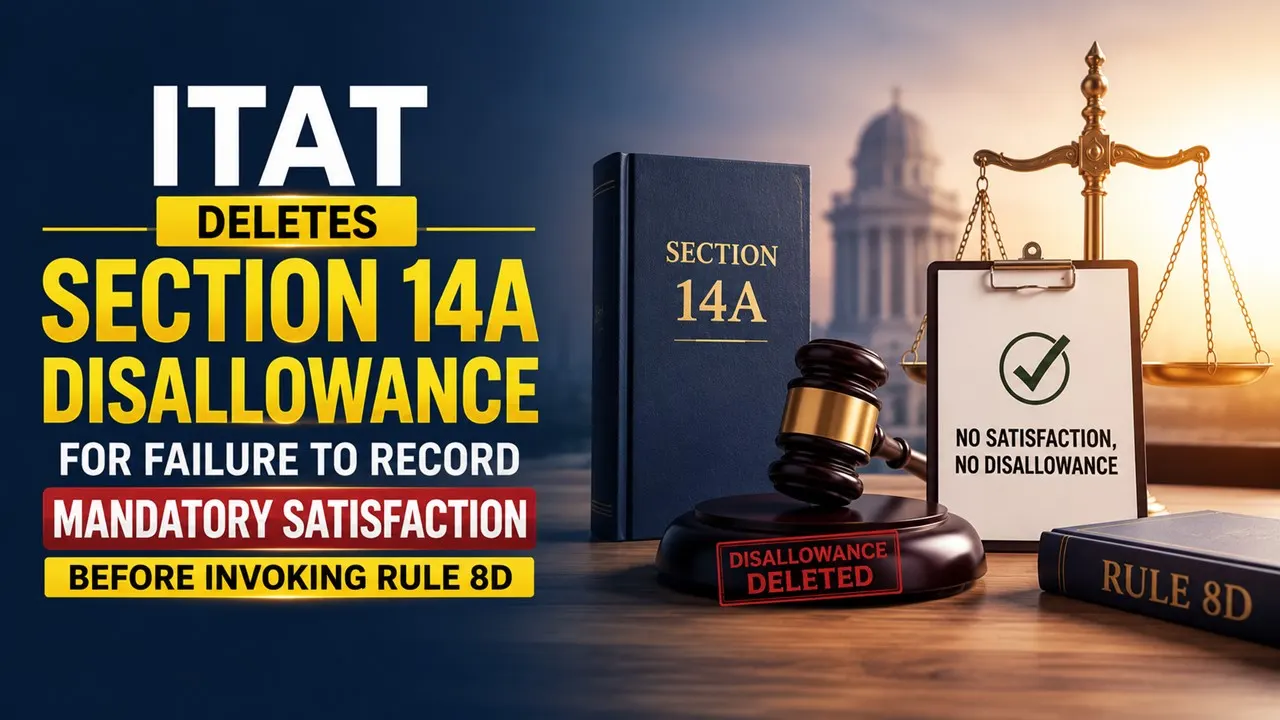
The Income Tax Appellate Tribunal (ITAT) Bangalore has held that an AO cannot invoke Section 14A read with Rule 8D without first recording the mandatory satisfaction after examining its accounts.
Rule 8D Cannot be Applied Unless the AO First Records Objective Dissatisfaction
 Saima
Saima Jun 29, 2026
ITAT Deletes Section 14A Disallowance for Failure to Record Mandatory Satisfaction Before Invoking Rule 8D
The Income Tax Appellate Tribunal (ITAT), Bangalore, held that the statutory requirement under Section 14A(2) obligates that the AO must first examine the books of account and record his satisfaction, supported by reasons, regarding the incorrectness of the assessee's claim.
The assessee is engaged in the business of real estate development and filed its return of income for assessment year 2016-17 declaring a total income of Rs 37.23 crore. During the relevant year, it earned exempt dividend income of Rs 1.46 crore from investments in mutual funds and voluntarily disallowed Rs 7.30 lakh, being 5% of the exempt income, towards expenditure incurred in earning such income.
The AO rejected the voluntary disallowance and applied Section 14A read with Rule 8D of the Income Tax Rules. Later, a disallowance of Rs 9.18 crore was calculated, resulting in an addition of Rs 9.11 crore.
The CIT(A) directed that only investments generating exempt income should be considered for the calculation but upheld the application of Rule 8D. Aggrieved by the disallowance, the assessee approached the Tribunal.
[related id="425275 "]
The Tribunal found that the AO only rejected the assessee's claim for "want of evidence" without identifying any specific incorrectness in the accounts or establishing any connection between borrowed funds and the investments generating exempt income. It further noted that the assessee had sufficient interest-free funds and that the audited cash-flow statements were not examined before making the disallowance.
The Tribunal allowed the assessee's appeal and held that the AO had failed to fulfil the mandatory requirement of Section 14A(2). It observed that before applying Rule 8D, the AO must properly examine the assessee's accounts and record clear reasons showing why the assessee's claim regarding expenditure relating to exempt income is incorrect.
Accordingly, the Tribunal directed the AO to delete the disallowance made under Section 14A to the extent it exceeded the assessee's voluntary disallowance of Rs 7.30 lakh.
About Author


Saima
Content Writer
Saima is a Law graduate with a passion for research and content writing. She writes for Finance, Taxation and Legal Updates at Studycafe.in, simplifying complex legal decisions by the ITAT, High Court, AAR and GSTAT into uncomplicated and clear explanations.
Saima is a Law graduate with a passion for research and content writing. She writes for Finance, Taxation and Legal Updates at Studycafe.in, simplifying complex legal decisions by the ITAT, High Court, AAR and GSTAT into uncomplicated and clear explanations.
 StudyCafe
 Delhi, Delhi, India
 576
576My Recent Articles
- GSTAT Allows Inverted Duty Refund Despite Same HSN for Inputs and Outputs
- ITAT Deletes Rs 10 Lakh Penalty for Non-Disclosure of Foreign Investment in Schedule FA
- High Court Rejects Customs Department’s Plea to Condonate 154-Day Delay in Filing Appeal
- ITAT Remands Rs 1.30 Crore Unexplained Money Addition and Penalty for Fresh Hearing
- ITAT Remands Rs 2.20 Crore Addition Under Section 69C for Fresh Examination
Up Next
Loading suggestions…


Recent Posts



All Posts


Recent Posts
All Posts