ITAT Denies Section 72A Benefit Where Resulting Company Failed to Issue Shares:
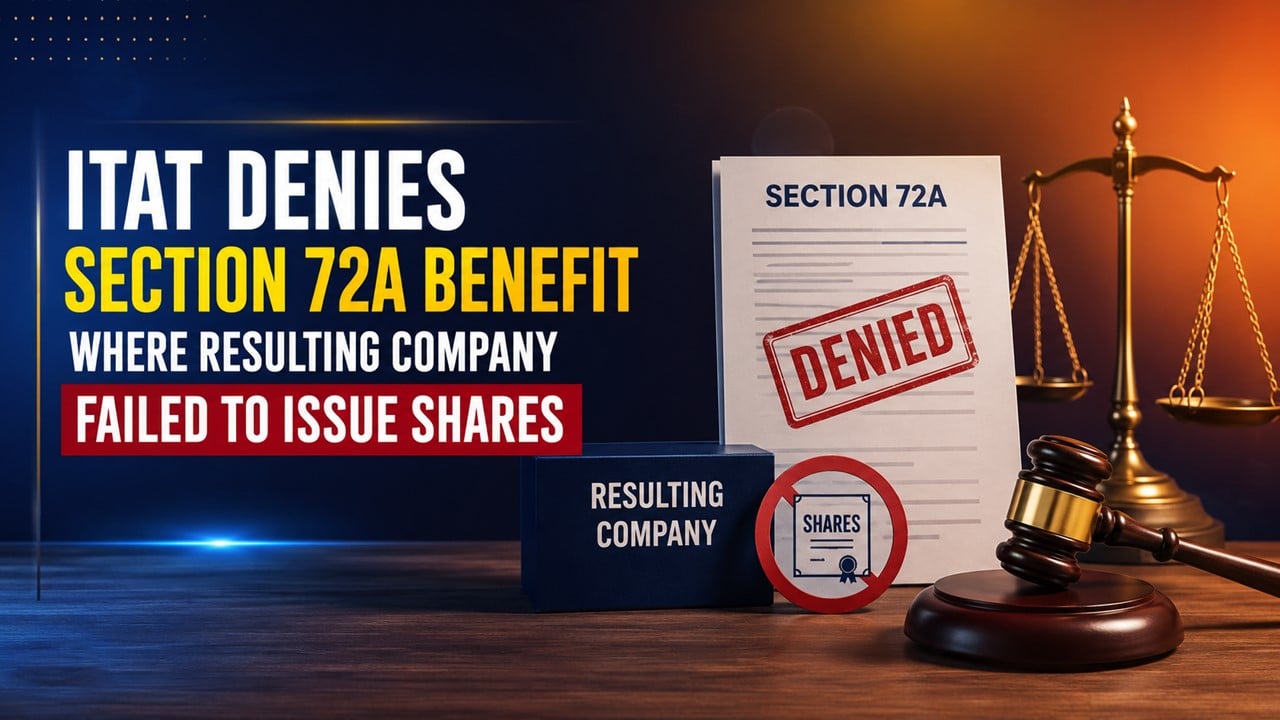
Tribunal allows ESOP deduction but denies loss carry forward under Section 72A. Prior Period Expenses Remanded While ESOP Claim Allowed By Tribunal Tribunal allows ESOP deduction but denies loss carry forward under Section 72A.
Prior Period Expenses Remanded While ESOP Claim Allowed By Tribunal
 Meetu Kumari
 Jun 27, 2026
The Mumbai Bench of the Income Tax Appellate Tribunal (ITAT) has partly allowed the appeal filed by Sterling Holiday Resorts Limited for AY 2015-16, granting relief on ESOP expenditure and remanding the issue of prior period expenses for fresh verification while rejecting the company's claim for carry forward and set-off of accumulated business losses and unabsorbed depreciation arising from a court-approved demerger. The Tribunal also dismissed the Revenue's appeal challenging the deletion of the addition on deferred income.
The assessee, formerly known as Thomas Cook Insurance Services India Ltd., had challenged three additions made by the Assessing Officer: disallowance of prior-period expenses of Rs 3.11 crore, ESOP expenditure of Rs 3.19 crore, and denial of carry forward and set-off of accumulated business losses and unabsorbed depreciation, aggregating to Rs 240.15 crore.

On the issue of prior period expenses, the Tribunal noted that the lower authorities had rejected the claim without properly examining the supporting details furnished by the assessee. The company contended that certain interest expenditure incurred on the securitisation of debtors was allowable under Section 36(1)(iii), while statutory dues covered by Section 43B became deductible upon actual payment. Accepting the request for reconsideration, the Tribunal restored the matter to the Assessing Officer for fresh adjudication after verifying whether the liabilities had crystallised during the relevant year. Accordingly, this issue was allowed for statistical purposes.
The principal dispute related to the denial of carry forward and set-off of business losses and unabsorbed depreciation under Section 72A(4) following a court-approved scheme involving Sterling Holiday Resorts India Limited, Thomas Cook (India) Limited (TCIL), and the assessee company. Under the scheme, the resort and timeshare undertaking of Sterling Holiday Resorts India Ltd. was transferred to the assessee, while TCIL issued shares to the shareholders of the demerged company.

The assessee argued that both it and its holding company, TCIL, qualified as a "resulting company" under Sections 2(19AA) and 2(41A), and therefore the issuance of shares by TCIL substantially satisfied the statutory requirements. It relied on principles of liberal interpretation of beneficial provisions and contended that a restrictive reading would defeat the purpose of tax-neutral corporate restructuring.
The Tribunal rejected these submissions. It held that the statutory provisions governing tax-neutral demergers are clear and unambiguous and must be interpreted strictly. Referring extensively to Supreme Court decisions, including Commissioner of Customs v. Dilip Kumar & Co., Ajmera Housing Corporation, Britannia Industries Limited, and Union of India v. Dharmendra Textiles Processors, the Bench reiterated that courts cannot read into tax statutes words that are not present.
Thus, the Tribunal upheld the denial of set-off of brought forward unabsorbed depreciation of Rs.5.19 crore and disallowance of carry forward of business losses of Rs.121.66 crore and unabsorbed depreciation of Rs.113.29 crore.
In the Revenue's cross-appeal, the only issue concerned the deletion of the addition of Rs 44.69 crore on account of deferred income. The CIT(A) had followed earlier Tribunal decisions in the assessee's own case, holding that income from vacation ownership schemes could be recognised over the period of entitlement in accordance with the consistently followed accounting method. Since the Revenue could not show that those earlier Tribunal orders had been stayed or reversed by any higher court, the Tribunal upheld the CIT(A)'s order and dismissed the Revenue's appeal.
Therefore, the assessee's appeal was partly allowed, while the Revenue's cross-appeal was dismissed.
To Read Full Order, Download PDF Given Below
About Author


Meetu Kumari
Content Manager
 Studycafe
 Jodhpur, Rajasthan, India
 2264
2264My Recent Articles
- ITAT Condones 302-Day Delay, Restores Salary Assessment for Fresh VerificationPremium
- ITAT Condones Delay After Tax Consultant's Death, Restores Appeals for Fresh HearingPremium
- ITAT Remands Salary Addition, Says Taxability Depends on Salary Becoming Due, Not Mere ReceiptPremium
- ITAT Deletes TP Royalty Adjustment, Orders Fresh Review of Commission BenchmarkingPremium
- ITAT Quashes Reassessment Over Unsigned Section 148 Notice Issued to AssesseePremium
Loading suggestions…


Recent Posts



All Posts


Recent Posts
All Posts