ITAT Holds Section 271(1)(c) Penalty Not Leviable for Consequential Depreciation Disallowance:
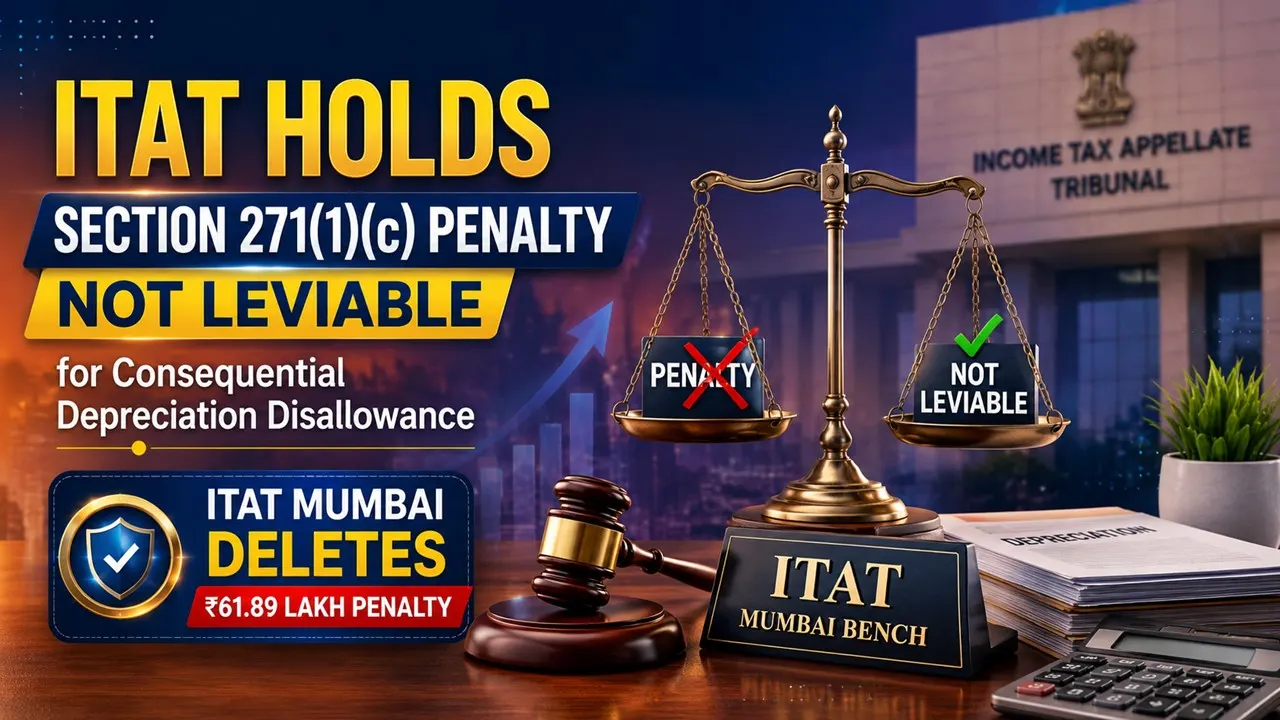
The ITAT Mumbai held that a bona fide excess depreciation claim arising from subsequent appellate adjustments cannot attract penalty under Section 271(1)(c).
ITAT Mumbai Deletes Rs 61.89 Lakh Penalty
 Saloni Kumari
 Jun 4, 2026
Premium
ITAT Holds Section 271(1)(c) Penalty Not Leviable for Consequential Depreciation Disallowance
The ITAT Mumbai held that a bona fide excess depreciation claim arising from subsequent appellate adjustments cannot attract penalty under Section 271(1)(c).
Also Read
High Court Quashes Income Tax Demand Against Contractual Worker Over Misuse of PANIncome Tax Department Suspects Rs 5,121 Crore Tax Evasion in Uttar Pradesh After Examining Over 26,000 Property Registration DocumentsITAT Deletes Rs 2.06 Crore Addition Under Section 68 for Unsecured LoansITAT Holds Section 263 Revision Invalid on Taxability of Interest Under Section 28 of Land Acquisition Act
About Author


Saloni Kumari
Content Writer
Saloni is a Content Writer with 2+ years of experience at studycafe.in. She writes legal, taxation, and finance related content including GST, Income Tax etc. Skilled in translating complex judicial pronouncements and regulatory developments into clear, and reader-friendly articles. Experienced in covering judgements of ITAT, High Court, GSTAT, and news related to Income Tax, GST, and corporate law. She can be reached at [email protected].
Saloni is a Content Writer with 2+ years of experience at studycafe.in. She writes legal, taxation, and finance related content including GST, Income Tax etc. Skilled in translating complex judicial pronouncements and regulatory developments into clear, and reader-friendly articles. Experienced in covering judgements of ITAT, High Court, GSTAT, and news related to Income Tax, GST, and corporate law. She can be reached at [email protected].
 StudyCafe
 Delhi, Delhi, India
 2931
2931My Recent Articles
- Rs 843.97 Crore Bogus Political Party Donation Racket Unearthed in Gujarat, Income Tax Dept Files Complaint With CID (Crime)
- Retired Central GST Commissioner Kidnapped by Unknown Persons, Assailants Nabbed Within Hours
- Madhya Pradesh HC Quashes Section 74 GST Show Cause Notice Passed Against G R Infraprojects
- GSTAT Introduces SOP for Branch Officer-to-Branch Officer (BO-to-BO) Case Transfer Ensuring Seamless Reassignment of Cases
- GSTAT: E-Way Bills Cannot Be Invalidated Merely Because They Were Not Generated by Original Supplier
Up Next
Loading suggestions…


Recent Posts


All Posts
Recent Posts
All Posts