ITAT Quashes Revenue’s Rs. 9.8 Crore Additions; Rejects Evidence from Third-Party Seized Diary:
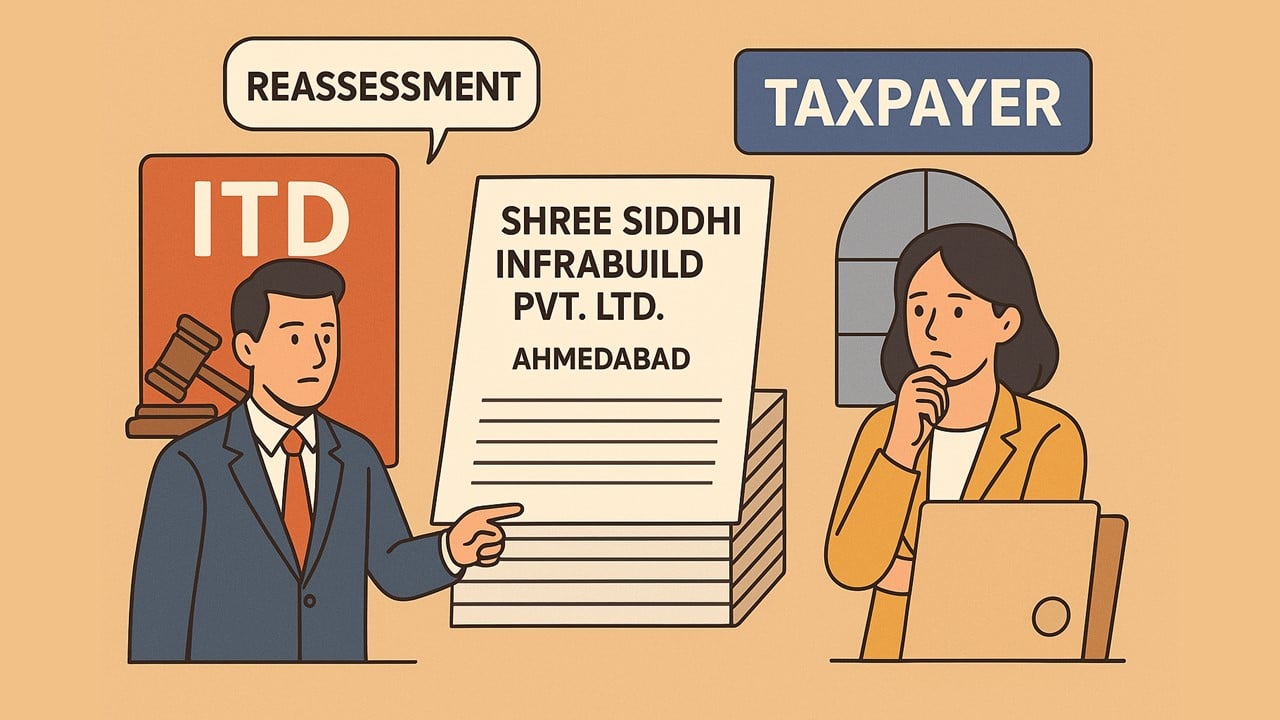
The Tribunal dismissed Revenue’s appeals, holding that unverified diary entries of the searched group had no nexus with the assessee’s books.
Tribunal Deletes Additions u/s 68 and 69A Based on Uncorroborated Diary
 Saloni Kumari
 Dec 8, 2025
ITAT Quashes Revenue’s Rs. 9.8 Crore Additions; Rejects Evidence from Third-Party Seized Diary
The case had been filed by the tax department (DCIT) against a taxpayer named Shree Siddhi Infrabuild Pvt. Ltd., based in Ahmedabad, challenging a common appellate order passed by the Commissioner of Income Tax (Appeals)-8 Ahmedabad [CIT(A)] on August 22, 2019. The order in question had deleted the relevant additions made by the assessing officer (AO) under section 143(3), read with section 147 of the Income Tax Act, 1961.
The dispute is regarding the reassessment of Shree Siddhi Infrabuild Pvt. Ltd. for assessment years 2011-12, 2012-13, and 2014-15. The department led this reassessment based on material confiscated during a search in the Venus Group’s premises, specifically a diary/cash book recording purportedly unaccounted cash transactions.
The tax officer alleged that the confiscated diary was a systematic, unaccounted cash book of the Venus Group that consisted of coded entries of cash receipts and payments involving the assessee company. When the entries were decoded by the tax officer, it was noted that the assessee was engaged in accommodation transactions with the Venus Group, resulting in unexplained cash credits and unexplained money under sections 68 and 69A of the Income Tax Act.
The tax officer noted that, "The assessee had paid cash of Rs. 4 crore to the Venus Group and received cheque payments in return, which constituted accommodation entries. The amount of Rs. 4 crore was therefore treated as unexplained cash credit under section 68." Additionally, "The assessee was the owner of unaccounted cash of Rs. 5.80 crore, which was utilised to make cheque payments to the Venus Group concerns and the corresponding cash was received back." In conclusion to these findings, the tax officer made an addition of Rs. 5.8 crore to the income of the assessee company as unexplained money under section 69A.
However, the assessee company argued that the confiscated diary and vouchers belonged entirely to the Venus Group and were third-party documents completely unrelated to it. Additionally, all the transactions with Venus Group entities were genuine business advances reflected in audited books and supported by banking evidence. The assessee highlighted substantial debit balances from previous years, and no evidence of corresponding cash withdrawals or deposits was found in its accounts.
When the assessee company approached CIT(A) challenging the decision of the tax officer, the CIT(A) upheld the validity of reopening; however, it deleted all the additions made by the tax officer. It was held that the seized diary, found only at Venus Group’s premises and containing no entry in the assessee’s handwriting or name, could not be treated as evidence against the assessee without corroboration. The CIT(A) also found significant discrepancies between the decoded entries and the assessee’s books, noting the AO’s selective and assumption-based approach ignored full loan cycles and banking transactions.
When the assessee had taken and filed the case before the ITAT Ahmedabad, the ITAT bench agreed with CIT(A)’s findings. The assessee company highlighted, "the assessee had also raised legal grounds challenging the very validity of the reassessment on the footing that, in the facts of the present case, proceedings under section 153C were the only proper course and that initiation of reopening under section 148 was therefore without jurisdiction. It was further submitted that, as evident from the RTI reply dated 20.08.2024 placed on record, the Assessing Officer had not applied his independent mind while recording reasons and had merely acted on borrowed satisfaction."
Since the Revenue failed to prove a nexus between the seized diary entries and the assessee’s accounts, the additions under sections 68 and 69A were unsustainable. Hence, in the end, the tribunal dismissed all revenue appeals and deleted all the additions made by the tax officer.

About Author


Saloni Kumari
Content Writer
Saloni is a Content Writer with 2+ years of experience at studycafe.in. She writes legal, taxation, and finance related content including GST, Income Tax etc. Skilled in translating complex judicial pronouncements and regulatory developments into clear, and reader-friendly articles. Experienced in covering judgements of ITAT, High Court, GSTAT, and news related to Income Tax, GST, and corporate law. She can be reached at [email protected].
Saloni is a Content Writer with 2+ years of experience at studycafe.in. She writes legal, taxation, and finance related content including GST, Income Tax etc. Skilled in translating complex judicial pronouncements and regulatory developments into clear, and reader-friendly articles. Experienced in covering judgements of ITAT, High Court, GSTAT, and news related to Income Tax, GST, and corporate law. She can be reached at [email protected].
 StudyCafe
 Delhi, Delhi, India
 2924
2924My Recent Articles
- Major Relief in Arbitration Case: MCIA Denies Rs 908 Crore Statement Claim Made by Allied Silica Against Tata Chemicals
- MCA and ICSI to Hold User Awareness Session on Form AOC-4 Filing Amid Glitches on MCA-21 Version-3 Portal
- GSTN Introduces New E-Invoicing Facility for Self-Invoices Under Reverse Charge Mechanism
- Flexi Cap vs Multi Cap Funds: What's the Real Difference?
- IBA Recommends Public Sector Banks to Reduce Ambit of Physical Branch Audits to 50% of Total Business
Up Next
Loading suggestions…


Recent Posts


All Posts


Tags
Recent Posts
All Posts