ITAT Quashes Section 263 Revision, Says PCIT Cannot Reopen Assessment for Mere Inadequate Inquiry:
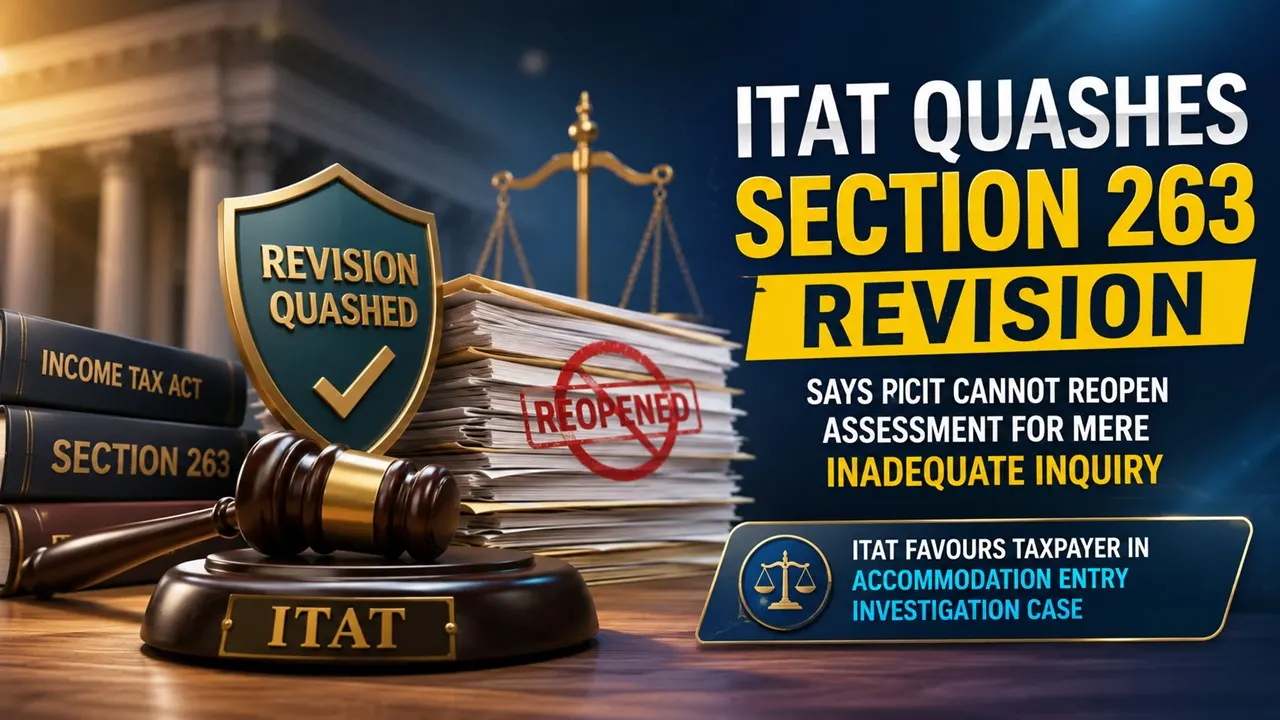
The ITAT quashed the Section 263 revision order, holding that an assessment cannot be revised merely because the PCIT believes further enquiries were warranted.
ITAT Favours Taxpayer in Accommodation Entry Investigation Case
 Saloni Kumari
 Jun 17, 2026
ITAT Quashes Section 263 Revision, Says PCIT Cannot Reopen Assessment for Mere Inadequate Inquiry
The ITAT Mumbai has set aside the Section 263 revisionary order, holding that the assessment order could not be treated as erroneous and prejudicial to the interests of the Revenue merely because the Principal Commissioner of Income Tax (PCIT) believed that further enquiries should have been conducted.
The tax authorities had carried out a search operation on Alankit Group under Section 132 of the Income Tax Act on October 18, 2019. In that operation, the AO found certain incriminating material pertaining to the assessee, Mridul Shashikant Khandelwal. Accordingly, a satisfaction note was recorded by the assessing officer of the non-searched person (assessee).
Thereafter, a notice dated September 26, 2022, under Section 153C of the Act was issued. In response to the same, the assessee filed his income tax return (ITR) for the Assessment Year 2014-2015, declaring a total income of Rs 10.88 lakh. The AO accepted the declared income without making any further additions.
However, later the PCIT noted that the AO had failed to properly verify the alleged accommodation entry transactions and that the assessment order was passed without adequate enquiry. Consequently, it issued a show cause notice (SCN) dated August 14, 2025, to the assessee in exercise of its powers granted under Section 263 of the Act. In the notice, the assessee was asked to explain "as to why the assessment order should not be treated as erroneous and prejudicial to the interests of the Revenue".
The PCIT did not find the submissions made by the assessee acceptable and ultimately set aside the assessment order dated March 16, 2024, and remanded the case back to the AO with directions to freshly consider the assessment after conducting necessary enquiries and verifications on all issues involved, including those specifically identified, and after granting a fair opportunity of hearing to the Assessee.
The assessee, being dissatisfied with the PCIT's decision, filed the present appeal before the ITAT Mumbai. When the tribunal analysed the complete case, it noted that the AO had in fact conducted several enquiries, issued multiple notices, and examined the seized material before accepting the returned income. Relying on the principle laid down by the Delhi High Court in CIT v. Sunbeam Auto Ltd, the Tribunal reiterated that Section 263 can be invoked only in cases of a complete lack of inquiry and not merely because the Commissioner considers the inquiry inadequate.
Accordingly, the Section 263 order was quashed and the assessee's appeal was allowed.
About Author


Saloni Kumari
Content Writer
Saloni is a Content Writer with 2+ years of experience at studycafe.in. She writes legal, taxation, and finance related content including GST, Income Tax etc. Skilled in translating complex judicial pronouncements and regulatory developments into clear, and reader-friendly articles. Experienced in covering judgements of ITAT, High Court, GSTAT, and news related to Income Tax, GST, and corporate law. She can be reached at [email protected].
Saloni is a Content Writer with 2+ years of experience at studycafe.in. She writes legal, taxation, and finance related content including GST, Income Tax etc. Skilled in translating complex judicial pronouncements and regulatory developments into clear, and reader-friendly articles. Experienced in covering judgements of ITAT, High Court, GSTAT, and news related to Income Tax, GST, and corporate law. She can be reached at [email protected].
 StudyCafe
 Delhi, Delhi, India
 2931
2931My Recent Articles
- Rs 843.97 Crore Bogus Political Party Donation Racket Unearthed in Gujarat, Income Tax Dept Files Complaint With CID (Crime)
- Retired Central GST Commissioner Kidnapped by Unknown Persons, Assailants Nabbed Within Hours
- Madhya Pradesh HC Quashes Section 74 GST Show Cause Notice Passed Against G R Infraprojects
- GSTAT Introduces SOP for Branch Officer-to-Branch Officer (BO-to-BO) Case Transfer Ensuring Seamless Reassignment of Cases
- GSTAT: E-Way Bills Cannot Be Invalidated Merely Because They Were Not Generated by Original Supplier
Up Next
Loading suggestions…


Recent Posts
All Posts
Recent Posts
All Posts