ITAT Quashes Section 263 Revision Where AO Conducted Detailed Enquiry:
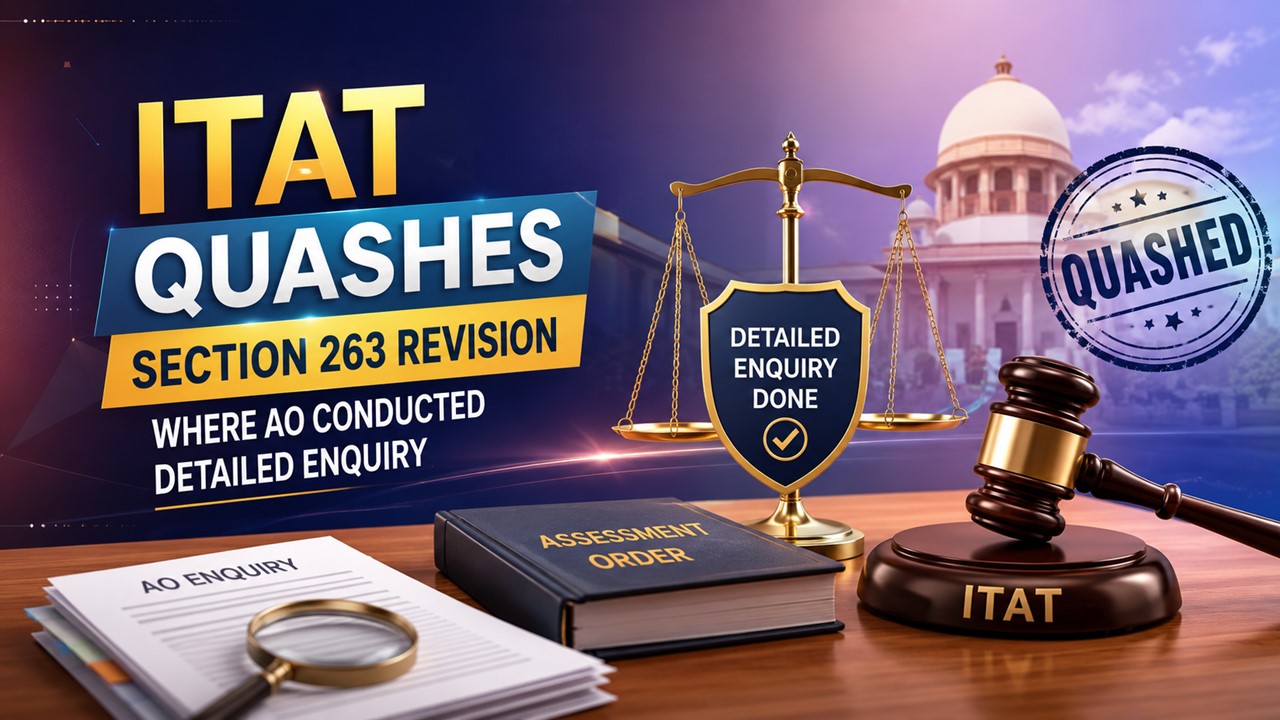
ITAT quashes Section 263 revision, holding completed enquiries cannot justify fresh verification without establishing error.
Commissioner Must Establish Assessment Error, Not Merely Seek Fresh Verification
 Meetu Kumari
 Jun 29, 2026
The Pune Bench of the Income Tax Appellate Tribunal (ITAT) has quashed a revisionary order passed under Section 263 of the Income Tax Act, holding that the Commissioner cannot invoke revision merely because he believes the Assessing Officer (AO) should have conducted a more elaborate inquiry. The Tribunal observed that where the AO has raised specific queries, examined the assessee's replies and taken a plausible view, the assessment order cannot be treated as erroneous and prejudicial to the interests of the Revenue.
The assessee, Digital Risk Mortgage Services LLC, a US-based company having a permanent establishment in India through its Pune branch, had filed its return for AY 2020-21 claiming deductions under Sections 10AA and 80JJAA. During scrutiny assessment, the AO issued multiple notices under Section 142(1), sought detailed explanations regarding both deductions, examined Form 56F, Form 3CEB, employee details, salary records and other supporting documents before completing the assessment under Sections 143(3) read with 144C, allowing the deductions.

Subsequently, the Commissioner of Income Tax (IT&TP), Pune invoked revisionary jurisdiction under Section 263, alleging that the AO had failed to properly verify the assessee's eligibility for deduction under Section 10AA, particularly compliance with CBDT Circular No. 14/2014 relating to redeployment of technical manpower in the SEZ unit. The Commissioner also alleged inadequate verification of the deduction under Section 80JJAA, contending that the AO had not examined employee-wise eligibility, period of employment, provident fund records and salary details.
Before the Tribunal, the assessee demonstrated that all these details had in fact been furnished during the original assessment proceedings. The paper book contained employee lists, salary details, working days, technical manpower deployment, responses to questionnaires and replies to the AO's show-cause notice. The assessee also pointed out that the Chennai SEZ unit had already been granted deduction under Section 10AA in the first eligible assessment year and that less than 35% of its employees had been transferred from the existing unit, satisfying the conditions prescribed under the CBDT Circular.

The Tribunal further noted that even during the Section 263 proceedings, the assessee had again submitted complete employee details and supporting documents. However, the Commissioner neither examined these documents nor recorded any finding that the assessee was ineligible for either deduction. Instead, the assessment was simply set aside for fresh verification, which is not permissible under Section 263.
Relying upon the Supreme Court's decisions in Malabar Industrial Co. Ltd. v. CIT (243 ITR 83) and PCIT v. V-Con Integrated Solutions (P.) Ltd. (476 ITR 526), along with various High Court decisions, the Tribunal reiterated that Section 263 cannot be invoked merely because the Commissioner prefers a deeper inquiry or holds a different opinion. Once the AO has conducted inquiries and adopted a plausible view, the Commissioner must establish that the assessment order is both erroneous and prejudicial to the interests of the Revenue. A remand for a fishing or roving inquiry cannot substitute such a finding.
Holding that the Commissioner failed to establish any error in the assessment order or identify any violation of the statutory conditions governing deductions under Sections 10AA and 80JJAA, the Tribunal quashed the order passed under Section 263 and restored the assessment framed by the AO.
To Read Full Order, Download PDF Given Below.
About Author


Meetu Kumari
Content Manager
 Studycafe
 Jodhpur, Rajasthan, India
 2264
2264My Recent Articles
- ITAT Condones 302-Day Delay, Restores Salary Assessment for Fresh VerificationPremium
- ITAT Condones Delay After Tax Consultant's Death, Restores Appeals for Fresh HearingPremium
- ITAT Remands Salary Addition, Says Taxability Depends on Salary Becoming Due, Not Mere ReceiptPremium
- ITAT Deletes TP Royalty Adjustment, Orders Fresh Review of Commission BenchmarkingPremium
- ITAT Quashes Reassessment Over Unsigned Section 148 Notice Issued to AssesseePremium
Loading suggestions…


Recent Posts
All Posts

Recent Posts
All Posts