ITAT Remands Section 80GGC Donation Case for Fresh Hearing Due to Non-Consideration of Case on Its Merits:
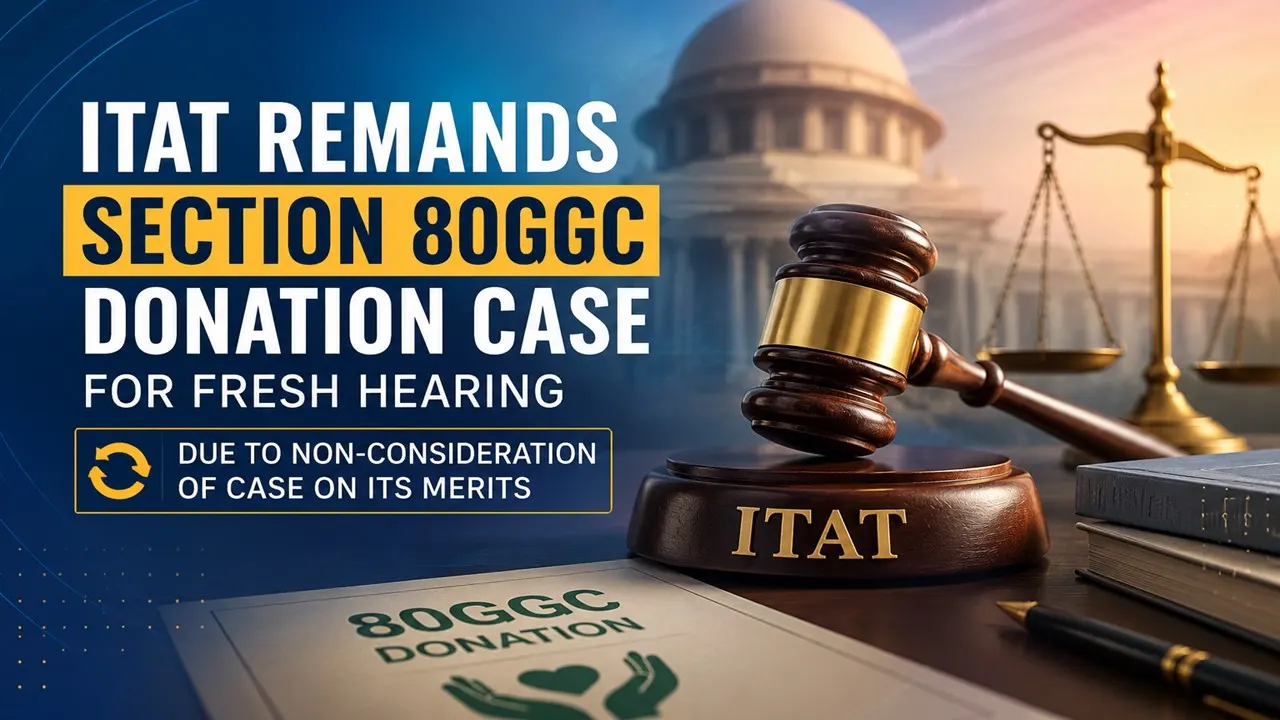
The ITAT remanded the case of the Section 80GGC exemption claim, holding that the CIT(A) had dismissed the appeal merely on the grounds of limitation, and the case was not heard on its merits.
ITAT Sends Section 80GGC Political Donation Case for Fresh Review
 Saloni Kumari
 Jun 30, 2026
ITAT Remands Section 80GGC Donation Case for Fresh Hearing Due to Non-Consideration of Case on Its Merits
The ITAT Mumbai remanded the case of a bogus exemption claim under Section 80GGC on the donations made to a political party. The tribunal held that the lower appellate authority had dismissed the appeal of Sarika Ravka merely on the grounds of limitation, and the case was not heard on its merits.
During the year under consideration, i.e., Assessment Year 2019-20, the assessee (Sarika Ravka) had donated Rs 5 lakh to a political party named Rashtriya Samajwadi Party (Secular) [RUPP] and, accordingly, had claimed full exemption on the same under Section 80GGC of the Income Tax Act.
The Assessing Officer (AO) had received a report from the Investigation Wing that the RUPP was involved in a fraud where they used to collect donations from interested parties so that they could claim a 100% exemption on such donations, which ultimately reduced their overall tax liability.
Considering the same findings, the AO treated the entire Rs 5 lakh donation as fake and made an addition of the same to the assessee's income. The assessee, dissatisfied with the aforementioned action of the AO, filed an appeal before the lower appellate authority, i.e., the CIT(A), with a 5-day delay. However, her appeal was dismissed merely on the grounds of limitation, and the impugned addition was sustained. Thereafter, the assessee approached the Income Tax Appellate Tribunal (ITAT) Mumbai.
When the tribunal examined the facts in the present case and heard the arguments from both sides, it noted that when the assessee filed an appeal before the CIT(A), she had not sought the condonation of the delay. Additionally, the dismissal of the assessee's appeal by the lower appellate authority was merely on the grounds of limitation, and the case was not heard on its merits. Accordingly, the tribunal found it fair to restore the case before the CIT(A) for fresh adjudication.
The assessee had been instructed to file a proper application seeking the condonation of delay along with an attached affidavit. The CIT(A) must thereafter consider the assessee's application for condonation of delay in accordance with law and pass a reasoned and speaking order after granting a fair opportunity of hearing to the assessee. In conclusion, the appeal is allowed for statistical purposes.
About Author


Saloni Kumari
Content Writer
Saloni is a Content Writer with 2+ years of experience at studycafe.in. She writes legal, taxation, and finance related content including GST, Income Tax etc. Skilled in translating complex judicial pronouncements and regulatory developments into clear, and reader-friendly articles. Experienced in covering judgements of ITAT, High Court, GSTAT, and news related to Income Tax, GST, and corporate law. She can be reached at [email protected].
Saloni is a Content Writer with 2+ years of experience at studycafe.in. She writes legal, taxation, and finance related content including GST, Income Tax etc. Skilled in translating complex judicial pronouncements and regulatory developments into clear, and reader-friendly articles. Experienced in covering judgements of ITAT, High Court, GSTAT, and news related to Income Tax, GST, and corporate law. She can be reached at [email protected].
 StudyCafe
 Delhi, Delhi, India
 2961
2961My Recent Articles
- GSTAT Sets Aside Ex Parte GST Appeal Order After First Appellate Authority Ignores Taxpayer’s Arguments
- GSTAT Sets Aside Non-Speaking GST Appellate Order, Remands Case Over Failure to Meet 80% Registered Procurement Requirement
- Sakshi Chandak Secures AIR 1 in CA Intermediate September 2026 Exam with 83.67% After Studying Up to 16 Hours a Day
- MCA Releases List of Companies Struck Off Under Section 248(2) for September 2026 at mca.gov.in
- ITAT Deletes Section 43 Penalty for Non-Disclosure of Foreign Assets in Schedule FA
Up Next
Loading suggestions…


Recent Posts

All Posts


Recent Posts
All Posts