ITR Filing 2025: How to Choose Between ITR 1 and 2?:
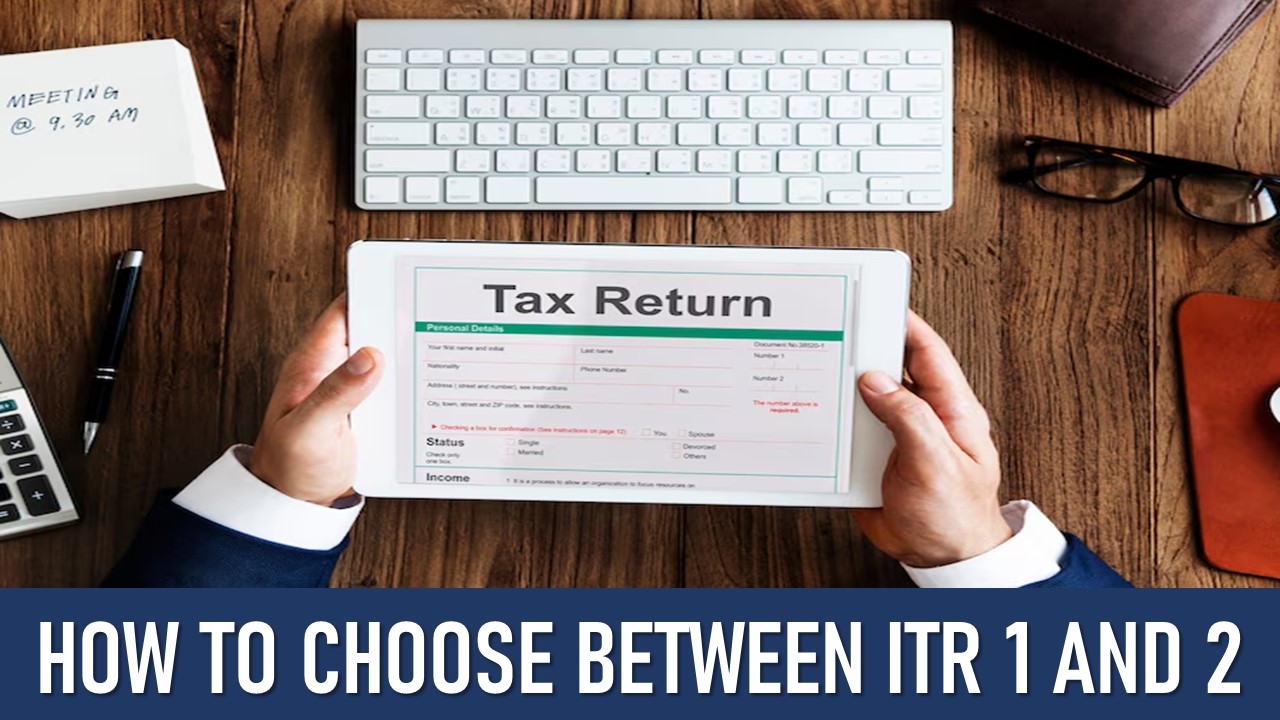
Know the eligibility criteria for ITR-1 and ITR-2 to help you choose between ITR-1 and ITR-2.
Who can File ITR-1 and ITR-2?
 Nidhi
Nidhi May 31, 2025
Table of Contents

ITR Filing 2025: How to Choose Between ITR 1 and 2?
The Income Tax Department has officially started the 2025-26 tax return filing season by releasing all Income Tax Return (ITR) forms earlier this month. Salaried individuals will need to wait until their Form 16 is out in June. However, they can still start preparation, which is time-consuming, by checking the changes in the ITR forms. Many of these modifications are due to changes announced in tax slabs and capital gains tax rationalization in the July 2024 budget.
For example, up until last year (AY 2024-25), Indian taxpayers who were ordinary residents could use ITR-1 (Sahaj) only if their income came from sources like salary or pension, one house property, interest, dividends, and agricultural income below Rs. 5,000.
But from this year, even those who have long-term capital gains (LTCG) from selling listed shares or equity mutual funds (taxed at 12.5%) can use ITR-1 if gains are not more than Rs. 1.25 lakh in the financial year 2024-25. Let us understand how you can choose between ITR-1 and ITR-2.
ITR-1: When to Use ITR-1
ITR-1 (Sahaj) is a simple ITR form that is used by salaried individuals and pensioners with simple financial dealings. The form is mostly pre-filled with your personal and income details, making it easier and faster to file. You just need to cross-check the ITR data with Form 16, Bank statements, Form 26AS, and Annual Information Statement (AIS). ITR-1 can be used by only resident (and ordinarily resident) individuals having an income up to Rs. 50 lakh. Income sources can include Salary or pension, One house property (if there is no carried-forward loss), Agricultural income up to Rs 5,000, Interest, dividends, and family pension. If you have a long-term capital gain of up to Rs. 1.25 lakh from listed shares or equity mutual funds under Section 112A, you can still use ITR-1.ITR-2: When to Use ITR-2
Individuals or pensioners who cannot file returns using ITR-1 can opt for ITR-2. Here are the conditions that make you ineligible to use ITR-1:- Your total income is more than Rs 50 lakh.
- Your capital gains under section 112A are more than Rs 1.25 lakh.
- You have unlisted equity shares.
- You have deferred tax on ESOPs (Employee Stock Option Plans).
- You have any foreign accounts or assets (including financial interest in any entity)
- You are a director of a company.
- If you have brought forward a loss or want to carry forward a loss under any head of income
- You have foreign income during the financial year.
About Author


Nidhi
Content Writer
Nidhi is a skilled content writer specializing in personal finance. She creates clear, engaging articles on mutual funds, investments, insurance, and wealth-building strategies. With a passion for simplifying complex financial topics, Nidhi helps readers make informed money decisions with confidence. She can be reached at [email protected]
Nidhi is a skilled content writer specializing in personal finance. She creates clear, engaging articles on mutual funds, investments, insurance, and wealth-building strategies. With a passion for simplifying complex financial topics, Nidhi helps readers make informed money decisions with confidence. She can be reached at [email protected]
 Studycafe
 New Delhi, Delhi, India
 1832
1832My Recent Articles
- Karnataka High Court Gives Another Chance in GST Matter Due to Lack of Hearing
- Delay Should Be Condoned if Explanation is Unrefuted: ITAT
- Non-Service of Income Tax Notice, Ill health of taxpayer, ITAT condones Appeal filing delay
- Books of Accounts Cannot be Rejected Without Any Specific Defect: ITAT Kolkata
- Karnataka High Court Sends ITC Matter Back to GST Authorities for Reconsideration
Up Next
Loading suggestions…


Recent Posts


All Posts


Tags
No tags yet.
Recent Posts
All Posts
Tags
No tags yet.