Key Compliance Requirements for Foreign Remittances: Overview of Forms 15CA and 15CB:
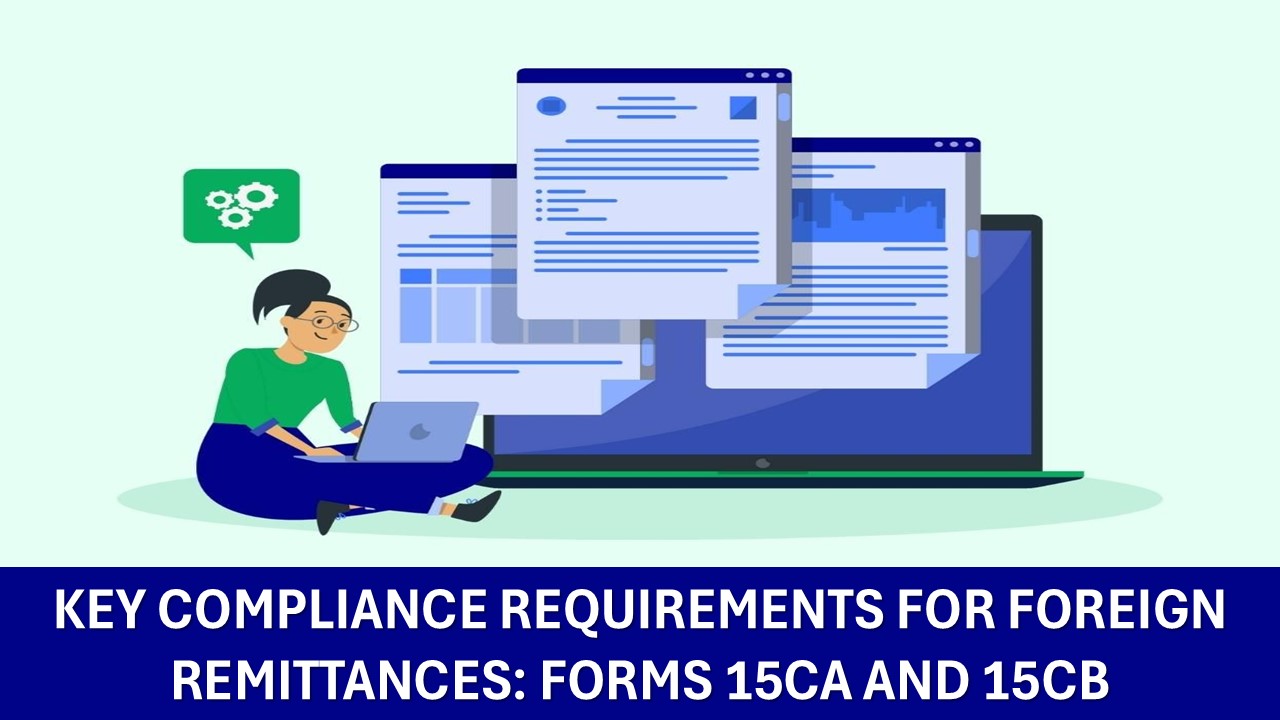
A simplified guide to Forms 15CA and 15CB, explaining their purpose, filing process, exemptions, and tax compliance requirements for foreign remittances.
Essential Guide to Tax Forms for Sending Money Abroad
 Saloni Kumari
 May 21, 2025
Table of Contents

Key Compliance Requirements for Foreign Remittances: Overview of Forms 15CA and 15CB
Tax authorities in India closely keep an eye on foreign remittances in order to avoid tax evasion and ensure compliance with international financial reporting norms. There are two major types of forms (Form 15CA and Form 15CB). These forms play an important role in this process. Individuals and business owners use these compulsory forms under certain conditions for making transactions to non-residents, as governed by the Income Tax Act, 1961, and related rules.
As per Section 195 of the Income Tax Act 1961, every person liable for making a payment to non residents shall deduct TDS from the payments made or credits given to non-residents at the rates in force.
Mechanism of form 15CA
The mechanism of form 15CA was introduced via rule 37BB of the Income Tax Act, so as to enable the person responsible for making foreign remittance to give information on foreign remittance & deduct TDS at the rates in force.
We can also say that the role of TDS return is played by form 15CA in case of foreign remittance.
Also the Reserve Bank of India has also mandated that except in cases of certain personal remittances which have been specifically exempted, no remittance should be made to a non-resident without furnishing an undertaking in Form 15CA accompanied by a certificate from a Chartered Accountant in Form 15CB if applicable.
Here is mentioned the simple terms why Forms 15CA and 15CB are needed, who should fill them out, how to file them, and what can happen if you don’t follow the rules.
If a bank asks for Form 15CA for any of these exempt payments, the person sending the money can give a simple declaration instead. This declaration explains why the payment is exempt, facilitates avoiding filing forms that are not needed.
What is the meaning of Forms 15CA and 15CB?
As per Section 195 of Income tax Act, 1961, every person liable for making a payment to non-residents shall deduct TDS from the payments made to non-residents if such sum is chargeable to Income tax then the withholding tax need to be deducted and form 15CA and 15CB are the declaration for the same. A person making the remittance to a Non Resident or a Foreign Company has to submit the form 15CA. Form 15CA is a type of form that an individual sending money (the remitter) is required to fill in. It’s a way of informing the Income Tax Department that tax has been paid or taken care of before tranferring money to someone outside India. Form 15CB is a certificate given by a Chartered Accountant (CA). It confirms that the money being sent is per the Indian tax rules, especially the rule about deducting tax when paying non-residents (Section 195). It also checks if any tax treaties with other countries apply. This form is required when payment exceeds Rs. 5 lakh.Why are these forms used for?
In accordance with Rule 37BB of the Income Tax Rules, these forms are usually used for the remittances that are applicable to tax in the country (India). The exemptions are as follows: Applicability and Thresholds:| Condition | Form/Part to File | Details |
| Remittance not chargeable to tax (e.g., imports, education) | None required | Covered under exemptions in Rule 37BB |
| Taxable remittance < ₹5 lakh in a financial year | Form 15CA – Part A | Simple declaration for smaller payments |
| Taxable remittance > ₹5 lakh with AO certificate | Form 15CA – Part B | Requires Assessing Officer’s certificate under Sections 195(2)/195(3)/197 |
| Taxable remittance > ₹5 lakh without AO certificate | Form 15CA – Part C + Form 15CB | Requires CA certificate confirming tax compliance |
| Remittance not chargeable but falling under a specified exemption (Rule 37BB) | Form 15CA – Part D | Applies to categories listed in Rule 37BB |
Exemptions and Special Cases:
The number of cases where Forms 15CA and 15CB are 33.| Sl. No. | Purpose code as per RBI | Nature of payment |
| 1 | S0001 | Indian investment abroad - in equity capital (shares) |
| 2 | S0002 | Indian investment abroad - in debt securities |
| 3 | S0003 | Indian investment abroad - in branches and wholly owned subsidiaries |
| 4 | S0004 | Indian investment abroad - in subsidiaries and associates |
| 5 | S0005 | Indian investment abroad - in real estate |
| 6 | S0011 | Loans extended to Non-Residents |
| 7 | S0101 | Advance payment against imports |
| 8 | S0102 | Payment towards imports - settlement of invoice |
| 9 | S0103 | Imports by diplomatic missions |
| 10 | S0104 | Intermediary trade |
| 11 | S0190 | Imports below Rs.5,00,000 - (For use by ECD offices) |
| 12 | SO202 | Payment for operating expenses of Indian shipping companies operating abroad |
| 13 | SO208 | Operating expenses of Indian Airlines companies operating abroad |
| 14 | S0212 | Booking of passages abroad - Airlines companies |
| 15 | S0301 | Remittance towards business travel |
| 16 | S0302 | Travel under basic travel quota (BTQ) |
| 17 | S0303 | Travel for pilgrimage |
| 18 | S0304 | Travel for medical treatment |
| 19 | S0305 | Travel for education (including fees, hostel expenses, etc.) |
| 20 | S0401 | Postal services |
| 21 | S0501 | Construction of projects abroad by Indian companies including import of goods at project site |
| 22 | S0602 | Freight insurance - relating to import and export of goods |
| 23 | S1011 | Payments for maintenance of offices abroad |
| 24 | S1201 | Maintenance of Indian embassies abroad |
| 25 | S1202 | Remittances by foreign embassies in India |
| 26 | S1301 | Remittance by non-residents towards family maintenance and savings |
| 27 | S1302 | Remittance towards personal gifts and donations |
| 28 | S1303 | Remittance towards donations to religious and charitable institutions abroad |
| 29 | S1304 | Remittance towards grants and donations to other Governments and charitable institutions established by the Governments |
| 30 | S1305 | Contributions or donations by the Government to international institutions |
| 31 | S1306 | Remittance towards payment or refund of taxes |
| 32 | S1501 | Refunds or rebates or reduction in invoice value on account of exports |
| 33 | S1503 | Payments by residents for international bidding. |
Filing Process:
Form 15CA- It must be filed before making the remittance.
- Can be submitted online via the Income Tax e-Filing portal or offline, though online filing is preferred for efficiency.
- Requires e-verification via Digital Signature Certificate (DSC) or Electronic Verification Code (EVC).
- Accompanying documents include:
- Invoices
- Tax Residency Certificate (TRC)
- Form 10F
- Service agreements or contracts
- Can be withdrawn within the time period of 15 days of submission for rectification or amendment.
- Should be issued by a CA registered with the Income Tax Department.
- E-verification is mandatory using the CA's DSC.
- Nature and purpose of the payment
- Applicable TDS rate under domestic law or DTAA
- Section 195 compliance
- Taxability analysis
- It is a mandatory requirement for filing Part C of Form 15CA, where relevant.
Common Situations Where Form 15CS/15CB are used:
Form 15CA and 13CB are commonly used in many situations. These situations are as follows:- Professional payments to foreign consultants or freelancers
- Royalty and license fee payments
- Interest or dividend payments to non-resident investors
- Commission to overseas agents
- Remittance of capital gains or business profits abroad
About Author


Saloni Kumari
Content Writer
Saloni is a Content Writer with 2+ years of experience at studycafe.in. She writes legal, taxation, and finance related content including GST, Income Tax etc. Skilled in translating complex judicial pronouncements and regulatory developments into clear, and reader-friendly articles. Experienced in covering judgements of ITAT, High Court, GSTAT, and news related to Income Tax, GST, and corporate law. She can be reached at [email protected].
Saloni is a Content Writer with 2+ years of experience at studycafe.in. She writes legal, taxation, and finance related content including GST, Income Tax etc. Skilled in translating complex judicial pronouncements and regulatory developments into clear, and reader-friendly articles. Experienced in covering judgements of ITAT, High Court, GSTAT, and news related to Income Tax, GST, and corporate law. She can be reached at [email protected].
 StudyCafe
 Delhi, Delhi, India
 2924
2924My Recent Articles
- Major Relief in Arbitration Case: MCIA Denies Rs 908 Crore Statement Claim Made by Allied Silica Against Tata Chemicals
- MCA and ICSI to Hold User Awareness Session on Form AOC-4 Filing Amid Glitches on MCA-21 Version-3 Portal
- GSTN Introduces New E-Invoicing Facility for Self-Invoices Under Reverse Charge Mechanism
- Flexi Cap vs Multi Cap Funds: What's the Real Difference?
- IBA Recommends Public Sector Banks to Reduce Ambit of Physical Branch Audits to 50% of Total Business
Up Next
Loading suggestions…


Recent Posts

All Posts


Tags
No tags yet.
Recent Posts
All Posts
Tags
No tags yet.