Mere Non-submission of Export Invoices and FIRC Cannot Be Ground of GST Refund Rejection: HC:
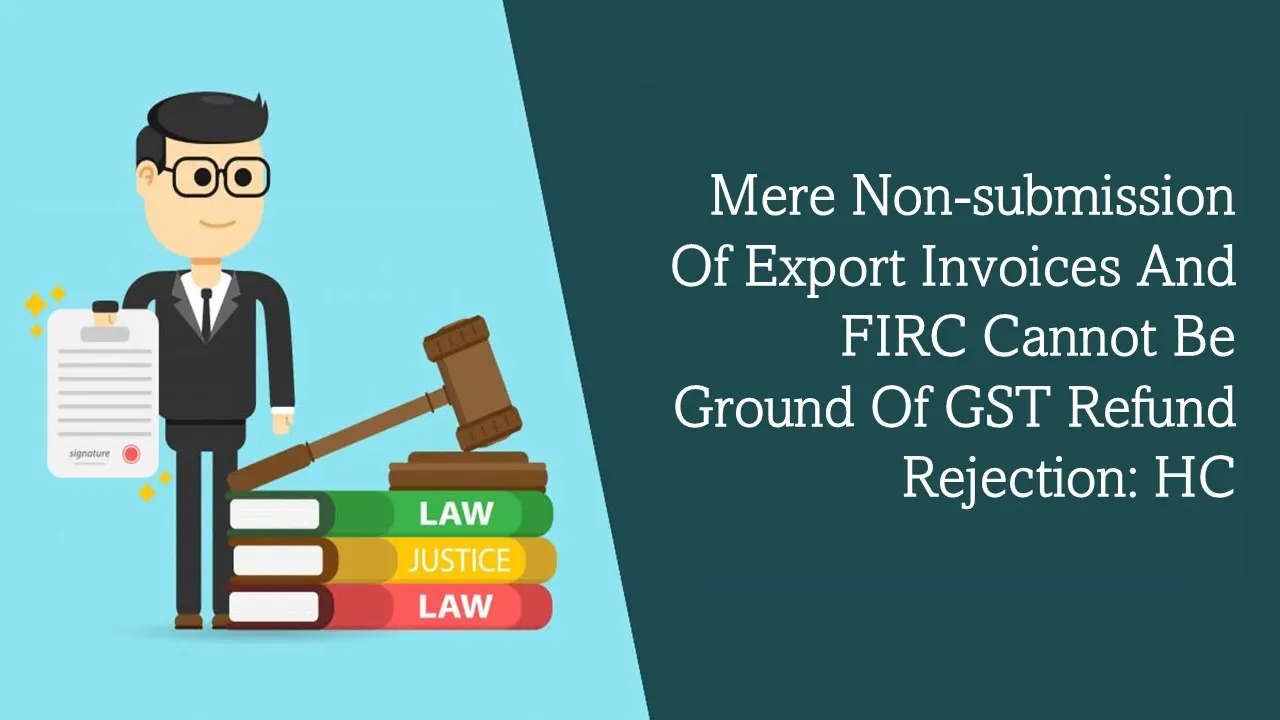
HC rules that GST refund cannot be denied solely for not submitting FIRC or export invoices when export services and foreign payments are proven.
Court Says Technical Lapses Can’t Deny Legitimate GST Export Refunds
 CA Pratibha Goyal
 Jun 5, 2025
Mere Non-submission of Export Invoices and FIRC Cannot Be Ground of GST Refund Rejection: HC
The petitioner is engaged in the business of providing opinions on equity and futures markets, trading stocks, and options based on stock and share markets.
The petitioner has remitted Goods and Services Tax (GST) for the services rendered to its clients/customers. According to the petitioner, predominantly all the clients/customers of the petitioners are from the U.S and the neighbouring countries.
Petitioner receives payment via PayPal in USD, which was then routed to Citibank (PayPal’s banker) and converted to INR before being credited to the petitioner’s HDFC bank account.
The petitioner claimed this constituted an "export of service" under Section 2(6) of the Integrated Goods and Services Tax (IGST) Act, 2017.
Refund claims under Section 54 of the CGST Act read with Section 16 of the IGST Act were rejected by the Department on two grounds: (i) non-receipt of foreign exchange directly, as the petitioner failed to produce FIRC and (ii) absence of export invoices. This was upheld by the appellate authority.
Petitioner Submission:
The petitioner is a startup company and is in the process of expanding and growing its business. In such circumstances, the petitioner is relying on the tax refund as one of the sources of recycling funds in the business. With the limited capital, the petitioner intricately manages its finances.
It is submitted that the petitioner has proven beyond a reasonable doubt that the service recipient is outside the country and that the money was in fact received in foreign exchange. In any event, mere technical breaches, assuming without admitting did exist, cannot be the reason for the denial of the claim.
It is submitted that, according to the petitioner, PayPal is acting as a gateway and receiving payment from subscribers in foreign currency into India and transferring the money to the assessee in Indian Rupees. Hence, the provisions provided in RBI master circular No.14/2015-16 dated 01.07.2015 are not applicable.
The routing of the payment by the intermediary viz., Paypal from its account in CITI Bank to the petitioner's own account with HDFC Bank in Indian Rupees is in accordance with the provisions of the Foreign Exchange Management (Manner of Receipt and Payment) Regulations, 2016 as notified by Notification No: FEMA 14(R)/2016-RB dated 02.05.2016. Regulation 3 prescribes the manner of receipt of foreign exchange.
Decision of High Court
The court agreed that there is no dispute regarding the services provided by the petitioner to its foreign clients. The petitioner has provided the export services within the meaning of Section 2(b) of the IGST Act, 2017. Paypal merely acts as an intermediary that receives the remittances in freely convertible foreign exchange and in as much required to comply with the requirements of the foreign exchange.
Merely because the receipts are routed through the intermediary and received in Indian currency ipso facto would not mean that the petitioner has not exported services within the meaning of Section 2(6) of the IGST Act, 2017. Receipt of payment by an intermediary for and on behalf of its client, like the petitioner, will qualify as payment received by the client. As the only requirement is that the payments received are freely convertible, foreign exchange has to be directly remitted into the authorised dealer's account, as otherwise an intermediary will be violating the requirements of the foreign exchange.
Regulation 3(3) of the Foreign Exchange Management (Manner of Receipt and Payment) Regulations, 2016 makes it clear that the authorized dealers have been permitted to allow receipts for export of goods/software to be received from a Third Party (a party other than the buyer) as per the guidelines issued by the Reserve Bank.
Thus, without doubt, the petitioner is entitled to a refund. Reference to Circular No.88/07/2019-GST dated 01.02.2019, to concluded that the petitioner has not realised the amount in freely convertible foreign exchange, therefore cannot be countenanced.
About Author


CA Pratibha Goyal
Co Founder
CA Pratibha Goyal is Chartered Accountant qualified in 2016, is a Member of The Institute of Chartered Accountants of India having wide experience in the field of Auditing, Taxation, ROC, GST and Secretarial matters etc.
She has written over a thousand articles & has made several videos on topics related to Auditing & Taxation. As a Speaker she has delivered various sessions on various branches of NIRC of ICAI.
CA Pratibha Goyal is Chartered Accountant qualified in 2016, is a Member of The Institute of Chartered Accountants of India having wide experience in the field of Auditing, Taxation, ROC, GST and Secretarial matters etc.
She has written over a thousand articles & has made several videos on topics related to Auditing & Taxation. As a Speaker she has delivered various sessions on various branches of NIRC of ICAI.
 Studycafe
 New Delhi, Delhi, India
 1486
1486My Recent Articles
- Biggest Labour Reform in Indian History: 4 Labour Codes Effective from today
- Tax Audit and ITR Due date not extended in this case: Know More
- Government notifies Agreement and Protocol between India and Qatar [Read Notification]
- CA Breaking: Results of ICAI Examination to be announced soon, Know probable Date
- Breaking: GSTR-3B Due Date for September 2025 extended by CBIC amid Diwali Festivities
Up Next
Loading suggestions…


Recent Posts

All Posts


Tags
No tags yet.
Recent Posts
All Posts
Tags
No tags yet.