Only Self-Grown Coffee Qualifies for Agricultural Income Benefit, Rules ITAT Bangalore:
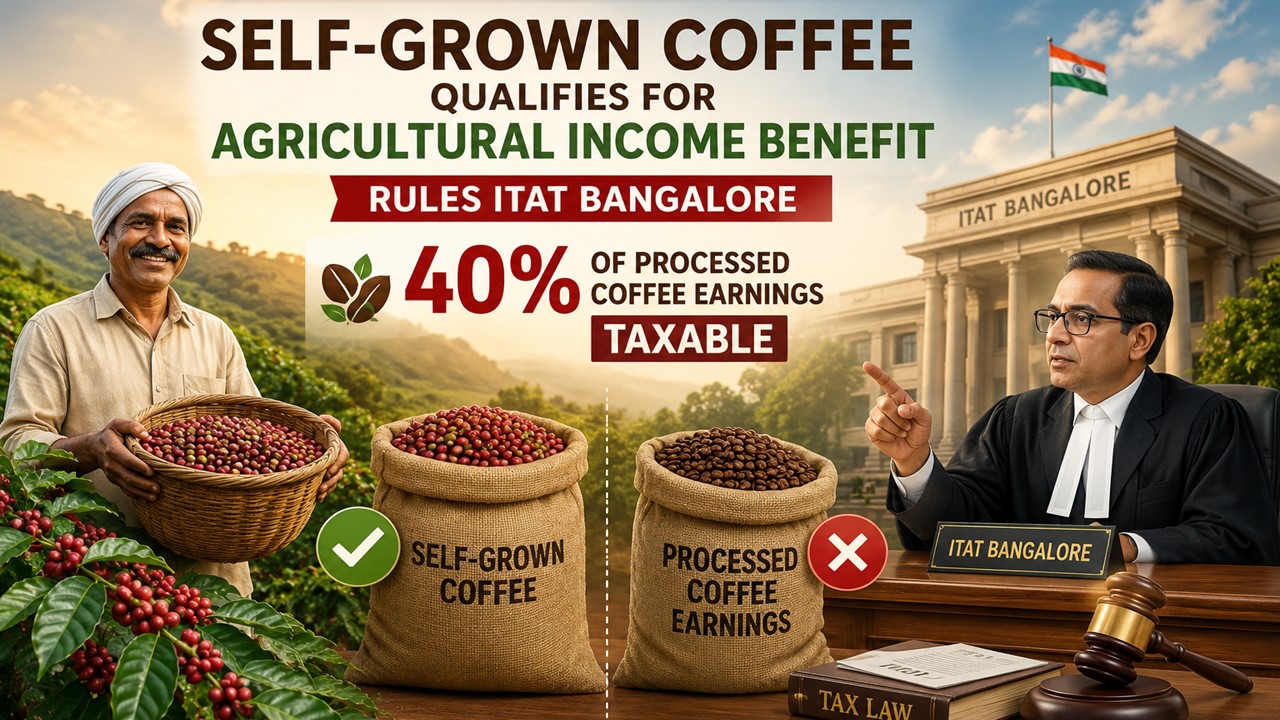
The ITAT held that income from self-grown and processed coffee is partly taxable under Rule 7B, while income from coffee purchased from external growers cannot be treated as agricultural income.
40% of Processed Coffee Earnings Taxable: ITAT
 Saloni Kumari
 May 13, 2026
Only Self-Grown Coffee Qualifies for Agricultural Income Benefit, Rules ITAT Bangalore
The ITAT ruled that Rule 7B applies to income from self-grown, cured, roasted, and processed coffee, making 40% taxable as business income. Income from coffee purchased from external growers cannot qualify as agricultural income and must be separately identified.
The ITAT Bangalore has recently delivered a significant ruling in a case involving the taxation on income generated by the agriculture of coffee. The assessee, Bennur Siddegowda Santhosh, is engaged in the agriculture of coffee and also runs a proprietary concern named Mudramane Coffee Curers, which purchases, cures, processes, and sells coffee.
While furnishing the income tax return (ITR), the assessee showed a total agricultural income of Rs 1.46 crore out of its total income of Rs 1.57 crore. He almost treated his entire income from coffee as agricultural income, which is exempt from tax. In conclusion, the tax authorities reopened the assessee's case on the grounds that "as per the provisions of income tax rules 7B sub-rule 1A, which states that income derived from the sale of coffee grown, cured, roasted and ground by the seller in India, with or without mixing chicory or other flavouring ingredients, shall be computed as if it were income derived from business and 40% of such income shall be deemed to be income liable to tax."
Consequently, the tax authorities held that 40% of the coffee production should be treated as business income. Accordingly, 40% of Rs 72.29 lakh, i.e., Rs 28.91 lakh, was treated as business income, while the remaining 60%, i.e., Rs 43.37 lakh, was treated as agricultural income. Hence, an addition amounting to Rs 28.91 lakh was made to the assessee's income.
However, the assessee argued that provisions of Rule 7 (a general provision for mixed agricultural and business income) should apply to the present case instead of Rule 7B. However, when the tribunal analysed this argument, it held that Rule 7B perfectly applies to the present case as it includes provisions related to the coffee business and thus overrides the general rule.
At the same time, the tribunal noted that the assessee’s proprietary concern had also purchased coffee from other growers. Income from processing and selling such purchased coffee cannot be treated as agricultural income because the coffee was not grown by the assessee.
In conclusion to the aforementioned findings, the tribunal remands the case to the tax authorities for fresh consideration. The assessee was directed to separately identify income from self-grown coffee and income from coffee purchased from outside growers. Hence, the appeals were allowed partly for statistical purposes.
About Author


Saloni Kumari
Content Writer
Saloni is a Content Writer with 2+ years of experience at studycafe.in. She writes legal, taxation, and finance related content including GST, Income Tax etc. Skilled in translating complex judicial pronouncements and regulatory developments into clear, and reader-friendly articles. Experienced in covering judgements of ITAT, High Court, GSTAT, and news related to Income Tax, GST, and corporate law. She can be reached at [email protected].
Saloni is a Content Writer with 2+ years of experience at studycafe.in. She writes legal, taxation, and finance related content including GST, Income Tax etc. Skilled in translating complex judicial pronouncements and regulatory developments into clear, and reader-friendly articles. Experienced in covering judgements of ITAT, High Court, GSTAT, and news related to Income Tax, GST, and corporate law. She can be reached at [email protected].
 StudyCafe
 Delhi, Delhi, India
 2879
2879My Recent Articles
- RBI Eases Foreign Exchange Compliance for Small Exporters and Freelancers
- GST Council Proposes Major Reforms in Registration, ITC, Refunds and Arrest Rules
- Govt Fixes 7.1% Interest Rate on Special Deposit Scheme for Non-Government PF Funds From Oct to Dec 2026
- CBI Apprehends Principal of Eklavya Model Residential School, Nuapada, for Demanding Rs 20,000 Bribe
- RBI Announces Exclusion of Paytm Payments Bank Limited from Second Schedule of RBI Act, 1934
Up Next
Loading suggestions…


Recent Posts

All Posts



Recent Posts
All Posts