Patna High Court Dismisses GST Penalty Plea Over Expired E-Way Bill During Transit:
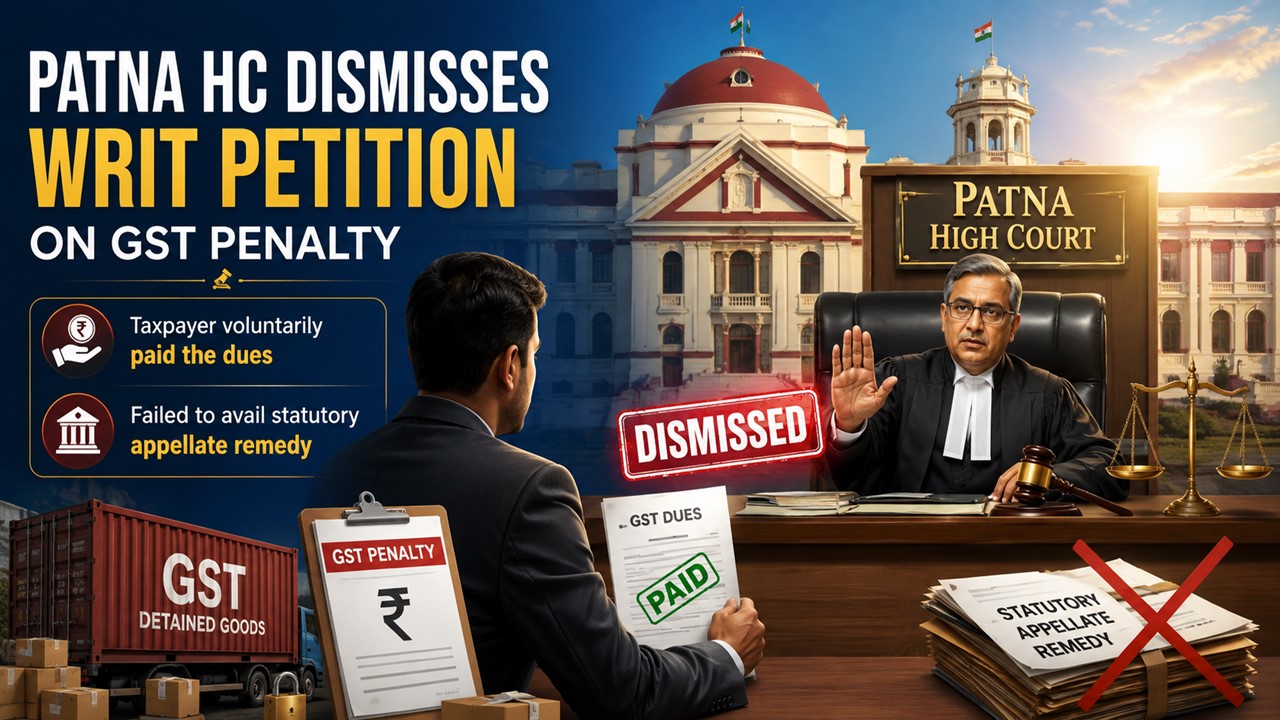
The Patna HC dismissed a writ petition challenging a GST penalty on detained goods, holding that the taxpayer had voluntarily paid the dues and failed to avail the statutory appellate remedy.
Expired E-Way Bill Due to Vehicle Breakdown Not Enough for Relief: HC
 Saloni Kumari
 May 16, 2026
Patna High Court Dismisses GST Penalty Plea Over Expired E-Way Bill During Transit
The Patna High Court dismissed a writ petition filed by M/S Kishan Cement Stores against the Bihar State Tax authorities regarding a GST penalty imposed during the transportation of goods.
In the case of the petitioner, the Deputy Commissioner of State Tax had detained a vehicle (bearing no. JH15AC794) carrying goods on October 11, 2025, vide an order of detention in Form GST MOV-06 and a notice in Form GST MOV-07, dated October 13, 2025. Thereafter, the concerned authorities initiated penalty proceedings in the case where the owner or person-in-charge of the vehicle had made the payment of the proposed tax and penalty.
However, during the personal hearing before the Patna High Court, the petitioner claimed that they were compelled to pay the levied penalty of about Rs 2 lakh under the Central Goods and Services Tax/Bihar Goods and Services Tax Act, 2017, along with interest deposited because the goods in question needed to be transported urgently for business purposes. Additionally, the tax authorities had not granted them a proper opportunity of hearing before levying the impugned penalty, which is an explicit contravention of the principles of natural justice under the CGST/BGST Act, 2017.
Further claimed that the detained goods were backed by an invoice and an e-way bill; however, the e-way bill had expired during transit because of a technical issue in the vehicle. The petitioner claimed that they did not have any intention of evading tax.
The tax authorities informed the court that after the detention of the vehicle in question, they had issued a notice in Form GST MOV-07. The owner later voluntarily paid the tax and penalty, after which the authorities released the goods and vehicle through Form GST MOV-05 dated October 13, 2025.
When the court analysed the case, it noted that the petitioner had paid the levied penalty and tax amount without raising any objections at the same time. It further noted that the GST law provides a statutory remedy of appeal within three months against such orders, but the petitioner failed to file any appeal and directly approached the High Court after about four months. Consequently, the Patna High Court dismissed the writ petition, holding that there was no clear violation of the principles of natural justice or a jurisdictional error.
About Author


Saloni Kumari
Content Writer
Saloni is a Content Writer with 2+ years of experience at studycafe.in. She writes legal, taxation, and finance related content including GST, Income Tax etc. Skilled in translating complex judicial pronouncements and regulatory developments into clear, and reader-friendly articles. Experienced in covering judgements of ITAT, High Court, GSTAT, and news related to Income Tax, GST, and corporate law. She can be reached at [email protected].
Saloni is a Content Writer with 2+ years of experience at studycafe.in. She writes legal, taxation, and finance related content including GST, Income Tax etc. Skilled in translating complex judicial pronouncements and regulatory developments into clear, and reader-friendly articles. Experienced in covering judgements of ITAT, High Court, GSTAT, and news related to Income Tax, GST, and corporate law. She can be reached at [email protected].
 StudyCafe
 Delhi, Delhi, India
 2889
2889My Recent Articles
- ITAT Sets Aside Rejection of Charitable Trust’s Section 12AB Registration Application, Remands Case to CIT(E) for Fresh Consideration
- Can Same-Sex Partners Claim Tax Exemption on Gifts as Spouses? Karnataka High Court to Examine
- ITAT Remits Section 80G Renewal Application to CIT(E) for Fresh Consideration in Light of CBDT Circular
- Dreamfolks Services Faces Rs 1.58 Crore IGST Demand Over ITC Availment on Invoices Issued by GST-Cancelled Supplier
- ITAT Restores Taxpayer's Appeal In Interest of Natural Justice After CIT(A)'s Failure to Decide Appeal on Merits
Up Next
Loading suggestions…


Recent Posts
All Posts

Recent Posts
All Posts