High Court Upholds GST Penalty for E-Way Bill Misdeclaration During Transit:
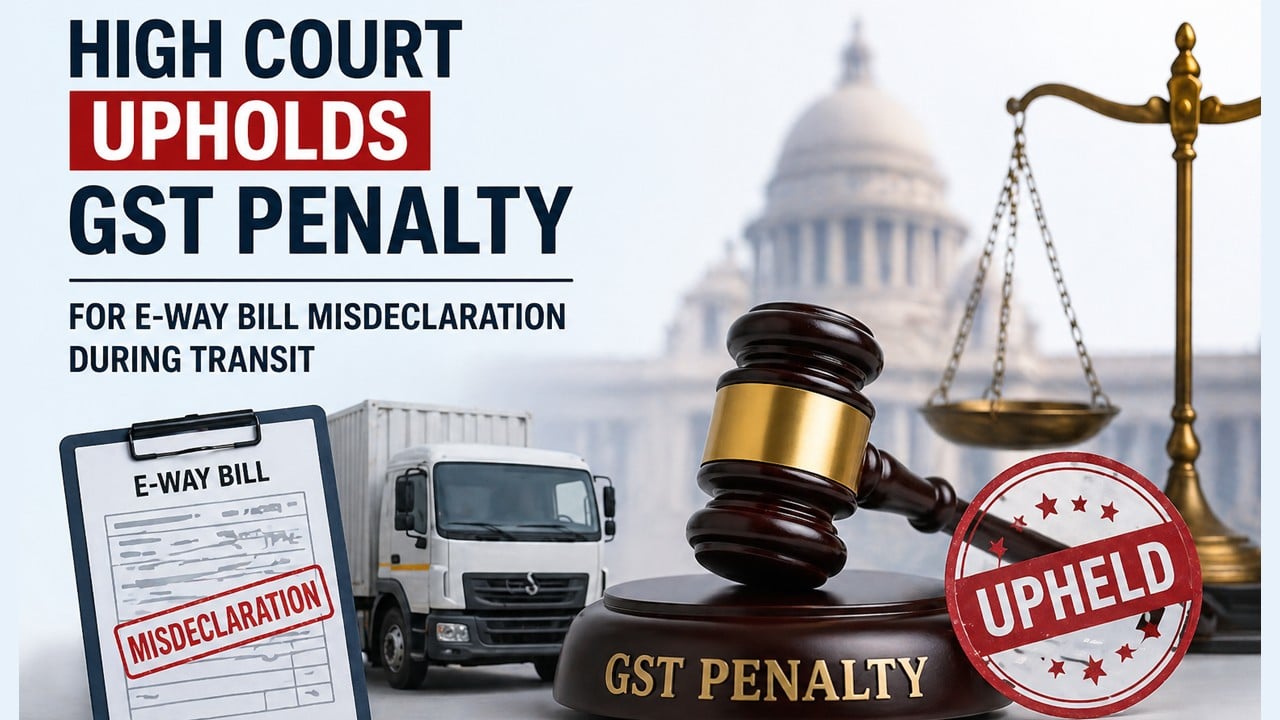
Court confirms penalty for URP misdeclaration and defective documents during inter-state goods transit.
Misdeclaration as unregistered person and invalid delivery challan justified detention and penalty .
 Meetu Kumari
 Apr 27, 2026
High Court Upholds GST Penalty for E-Way Bill Misdeclaration During Transit
The appellant, a sole proprietor engaged in leasing construction machinery, arranged transportation of a hydraulic excavator from Jharkhand to Meghalaya through West Bengal. During transit, the vehicle was intercepted by State GST authorities in West Bengal. On inspection, it was found that the appellant—despite being a registered taxpayer—had declared himself as an “Unregistered Person (URP)” in the e-way bill. Further, the delivery challan accompanying the goods was signed by the driver and not by an authorised signatory of the appellant. The authorities treated this as a contravention under Section 129 of the GST Act and detained the goods. Penalty proceedings were initiated and confirmed by the adjudicating authority as well as the appellate authority. The writ petition challenging the same was dismissed by the Single Judge, leading to the present appeal.
Main Issue: Whether the GST authorities of a transit state (West Bengal) had jurisdiction to detain goods merely passing through; misdeclaration as URP and improper documentation justified penalty under Section 129.
HC's Ruling: The High Court dismissed the appeal and upheld the penalty. The Court held that GST officers in West Bengal were fully empowered to intercept and detain goods in transit due to the principle of cross-empowerment under GST laws. The argument that the State was merely a “transport corridor” was rejected. On merits, the Court found that declaring a registered person as an unregistered person in the e-way bill was a clear false declaration. Whether intentional or not was irrelevant, as mens rea is not essential in tax evasion matters.
The Court further held that the driver could not be treated as an authorised signatory of the appellant. The delivery challan, therefore, was defective and not in compliance with statutory requirements. Importantly, the Court observed that such discrepancies create doubt regarding the genuineness of the transaction and can justify detention and penalty even without direct evidence of tax evasion. Accordingly, the order of the Single Judge and the penalty under Section 129 were upheld.
To Read Full Judgment, Download PDF Given Below.
About Author


Meetu Kumari
Content Manager
Meetu Kumari is an Experienced Advocate and Content Writer with 4+ years of demonstrated history of working in the law practice industry. Skilled in Developing Content, Researching, and Drafting. Strong professional with a Bachelor of Science (B.Sc.) focused on Law from Gujarat National Law University.
Meetu Kumari is an Experienced Advocate and Content Writer with 4+ years of demonstrated history of working in the law practice industry. Skilled in Developing Content, Researching, and Drafting. Strong professional with a Bachelor of Science (B.Sc.) focused on Law from Gujarat National Law University.
 Studycafe
 Jodhpur, Rajasthan, India
 2264
2264My Recent Articles
- ITAT Condones 302-Day Delay, Restores Salary Assessment for Fresh VerificationPremium
- ITAT Condones Delay After Tax Consultant's Death, Restores Appeals for Fresh HearingPremium
- ITAT Remands Salary Addition, Says Taxability Depends on Salary Becoming Due, Not Mere ReceiptPremium
- ITAT Deletes TP Royalty Adjustment, Orders Fresh Review of Commission BenchmarkingPremium
- ITAT Quashes Reassessment Over Unsigned Section 148 Notice Issued to AssesseePremium
Up Next
Loading suggestions…


Recent Posts

All Posts


Recent Posts
All Posts