Reassessment Quashed: ITAT Rules Notice to Deceased Taxpayer Invalid:
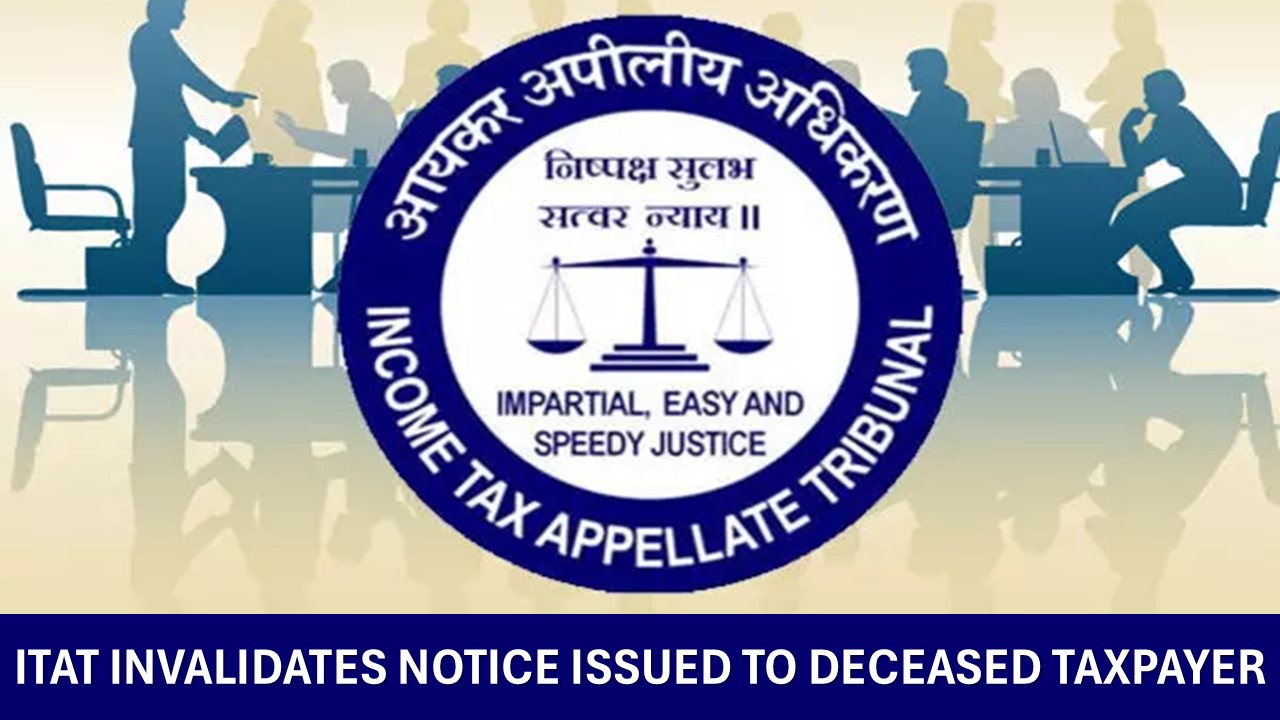
ITAT Delhi ruled that the income tax reassessment notice issued to a deceased taxpayer is invalid, quashing the case in Pranav Gupta’s appeal.
ITAT Invalidates Notice Issued to Deceased Taxpayer in Capital Gains Case
 Saloni Kumari
 Jun 24, 2025
Reassessment Quashed: ITAT Rules Notice to Deceased Taxpayer Invalid
The case is regarding an Income Tax conflict that was taken to the Income Tax Appellate Tribunal (ITAT) in Delhi (ITA No. 2192/Del/2023). The case relates to the assessment year 2009-10. The conflict is between the Deputy Commissioner of Income Tax (DCIT) and Mr. Pranav Gupta, the legal heir of the late Shri Vijay Kumar Gupta. Background of Case An income tax return was filed by Shri Vijay Kumar on July 22, 2009, announcing a total income of around Rs. 2.09 crores (long-term capital gain (LTCG) from the sale of his house property in Greater Kailash, New Delhi, included). The sale of the house property was valued at Rs. 2.75 crores. This ITR was accepted without any inspection under Section 143(1) of the Income Tax Act. On October 2, 2025, the original taxpayer, i.e., the late Shri Vijay Kumar Gupta, expired. Later, the income tax department conducted a search in 2013, where it found some evidence related to the deed writer whose name is Naresh Gupta. The inspection revealed the house may have been sold at a much higher amount, around Rs. 9.90 crores, instead of Rs. 2.75 crores. On the basis of the inspection, the Assessing Officer (AO) reopened the case under Section 147/148 (used to reassess income if any income is believed to have escaped tax). After the notice was received by his son, named Pranav Gupta, he wrote to the Assessing Officer (AO) on April 19, 2016, informing them that the concerned person was already dead and asking them to drop the case. However, the case was still not quashed, and it further asked Pranav Gupta to file the return. Pranav Gupta filed the same old return that was earlier filed by his father and asked the authorities the reason why the case was reopened. In response, the AO showed two unregistered agreements displayed on the computer of Naresh Gupta. These agreements indicated possible undisclosed income; the believed actual sale value was Rs. 9.90 crores. Hence, the AO, after calculation, declared the LTCG as Rs. 8.71 crores and tried to add it to the income for taxation. Then, Pranav Gupta appealed to the Commissioner of Income Tax (Appeals), arguing: The notice was issued under Section 148, which is invalid as it was issued against a dead person. Section 159 of the Income Tax Act says that if a taxpayer dies, the legal heirs become a "deemed assessee," and notices must be issued within the proper time limit. However, the AO did not issue the fresh notice to the legal heir before the due date, i.e., March 31, 2016. Since the original notice itself was invalid, the entire reassessment proceeding was illegal. The CIT(A) agreed with this argument and quashed the entire reassessment, saying: The notice was not just a minor technical error, but it was a complete jurisdictional error. The case was similar to the earlier court rulings, including the SC, which also ruled the same, i.e., notices sent to dead people are considered invalid. ITAT Decision The ITAT examined the entire case and both aspects and dismissed the Income Tax Department's appeal, holding that the notice and the assessment were invalid from the beginning. The appeal filed by the Income Tax Department was dismissed. The addition of Rs. 8.71 crores to the income was deleted permanently. The tribunal held that all proceedings based on a notice to a dead person are void, and even the legal heir’s participation cannot make it valid. No further arguments were needed on the merits of the actual sale value or capital gain, since the entire case collapsed due to the invalid notice.
About Author


Saloni Kumari
Content Writer
Saloni is a Content Writer with 2+ years of experience at studycafe.in. She writes legal, taxation, and finance related content including GST, Income Tax etc. Skilled in translating complex judicial pronouncements and regulatory developments into clear, and reader-friendly articles. Experienced in covering judgements of ITAT, High Court, GSTAT, and news related to Income Tax, GST, and corporate law. She can be reached at [email protected].
Saloni is a Content Writer with 2+ years of experience at studycafe.in. She writes legal, taxation, and finance related content including GST, Income Tax etc. Skilled in translating complex judicial pronouncements and regulatory developments into clear, and reader-friendly articles. Experienced in covering judgements of ITAT, High Court, GSTAT, and news related to Income Tax, GST, and corporate law. She can be reached at [email protected].
 StudyCafe
 Delhi, Delhi, India
 2924
2924My Recent Articles
- Major Relief in Arbitration Case: MCIA Denies Rs 908 Crore Statement Claim Made by Allied Silica Against Tata Chemicals
- MCA and ICSI to Hold User Awareness Session on Form AOC-4 Filing Amid Glitches on MCA-21 Version-3 Portal
- GSTN Introduces New E-Invoicing Facility for Self-Invoices Under Reverse Charge Mechanism
- Flexi Cap vs Multi Cap Funds: What's the Real Difference?
- IBA Recommends Public Sector Banks to Reduce Ambit of Physical Branch Audits to 50% of Total Business
Up Next
Loading suggestions…


Recent Posts
All Posts
Recent Posts
All Posts