Supreme Court Holds AO Cannot Reopen Settlement Commission Order to Reassess Section 80IB(10) Deduction:
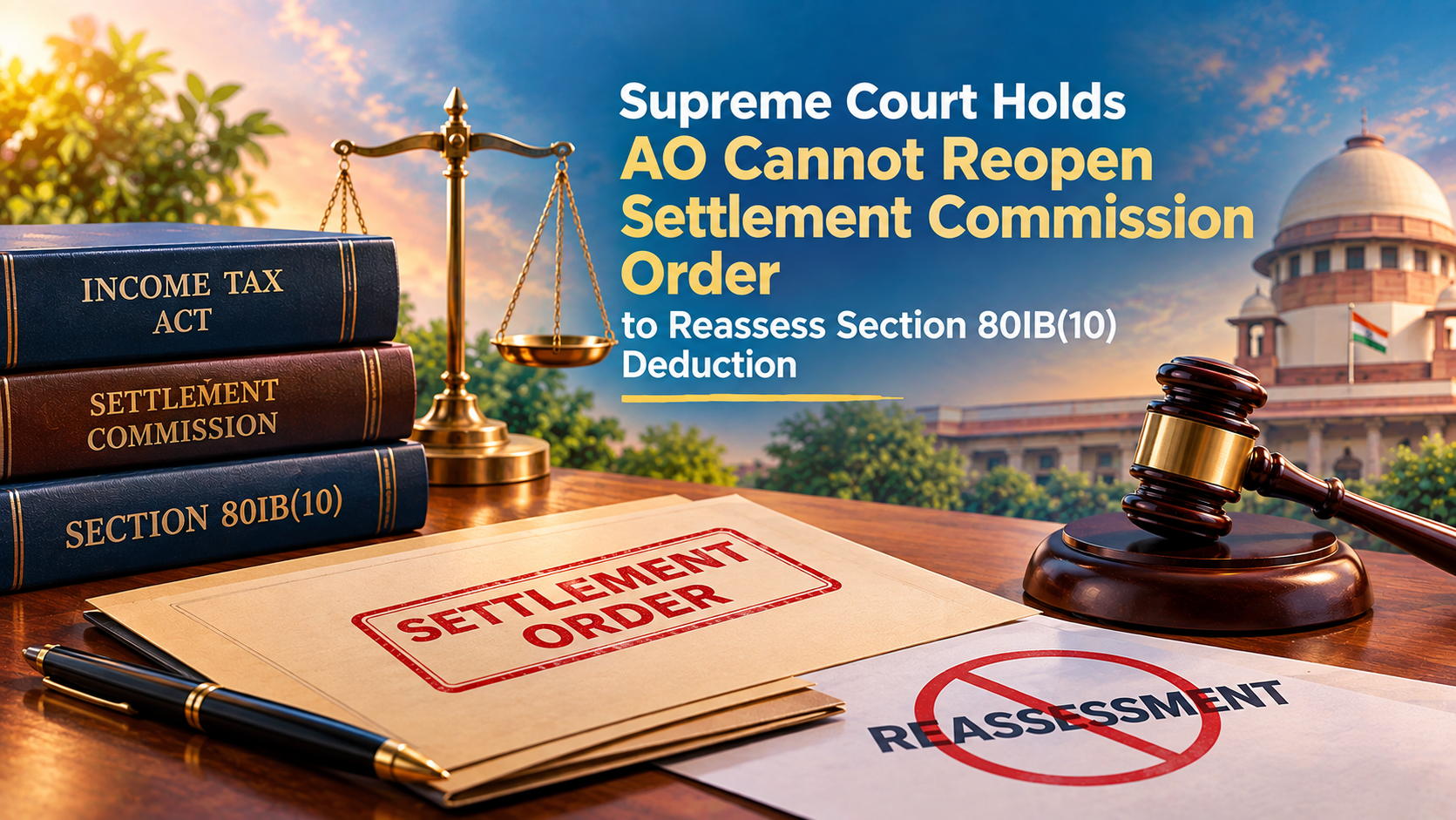
The Supreme Court holds once ITSC settlement order attains finality, AO cannot reopen covered issues under Section 148.
Supreme Court Dismisses Revenue’s Appeal
 Saima
Saima Sep 22, 2026
The Supreme Court considered whether the AO could reopen an assessment under Section 148 of the Income Tax Act, 1961, despite a final order passed by the Income Tax Settlement Commission (ITSC) under Section 245D(4), particularly in relation to a deduction claimed under Section 80IB(10).
M/s. Omaxe Limited is a public limited company engaged in the real estate business, had filed its return for Assessment Year 2006-07 declaring taxable income of Rs. 89.20 crore and claiming deduction of approximately Rs. 78.99 crore under Section 80IB(10) in respect of its housing projects. Subsequently, the assessee approached the Income Tax Settlement Commission under Section 245C for settlement of its tax liabilities for Assessment Years 2000-01 to 2006-07. The Settlement Commission passed its final order under Section 245D(4) on March 17, 2008. For AY 2006-07, it accepted additional income of Rs. 18 lakh and determined the total income after allowing the deductions claimed by the assessee.

Subsequently, the Revenue conducted a survey under Section 133A on December 17 and 18, 2009. The Revenue alleged that the commercial area in certain projects exceeded the statutory limit prescribed under Section 80IB(10)(vi). Consequently, the AO issued a notice under Section 148 on June 30, 2010, proposing to disallow Rs. 55.58 crore of deduction relating to four projects, namely OMAXE City Lucknow, OMAXE City Sonepat, OMAXE Heights Sonepat and OMAXE Heights Faridabad.
Omaxe Limited challenged the reassessment proceedings before the Delhi High Court. The High Court quashed the reassessment notice and order, holding that once the Settlement Commission had passed its final order, the AO could not reopen the assessment in respect of matters covered by the settlement. The High Court found that the final income determined by the ITSC reflected the deduction claimed under Section 80IB(10). It further held that the Settlement Commission had exclusive jurisdiction over the assessment once the settlement application was admitted and that the statutory scheme did not permit parallel determination of the same assessment year by the ITSC and the AO

The Supreme Court observed that the assessee's settlement application disclosed the income forming part of its gross total income and computed the net taxable income after claiming statutory deductions. Therefore, once the Settlement Commission admitted the matter and passed its final order under Section 245D(4), the consideration before it included the return for the relevant assessment year along with the deductions claimed therein.
The Court further held that the Revenue was not without remedy where a settlement order had been obtained through fraud or misrepresentation. Section 245D(6) specifically provides the statutory mechanism for such cases. However, unless that mechanism is successfully invoked, the AO cannot independently reopen the Settlement Commission's final order under Sections 147 or 148.
Accordingly, the Supreme Court found no merit in the Revenue's appeal and dismissed Civil Appeal No. 9190 of 2013.
About Author


Saima
Content Writer
 StudyCafe
 Delhi, Delhi, India
 549
549My Recent Articles
- High Court Directs Assessee to Avail Statutory Remedies
- ITAT Quashes Reassessment as Section 148 Approval Was Obtained from PCIT Instead of Pr. CCIT
- ITAT Admits Additional Evidence Relating to Unexplained Cash Credits
- ITAT Directs CIT(A) to Condonе 315-Day Delay and Decide Income Tax Appeal on Merits
- ITAT Quashes Section 263 Revision as AO Had Examined Related-Party Payments Under Section 40A(2)(b)
Loading suggestions…


Recent Posts


All Posts


Recent Posts
All Posts