Supreme Court: Overtime Must Be Paid on Full Wages, Not Just Basic Pay:
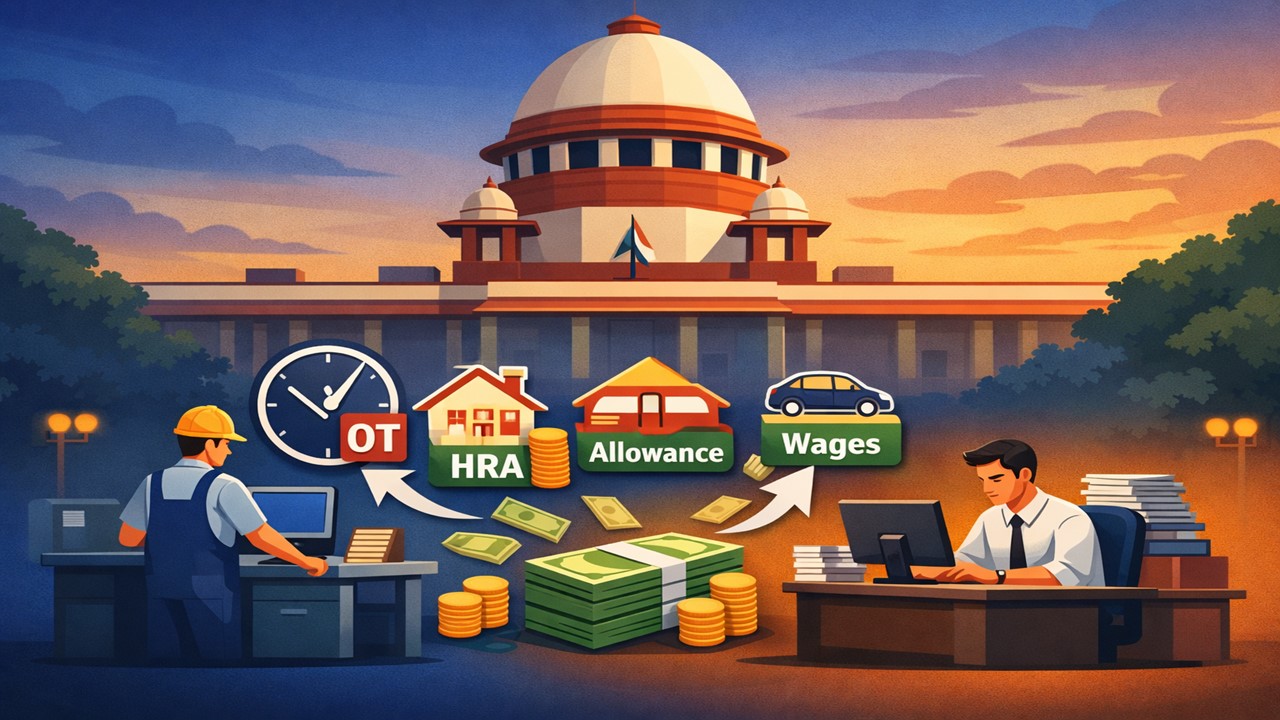
Compensatory allowances like HRA, Transport and other benefits form part of “ordinary rate of wages” for overtime under the Factories Act
Supreme Court: Overtime Pay Must Include HRA and Other Allowances
 Meetu Kumari
 Jan 22, 2026
Supreme Court: Overtime Must Be Paid on Full Wages, Not Just Basic Pay
The dispute arose from instructions issued by various Central Government Ministries excluding compensatory allowances such as House Rent Allowance (HRA), Transport Allowance, Clothing and Washing Allowance and Small Family Allowance from the computation of overtime wages payable to employees of defence production factories. Employee unions challenged these exclusions before the Central Administrative Tribunal, which rejected their claims.
The High Court reversed the Tribunal’s decision, holding that such allowances must be included while calculating overtime wages under Section 59(2) of the Factories Act, 1948. Aggrieved, the Union of India filed appeals before the Supreme Court.
Main Issue: Whether compensatory allowances form part of the “ordinary rate of wages” for the purpose of calculating overtime wages under Section 59(2) of the Factories Act, 1948.
Apex Court Held: The Supreme Court dismissed the Union of India’s appeals and upheld the Madras High Court’s ruling. It held that Section 59(2) of the Factories Act clearly defines “ordinary rate of wages” as basic wages plus all allowances to which a worker is entitled, except bonus and overtime wages. The Court ruled that executive circulars or office memorandums issued by Central Government ministries have no authority to introduce exclusions not provided by Parliament.
As the Act vests rule-making and exemption powers only with State Governments, Central ministries cannot narrow workers’ statutory entitlements through administrative instructions. The Court held that any interpretation curtailing workers’ rights must be avoided. Thus, compensatory allowances such as HRA and Transport Allowance must be included while computing overtime wages.
To Read Full Judgment, Download PDF Given Below
About Author


Meetu Kumari
Content Manager
Meetu Kumari is an Experienced Advocate and Content Writer with 4+ years of demonstrated history of working in the law practice industry. Skilled in Developing Content, Researching, and Drafting. Strong professional with a Bachelor of Science (B.Sc.) focused on Law from Gujarat National Law University.
Meetu Kumari is an Experienced Advocate and Content Writer with 4+ years of demonstrated history of working in the law practice industry. Skilled in Developing Content, Researching, and Drafting. Strong professional with a Bachelor of Science (B.Sc.) focused on Law from Gujarat National Law University.
 Studycafe
 Jodhpur, Rajasthan, India
 2264
2264My Recent Articles
- ITAT Condones 302-Day Delay, Restores Salary Assessment for Fresh VerificationPremium
- ITAT Condones Delay After Tax Consultant's Death, Restores Appeals for Fresh HearingPremium
- ITAT Remands Salary Addition, Says Taxability Depends on Salary Becoming Due, Not Mere ReceiptPremium
- ITAT Deletes TP Royalty Adjustment, Orders Fresh Review of Commission BenchmarkingPremium
- ITAT Quashes Reassessment Over Unsigned Section 148 Notice Issued to AssesseePremium
Up Next
Loading suggestions…


Recent Posts


All Posts


Recent Posts
All Posts