Supreme Court Quashes Excise Demand; Upholds Revenue Neutrality in Fertilizer Subsidies:
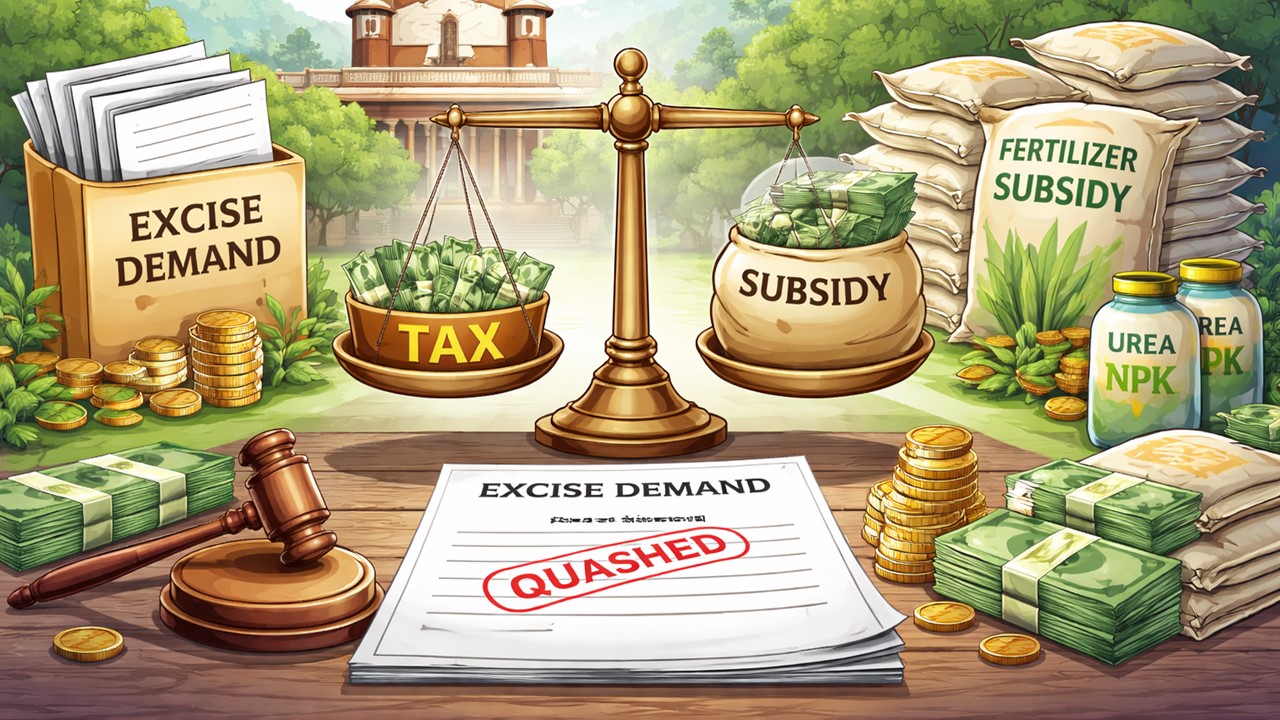
Apex Court Rules Reimbursement of Notional Excise Duty by Government Does Not Attract Further Tax
Supreme Court: Fertilizer Subsidy Notional Excise Not Taxable
 Meetu Kumari
 Mar 27, 2026
Supreme Court Quashes Excise Demand; Upholds Revenue Neutrality in Fertilizer Subsidies
The appellant, M/s. Rashtriya Chemicals and Fertilizers Limited (RCF), a Government of India undertaking, is engaged in the manufacture of fertilisers. Under the subsidy schemes, which are the Retention Price Scheme and the New Pricing Scheme, the price of fertilisers is controlled to ensure affordability for farmers. The Government pays the manufacturer the difference between the "normative cost of production" and the "statutory sale price" as a subsidy. This normative cost includes a "notional" excise duty component, the amount the manufacturer would have paid if not for specific exemption notifications.
The Revenue contended that this reimbursement of notional excise duty should be treated as "additional consideration" and added to the transaction value for further excise duty under Section 4 of the Central Excise Act.
Issue Before Supreme Court: Whether the reimbursement of "notional excise duty" by the Central Government to a fertiliser manufacturer, as part of a subsidy scheme, forms "additional consideration" flowing from a third party to the seller and attracts excise duty on such an amount.
SC's Decision: The Supreme Court allowed the appeals and set aside the orders of the CESTAT and the Revenue. The Supreme Court allowed the appeals and set aside the excise demand, holding that the benefit of exemption could not be denied when the dominant and intended use of Naphtha was for fertilizer production. The Court held that the subsidy received from the Government is to bridge the gap between production cost and the controlled selling price, not a payment "on behalf of the buyer." The Court applied the principle of "Revenue Neutrality," observing that if the appellant were to pay excise duty on this amount, the same would again be reimbursed by the Government as a subsidy.
The Court also ruled in favour of the appellant on the grounds of limitation, stating that since the entire exercise was revenue-neutral and based on transparent Government policy, there was no "intent to evade duty" to justify invoking the extended period of limitation.
To Read Full Judgment, Download PDF Given Below
About Author


Meetu Kumari
Content Manager
Meetu Kumari is an Experienced Advocate and Content Writer with 4+ years of demonstrated history of working in the law practice industry. Skilled in Developing Content, Researching, and Drafting. Strong professional with a Bachelor of Science (B.Sc.) focused on Law from Gujarat National Law University.
Meetu Kumari is an Experienced Advocate and Content Writer with 4+ years of demonstrated history of working in the law practice industry. Skilled in Developing Content, Researching, and Drafting. Strong professional with a Bachelor of Science (B.Sc.) focused on Law from Gujarat National Law University.
 Studycafe
 Jodhpur, Rajasthan, India
 2264
2264My Recent Articles
- ITAT Condones 302-Day Delay, Restores Salary Assessment for Fresh VerificationPremium
- ITAT Condones Delay After Tax Consultant's Death, Restores Appeals for Fresh HearingPremium
- ITAT Remands Salary Addition, Says Taxability Depends on Salary Becoming Due, Not Mere ReceiptPremium
- ITAT Deletes TP Royalty Adjustment, Orders Fresh Review of Commission BenchmarkingPremium
- ITAT Quashes Reassessment Over Unsigned Section 148 Notice Issued to AssesseePremium
Up Next
Loading suggestions…


Recent Posts



All Posts



Recent Posts
All Posts