Top 3 Midcap Mutual Funds to Invest in December 2021

Top 3 Midcap Mutual Funds to Invest in December 2021 Midcap mutual funds are one of the riskiest but most profitable forms of mutual funds. The midca…
 Deepshikha Mahapatra
 Dec 9, 2021
Table of Contents

Top 3 Midcap Mutual Funds to Invest in December 2021
Midcap mutual funds are one of the riskiest but most profitable forms of mutual funds. The midcap mutual fund category has delivered a remarkable return of 67.92 per cent over the last year (as of 14th September 2021).
Midcap mutual funds invest in companies that are somewhat mid-sized and have limited liquidity. This makes it harder for investors to enter and exit the market. These businesses are particularly vulnerable to economic downturns due to their financial instability.
Fortunately, knowing the basics of midcap mutual funds can help you reduce this risk. Now, we'll look at the finest midcap mutual funds in December 2021.
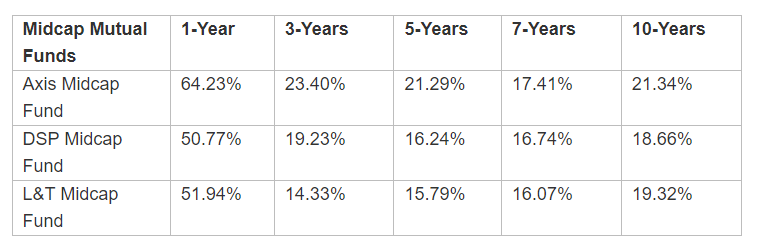
What are Midcap Mutual Funds?
Midcap mutual funds must invest at least 65 per cent of their assets in midcap companies, according to the Securities and Exchange Board of India (SEBI). The remaining 35% is split between major and small size stocks, as well as cash. Companies with a market capitalization of Rs 5,000 to Rs 20,000 crores are classified as midcap stocks. These are the firms ranked 101st to 250th in terms of market capitalization. They're also known as large-cap stocks of the future or impending large-cap stocks. Midcap funds, unlike large-cap funds, do not invest in well-known and reputable companies. Instead, they invest in smaller, less well-known businesses that are still in the early stages of development. When the company gets back into the big leagues, this helps them earn significantly bigger returns.List of Top 3 Midcap Mutual Funds to Invest in December 2021
Advantages of Midcap Mutual Funds
Superior Performance in Bull Markets
Midcap mutual funds have historically outperformed large-cap funds during bull markets.Greater Diversification
Large-cap mutual funds have insufficient diversity. The same pool of 100 equities is used by all large-cap funds. As a result, the vast majority of large-cap funds invest in the same 20-30 stocks. Midcap mutual funds, on the other hand, do not fall into this category. With 150 stocks, they have a larger playing field. Furthermore, because these stocks are relatively unknown, different fund managers' perspectives on the same midcap equities may differ. As a result, there is less overlap amongst midcap mutual funds.Stronger Liquidity
This is a significant benefit of midcap mutual funds. Liquidity refers to the fund manager's capacity to promptly sell the underlying stocks. Small-cap stocks are illiquid, but large-cap stocks are highly liquid. The fund manager's ability to enter and exit positions are hampered as a result. This is why, after a certain corpus limit is reached, many small-cap funds cease accepting new money. Midcap stocks are the way to go in this market. In comparison to small-cap companies, they have good liquidity. This provides the fund management with the flexibility to profit from market ups and downs without affecting share prices.Perfect for building long-term wealth
Midcap funds have a proven track record of providing greater long-term returns. The longer you retain, the better the returns will be. As a result, it is suggested that midcap funds be held for at least 10 years to realise their full potential.First-Mover Advantage
This is yet another significant benefit of midcap funds. They provide you with the option to participate in tomorrow's large-cap stocks. Investors might buy these stocks when they are in the early stages of development and wait for them to take off.A Better Alternative to Sector and Thematic Funds
To obtain significant returns, investors frequently invest in sectoral and thematic funds. However, this method has the potential to backfire. Mutual funds that invest in a certain area or subject are known as sectoral and thematic mutual funds. As a result, they are particularly dangerous, as sectors frequently experience protracted bear periods.Disadvantages of Midcap Mutual Funds
Midcap mutual funds suffer the most during bear markets, which is their largest drawback. Smaller enterprises are represented by midcap stocks. These businesses have yet to make a name for themselves. As a result, they lack brand loyalty and substantial cash reserves. As a result, they are extremely vulnerable to economic shocks. Companies are frequently forced to declare bankruptcy as a result of the damage. High cap funds, on the other hand, benefit from large capital reserves, which help them weather economic downturns. This is why midcap funds have suffered a greater loss than large size funds.About Author


Deepshikha Mahapatra
Editor
 Studycafe
 Bhubaneswar, Orissa, India
 226
226Up Next
Loading suggestions…


Recent Posts



All Posts



Tags
No tags yet.
Recent Posts
All Posts
Tags
No tags yet.