Understanding ITR Forms, Their Applicability and Due Dates for AY 2026-27:
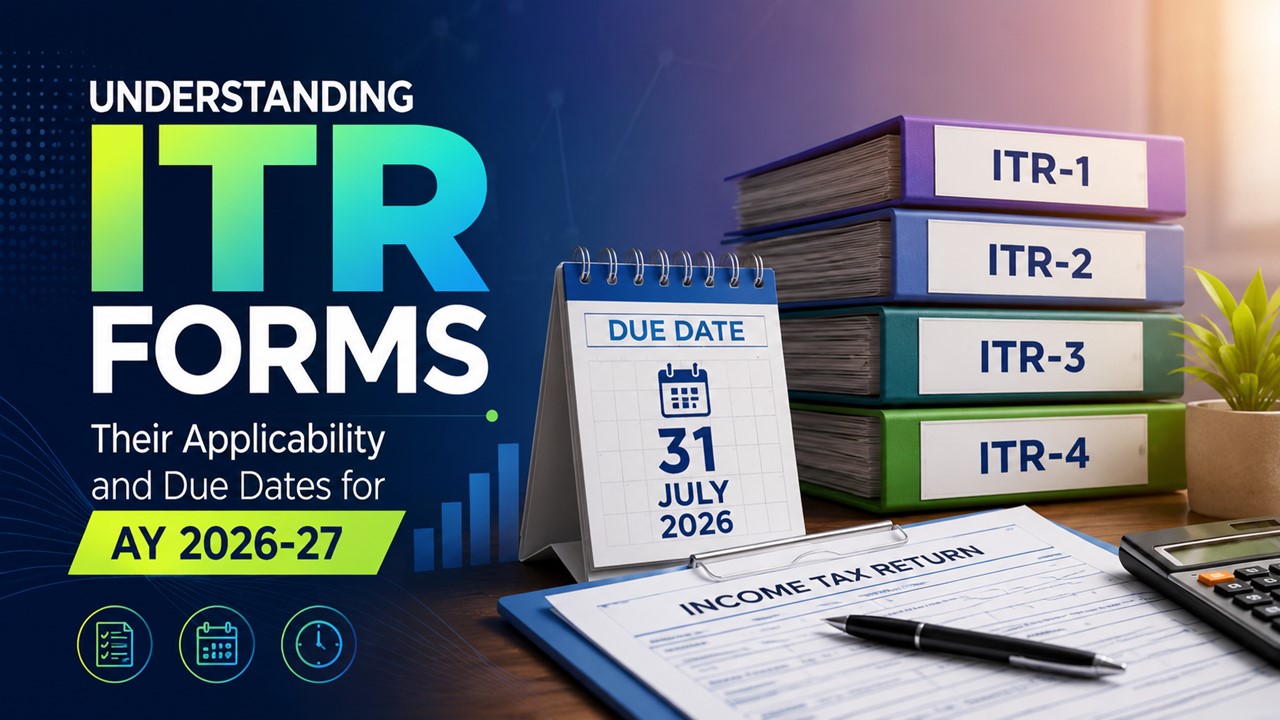
The Income Tax Department has commenced the release of e-filing utilities for AY 2026-27; here is a comprehensive view of the different ITR forms available and who can file them.
Online filing facility and Excel Based Utility for ITR-1, ITR-4, and ITR-2 Now Enabled
 Khush Trivedi
 Jun 3, 2026
Understanding ITR Forms, Their Applicability and Due Dates for AY 2026-27
Latest update
Have you guys heard about the latest update about the Income Tax Department, which has already commenced the release of e-filing utilities for AY 2026-27?
Utilities Currently Available:
Note:
Although filing utilities are available, taxpayers are advised to wait until Form 16, Annual Information Statement (AIS), and Taxpayer Information Summary (TIS) are fully updated before filing returns to avoid mismatches and defects.
- Online filing facility & Excel Based utility for ITR-1 (Sahaj) is enabled.
- Online filing facility & Excel Based utility for ITR-4 (Sugam) is enabled.
- Online filing facility & Excel Utility for ITR-2 have also been enabled on the Income Tax e-Filing Portal.
- Total income up to Rs 50 lakh.
- Income from Salary or Pension.
- Income from up to two House Properties (Loss cannot be carried forward).
- Income from Other Sources, such as Interest.
- Agricultural income up to Rs 5,000.
- Long-Term Capital Gain under Section 112A up to Rs 1.25 lakh (subject to prescribed conditions).
- Non-Residents (NRIs).
- Directors in companies.
- Persons holding unlisted equity shares.
- Individuals having foreign assets or foreign income.
- Persons having business or professional income.
- Individuals have complex capital gain transactions.
- Individuals have brought forward losses & need to be carried forward under any head of income.
- Income exceeding Rs 50 lakh.
- Income from Salary
- Capital gains from shares, mutual funds, property, etc.
- Multiple house properties.
- Income from other sources, including casual incomes such as the Lottery, winning, etc.
- Foreign assets or foreign income.
- Directorship in a company.
- Residential status as ROR, RNOR & NR
- Unlisted equity shareholdings.
- Agricultural income exceeding Rs 5,000.
- Individuals have brought forward losses & need to be carried forward under any head of income.
- Income from Business or Profession. (Either presumptive or Audit case)
- Proprietorship business.
- Partner’s remuneration, interest, and salary from partnership firms.
- Futures & Options (F&O) trading income.
- Intraday trading income.
- Salary/House Property/IFOS/CG income along with Business or profession.
- Resident Individuals, Hindu Undivided Families (HUFs), and Partnership Firms (excluding LLPs)
- Those with a total income of up to Rs 50 lakh
- Taxpayers declaring income under the presumptive taxation scheme — Section 44AD (businesses), Section 44ADA (professionals), or Section 44AE (goods carriage operators)
- Individuals with income from salary, one- or two-house properties, and other sources, in addition to presumptive business income
- Partnership Firms
- LLPs
- Association of Persons (AOP)
- Body of Individuals (BOI)
- Artificial Juridical Persons
- Co-operative Societies

- Companies other than those claiming exemption under Section 11 (income from property held for charitable or religious purposes)
- Charitable and Religious Trusts
- Political Parties
- Educational Institutions
- Research Associations
- Certain Funds and Universities
| ITR Form | Category of Taxpayer | Due Date |
| ITR-1 (Sahaj) | Individuals not having business/professional income and satisfying the prescribed conditions | 31-Jul-26 |
| ITR-2 | Individuals/HUFs not having business or professional income | 31-Jul-26 |
| ITR-3 | Business/Professional Income (Non-Audit Cases) | 31-Aug-26 |
| ITR-3 | Business/Professional Income requiring Tax Audit u/s 44AB | 31-Oct-26 |
| ITR-3 | Cases covered under Transfer Pricing provisions (Form 3CEB applicable) | 30-Nov-26 |
| ITR-4 (Sugam) | Presumptive Taxation Scheme Non-Audit Cases | 31-Aug-26 |
| ITR-4 (Sugam) | Presumptive Taxation cases requiring Audit | 31-Oct-26 |
| ITR-5 | Firms, LLPs, AOPs, BOIs, etc. (Non-Audit Cases) | 31-Aug-26 |
| ITR-5 | Audit Cases | 31-Oct-26 |
| ITR-6 | Companies | 31-Oct-26 |
| ITR-6 | Companies covered under Transfer Pricing provisions | 30-Nov-26 |
| ITR-7 | Trusts, Institutions, Political Parties, etc. (Audit Cases) | 31-Oct-26 |
| Belated Return [Sec. 139(4)] | All Taxpayers | 31-Dec-26 |
| Revised Return [Sec. 139(5)] | All Taxpayers | 31-Mar-2027 (with late fee after 31/12/2026) |
| Updated Return (ITR-U) | Eligible Taxpayers | Up to 48 months from the end of the relevant AY |
About Author


Khush Trivedi
Content writer
 Study cafe
 AHMEDABAD, Gujarat, India
 46
46My Recent Articles
- Taxation of Preliminary Expenses Under the Income Tax Act: Complete Guide to Section 35D
- Selling a Property or Asset? Know These Capital Gains Tax Exemptions
- Taxation of Joint Development Agreements (JDA): Everything Landowners Need to Know
- Section 139(9) Defective Return Notice: Complete Guide to Fixing Your ITR
- Section 32 of the Income Tax Act, 1961: Depreciation on Business Assets
Up Next
Loading suggestions…


Recent Posts


All Posts


Tags
Recent Posts
All Posts