Shivani Verma | Feb 21, 2025 |
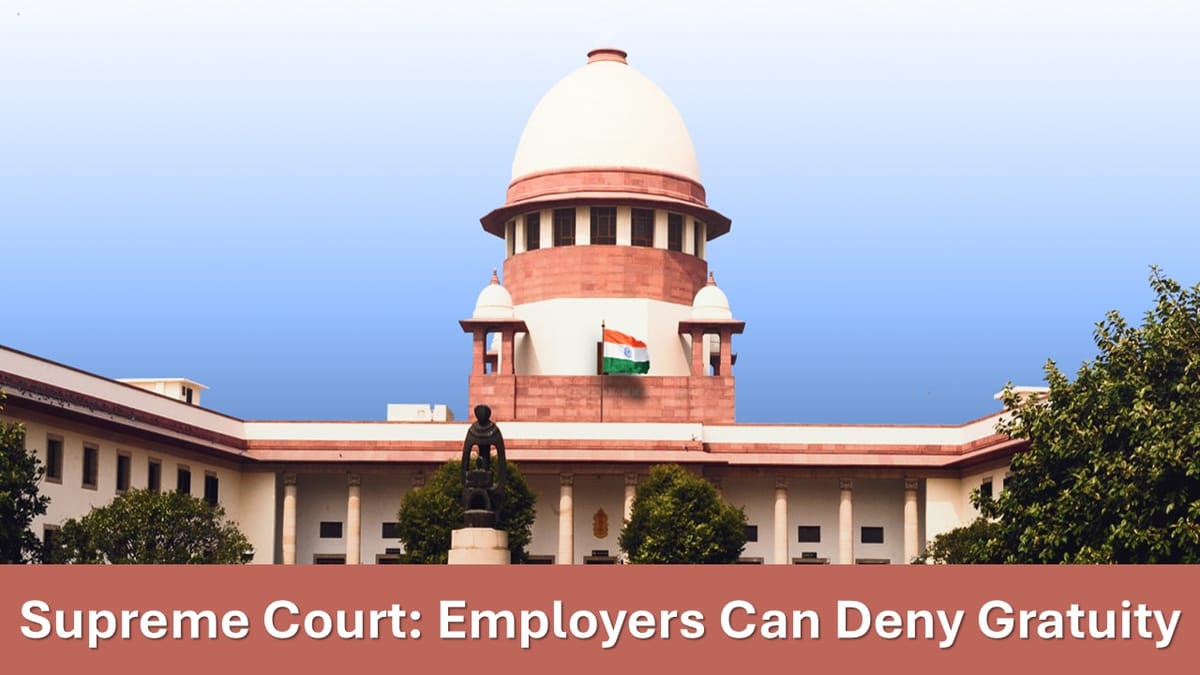

Supreme Court: Employers Can Deny Gratuity in This Situation!
On February 17, 2025, the Supreme Court of India decided that an employee’s gratuity can be taken away under the Payment of Gratuity Act, 1972, even without a criminal conviction.
If an employee is fired for ‘moral turpitude,’ in this situation employer has the right to deny their gratuity. Moral turpitude refers to serious offences, such as fraud or unethical behaviour. It is commonly used in labour and employment law to describe actions that are dishonest or morally wrong.

Employers can now deny gratuity payments if an employee is dismissed for moral corruption. Lawyers say this is a major ruling and differs from the Supreme Court’s 2018 judgment. Employers can forfeit gratuity under the Payment of Gratuity Act, 1972, with this new decision. Without waiting for a court ruling if the termination was due to moral turpitude.
In 2018, the Supreme Court (SC) ruled in the Union of India vs. Ajay Babu case that employers had to confirm in court that an employee was dismissed for ‘moral turpitude’ to deny gratuity. However, as per the current 2025 judgment, this requirement is no longer necessary. In legal terms, the 2018 ruling is now considered an obiter, meaning it is no longer a binding precedent.
In the recent ruling, the Supreme Court said that if an employer fired an employee for fraud or similar misconduct, his gratuity could be forfeited without waiting for a court decision.


Supreme court
The case was about a Public Sector Undertaking (PSU) employee who was born in 1953 but lied about his birth year, changing it to 1960 to get the job. The employee worked at PSU for around 22 years, but when the company’s disciplinary committee found out about the false information, they terminated his employment and denied his gratuity, citing it as an act of moral wrongdoing.
What Did the Supreme Court State?
The Supreme Court supported the PSU’s decision and said in its judgment that the petitioner had deliberately hidden his real date of birth. The Court clarified that even though the employer did not file a criminal case for the fraud committed using a fake or forged certificate to secure the job, it does not prevent them from cancelling the gratuity. According to the law, a criminal conviction is not required if the proven misconduct involves moral wrongdoing.

In case of any Doubt regarding Membership you can mail us at [email protected]
Join Studycafe's WhatsApp Group or Telegram Channel for Latest Updates on Government Job, Sarkari Naukri, Private Jobs, Income Tax, GST, Companies Act, Judgements and CA, CS, ICWA, and MUCH MORE!"