Income Tax Department Sending Bulk Notices for Crypto Transactions

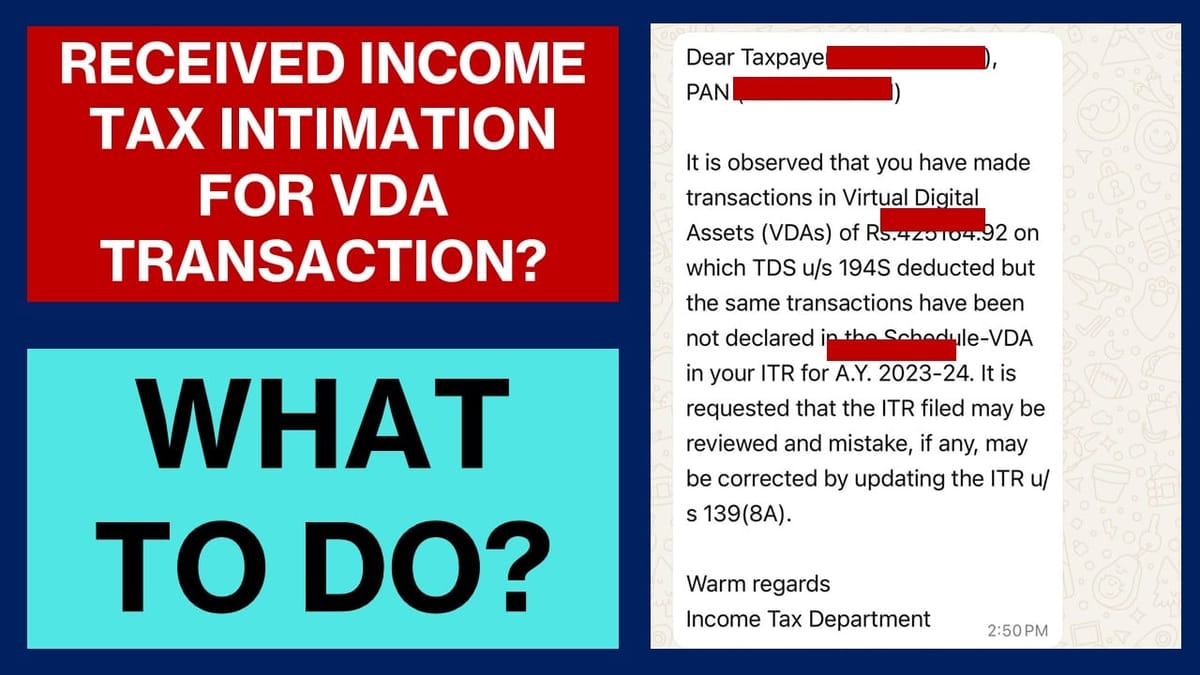
Many taxpayers have received Intimations from Tax Department for non-disclosure of income from VDA. Here is what you can do.

Income Tax Notice for VDA Transaction

Nidhi | Jun 9, 2025 |

Income Tax Department Sending Bulk Notices for Crypto Transactions

Income Tax Department Sending Bulk Notices for Crypto Transactions

The Income Tax Department, after tightening scrutiny on political donations & House Rent Allowance (HRA) claims is now issuing bulk Income Tax Intimations for non-disclosure of income from Virtual Digital Assets (VDA).

Received Income Tax Intimation for Crypto Transactions, What can you do?

  • These notices are being triggered via a virtual digital asset transaction reflected in the Annual Information Statement (AIS).
  • First, check the AIS and the data fed in the Income Tax Return (ITR) filed in relevant Assessment Year.
  • Do not worry if all the transactions are correctly reported, the required tax paid and you have all the supporting documentation.
  • In case of any pending tax liability, file ITR-U, paying the required Tax along with Interest and Additional Tax.
  • Income Tax Department may reopen the assessment in case, the required tax, interest is not paid on time.

Table of Content
  1. Other than VDA transactions, here are some of the common reasons for receiving Income Tax Notice
  2. Types of Tax Notices under Income Tax
  3. How to Deal With Income Tax Notices
  4. How to Avoid Income Tax Notices and Further Penalties?

Other than VDA transactions, here are some of the common reasons for receiving Income Tax Notice

The Income Tax Department can send you notices in the following situations:

  • Wrong Deductions: If you have claimed exemptions or deductions without supporting proofs, or for which you are ineligible, then you might receive a tax notice. Many individuals submit fake rent receipts to wrongly claim deductions for House Rent Allowance (HRA).
  • Income Mismatch: If the income that you have disclosed does not match the income reported by your employers or other sources, then you may face an income tax notice.
  • Large-Value Transactions: If you carry out high-value transactions, such as property dealings or large investments, the income tax department might issue a notice to examine these transactions.
  • Not Disclosing Income: If you have not reported all the sources of your income, then this might result in receiving a notice.
  • Inconsistency in Form 26AS: Tax authorities might send a notice if the income you have reported in your ITR does not match the transactions mentioned in your Form 26AS.
  • Belated ITR: If you have missed your ITR filing or have filed it after the due date, then tax authorities might ask you the reason for this delay through an income tax notice.
  • Foreign Assets: If you own overseas income or assets and do not disclose them as required by the tax laws, then this can attract a tax notice.

Types of Tax Notices under Income Tax

Here are the different types of income tax notices under various sections that the income tax department may issue you:

  • Notice Under Section 142(1): This notice is usually sent for two reasons: either you have filed your income tax return but the officer needs more details or documents, or you have not filed your return and are being asked to do it. Ignoring this notice can lead to a fine of up to Rs. 10,000 and even imprisonment of up to one year.
  • Notice Under Section 148: This notice can be issued if there is proof or reason to believe that the income has not been reported or is underreported, or if taxes are not paid fully.
  • Intimation Under Section 143(1): This notice is issued after your ITR has been processed. It shows how the tax department has calculated your taxes and lets you know if you need to pay more tax, if everything is fine, or if you are eligible to get a refund.
  • Notice Under Section 139(9): This notice is also called the defective return notice. It is sent when tax authorities find some mismatches or mistakes in your ITR. The taxpayer can correct these errors by filing a revised return within 15 days of receiving the notice.
  • Notice Under Section 156: This is also known as a Demand Notice. It is issued if there are outstanding tax dues, penalties, or fines that have to be paid by the taxpayers. They are required to make the payment within 30 days.
  • Notice Under Section 143(2): This notice indicates that your ITR has been selected for investigation or detailed analysis to check the accuracy of disclosed income, tax payments, etc.
  • Notice Under Section 245: This notice is sent when you have unpaid taxes from last year, and the tax department wants to adjust that amount against any refund you are supposed to get this year. You have 30 days to respond, if you do not respond on time, it may be taken as your consent to the adjustment.

How to Deal With Income Tax Notices

Here is what you should do when you receive an income tax notice.

  • Review the Notice: Start with a detailed analysis of the notice to understand the reason why it has been issued to you. Understand the specific concerns and the actions you must take.
  • Check for the Section under which the Notice is Issued: Notices are issued under various Sections as mentioned above, and it is important to reply to the notice on the basis of the section under which it has been issued.
  • Prepare Documents: Gather all the required documents, such as your ITR, Form 16, Form 26AS, bank statements, etc., that are required for the notice.
  • Respond by the Given Date: The notices issued by the Income Tax Department mention a date by which the taxpayer must respond. If you do not respond by the mentioned deadline, you can end up being penalised by the tax authority.
  • Correct your ITR Mistakes: If there is a mismatch or mistake in the information in the ITR, you can correct them by filing a revised return or rectifying the error. Such a notice received under Section 139(9) can be resolved by filing a defective return and rectifying the mistakes within 15 days.
  • Consult a professional: If you do not know how to reply to the notice, then it is best to seek consultation from a tax expert.
  • Track Response Submission: If you are responding online, then keep an eye on the submission process to ensure you receive an acknowledgement or any form of response from the tax department.

How to Avoid Income Tax Notices and Further Penalties?

  • File ITR on Time: Make sure you file your ITR by the prescribed due date. If you fail to do so, then file a belated return immediately to avoid further penalties.
  • Record Financial Transactions: Maintain a record of your financial transactions. This will be helpful during an audit.
  • Reconcile with Form 26AS: Always match the details in your ITR with the details in Form 26AS.
  • Disclose Income Sources: You should report all the income sources and should not underreport any asset or income to avoid scrutiny by tax authorities.
  • Organise Documents: Keep your documents organised, as the tax department may ask for these documents to verify.

StudyCafe Membership

Join StudyCafe Membership. For More details about Membership Click Join Membership Button
Join Membership

In case of any Doubt regarding Membership you can mail us at [email protected]

Join Studycafe's WhatsApp Group or Telegram Channel for Latest Updates on Government Job, Sarkari Naukri, Private Jobs, Income Tax, GST, Companies Act, Judgements and CA, CS, ICWA, and MUCH MORE!"





Author Bio
My Recent Articles
SEBI Study Reveals Rs 1 Lakh Crore F&O Trading Losses in FY 2025 Budget 2026: Chartered Accountant Raises Concern Over Corporate Mitras Concept Budget 2026: No More Interest Expenditure Deduction on Dividend and Mutual Fund Income Government Clarifies Time Limit for Completing Assessments Under Section 144C GSTN Enables GST Payment Using Credit Card, Debit Card and UPI in TelanganaView All Posts