SC excludes COVID-19 period while computing limitation and directs Delhi International Arbitration Centre to appoint arbitrator.
Meetu Kumari | Oct 13, 2025 |
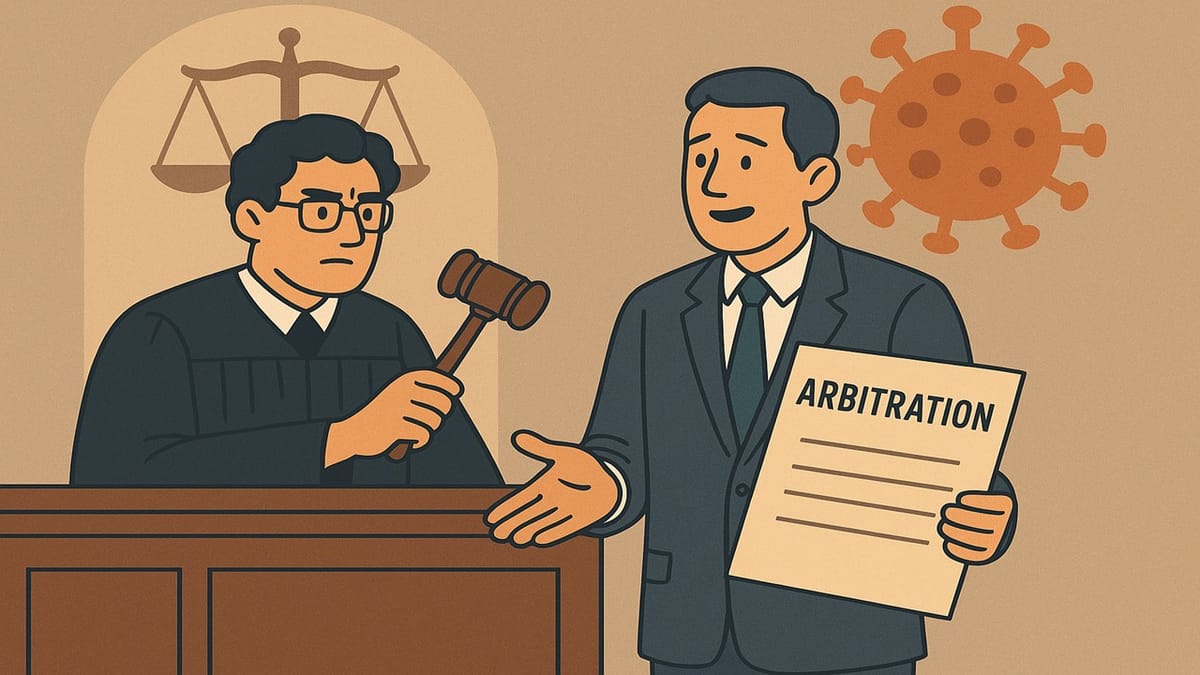

Supreme Court: COVID Extension Saves Arbitration Claim Filed After 3 Years
The appeals challenged the High Court’s orders dated 19.12.2023 and 10.04.2024, which had dismissed Assessee Company’s application under Section 11(6) of the Arbitration and Conciliation Act, 1996, for being time-barred. The dispute arose from a work contract awarded by Bharat Oman Refineries Limited (now merged with Bharat Petroleum Corporation Ltd.) for establishing a modular Penex unit at Bina Refinery. Though the project was completed in January 2018, disputes arose over deductions of liquidated damages.
The final bill was raised on 20.03.2018, followed by a “No Claim Certificate” on 03.10.2018, and final payment on 26.03.2019. The contractor invoked arbitration on 14.06.2021 after issuance of a consolidated claim notice.

HC’s Decision: The High Court rejected the petition, holding that limitation began on 03.10.2018 (date of the “No Claim Certificate”) and expired by 02.10.2021, rendering the Section 11(6) application of March 2022 time-barred. It also held the arbitration clause invalid since it empowered the Managing Director to act as or appoint the arbitrator, which is impermissible under the 2015 amendments to the Act.
Main Issue: Whether an arbitration clause becomes void when the named authority becomes ineligible after statutory amendments, and whether limitation for seeking appointment of an arbitrator was saved by COVID-19 extension orders.
SC’s Decision: The Court held that the arbitration clause itself survives even if the appointment procedure becomes inoperative due to legislative amendments. Relying on Perkins Eastman Architects DPC v. HSCC (India) Ltd. and Voestalpine Schienen GmbH v. DMRC Ltd., it ruled that statutory changes under Section 12(5) of the 1996 Act were meant to ensure neutrality, not to extinguish the arbitration mechanism. Thus, the clause remained enforceable, and courts could appoint an independent arbitrator under Section 11(6).

On limitation, the Bench observed that while the cause of action arose on 21.04.2018 (30 days after submission of final bill), the COVID-19 period from 15.03.2020 to 28.02.2022 stood excluded pursuant to this Court’s order in In Re: Cognizance for Extension of Limitation (2022). Thus, the contractor’s application filed in March 2022 was within limitation.
Setting aside the High Court’s orders, the Supreme Court directed the Delhi International Arbitration Centre (DIAC) to appoint an independent arbitrator to adjudicate the dispute in accordance with law and rules. The appeals were allowed with no order as to costs.
To Read Full Judgment, Download PDF Given Below

In case of any Doubt regarding Membership you can mail us at [email protected]
Join Studycafe's WhatsApp Group or Telegram Channel for Latest Updates on Government Job, Sarkari Naukri, Private Jobs, Income Tax, GST, Companies Act, Judgements and CA, CS, ICWA, and MUCH MORE!"