Budget 2026: FM Proposes to Simplify Dividend Provisions for IFSC Treasury Centres:
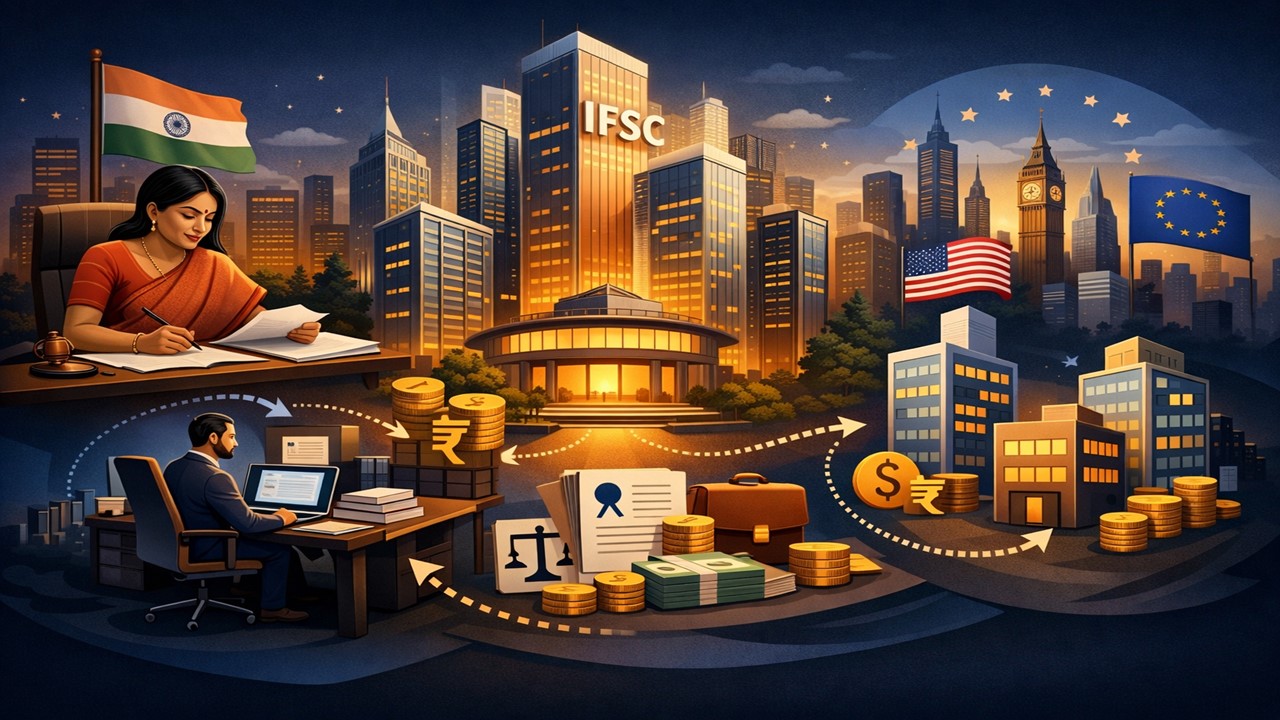
Nirmala Sitharaman proposed amendment to rationalise certain terms for treasury centres in IFSC
Clarification of Dividend Treatment in IFSC Treasury Centres
 Vanshika verma
 Feb 3, 2026
Budget 2026: FM Proposes to Simplify Dividend Provisions for IFSC Treasury Centres
Finance Minister Nirmala Sitharaman, during the 2026 budget, proposed an amendment that aims to make the law clearer and simpler by clearly stating when loans or advances between group companies will not be treated as dividends, especially in the case of treasury centres operating in IFSCs.
Clause (40) of Section 2 defines the term "dividend". However, sub-clause (v) of this clause states that certain payments are not treated as dividends. Specifically, it excludes any advance or loan given between group entities, provided that one of the entities is a finance company or a finance unit, and the parent or principal entity of the group is listed on a stock exchange outside India (except in such countries or territories as may be specifically notified by the Board). In short, loans or advances between group companies are not considered dividends when these conditions are met.
The proposed amendment seeks to simplify the provision by changing sub-clause (v) of clause (40). It clarifies that the other group entity involved in the transaction must also be located in a country or territory outside India that is notified by the Government. In addition, the parent or principal entity of the group must be listed on a stock exchange outside India. For this purpose, the countries or territories outside India will be those specifically notified by the Central Government through an official notification in the Official Gazette.
For these provisions, certain terms are proposed to be defined as:
a) "group entity" will have the same meaning as given under clause (m) of sub-regulation (1) of regulation 2 of the International Financial Services Authority (Payment Services) Regulations, 2024.
b) "Parent entity" or "principal entity" refers to an entity that has one or more subsidiary group entities. Such an entity is considered a parent or principal entity if it, either on its own or together with its subsidiaries, holds more than half of the total voting power in those entities, or if it has the power to control the composition of their Board of Directors.
These amendments will come into force from April 1, 2026 and will apply to the tax year 2026-27 and subsequent tax years.
About Author


Vanshika verma
Content Writer
Vanshika Verma is a Content Writer with 1+ year of experience at Studycafe.in. A B.Com graduate from Delhi University, She writes articles on Finance, Tax, ICAI, GST, and the latest financial news, with a focus on making complex topics easy for readers and professionals.
Vanshika Verma is a Content Writer with 1+ year of experience at Studycafe.in. A B.Com graduate from Delhi University, She writes articles on Finance, Tax, ICAI, GST, and the latest financial news, with a focus on making complex topics easy for readers and professionals.
 Studycafe
 Delhi, Delhi, India
 2096
2096My Recent Articles
- Pinarayi Vijayan Moves Supreme Court Challenging Kerala High Court Order to Register FIR in CMRL Alleged Bribery Case
- CBI Lays Trap in Srinagar, Arrests SMC Ward Officer Red-Handed While Allegedly Accepting Rs 10,000 Bribe
- NIIT Limited Discloses Income Tax Department’s Appeal Before Delhi ITAT, Says No Adverse Financial Impact Expected
- Fake WhatsApp Boss Dupes Company Accountant of Rs 40 Lakh; Surat Police Arrest Haryana Man in Cyber Fraud Case
- Uttarakhand Tax Department Detects Rs 2.5 Crore Tax Evasion at Ramnagar Resort
Up Next
Loading suggestions…


Recent Posts


All Posts


Recent Posts
All Posts