The Delhi High Court upheld the CIT(A) and ITAT’s view that the alleged Rs. 10 bogus lakh loan was genuine and dismissed the Revenue’s appeal.
Saloni Kumari | Nov 15, 2025 |

Assessee not required to prove “source of source” of funds credited as unsecured loans: Delhi HC
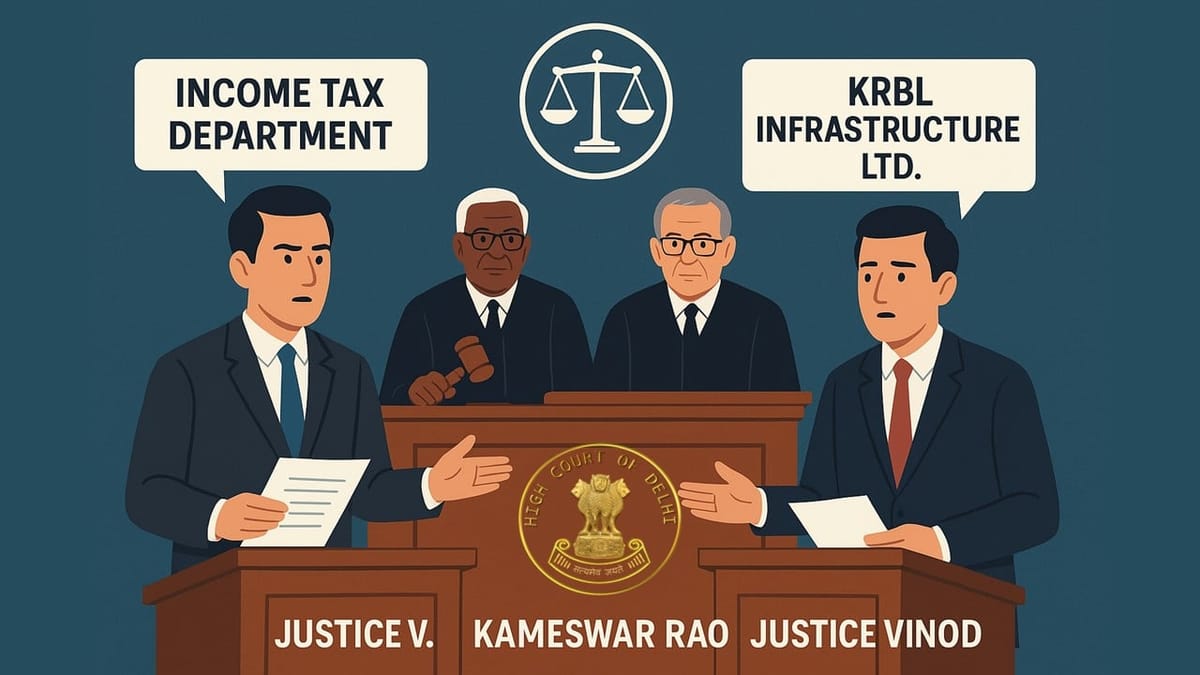
The present appeal has been filed by the Principal Commissioner of Income Tax-4 Delhi (Appellant) under Section 260A of the Income Tax Act, 1961, against the KRBL Infrastructure Limited (Respondent), in the Delhi High Court. The benches comprised Honourable Justice V. Kameswar Rao and Justice Vinod Kumar.
The final decision was announced on November 13, 2025. The appellant challenged an order dated June 08, 2024, passed by the Income Tax Appellate Tribunal (ITAT) vide ITA No. 3963/DEL/2019. In that ruling, ITAT dismissed the appeals filed by the appellant.

Background of Case:
The appellant here is the Income Tax Department or Revenue, which has filed an appeal against an order of the Income Tax Appellate Tribunal (ITAT). In the order, the tribunal has deleted the addition of Rs. 10 lakh on the grounds of an unsecured loan and reduced the disallowance of Interest on that loan. Now, the High Court has accepted the appeal on two legal questions:

“Whether the ITAT was wrong in deleting the Rs. 10 crore “unsecured loan” addition and related interest of Rs. 1.03 crore.
Whether the ITAT was right in following the Supreme Court’s decision in Abhisar Buildwell, which limits additions in search cases.”
On March 30, 2016, a search was conducted on the KRBL Group under Section 132. On August 25, 2017, the assessee (KRBL Infrastructure Ltd.) had filed its Income Tax Return (ITR), declaring a loss of Rs. 3,49,55,515. Following the search, an assessment was done under Section 153A. When the Assessing Officer (AO) made an addition of Rs. 10 crore to the income of the assessee as a bogus unsecured loan allegedly taken from Shashi Foods India Pvt. Ltd. Additionally, AO disallowed Rs. 1.03 crore interest on this loan.
The aggrieved assessee, unhappy with the decision of the AO, then filed an appeal before the CIT(A); the authority deleted the Rs. 10 crore addition and reduced interest to Rs. 84 lakh. Aggrieved by the ruling of CIT(A), the revenue approached ITAT, where the tribunal dismissed the appeal filed by the Revenue and allowed the assessee’s appeal. Thereafter, Revenue challenged the order of ITAT before the Delhi High Court by filing an appeal.
Revenue’s Key Arguments:
Revenue claimed that Shashi Foods did not have the real money to give such a huge loan. Statements and investigations show questionable business practices. During the investigation, a person named Dinesh Jain admitted to giving bogus purchase bills to companies (including KRBL group entities). He controlled several bogus firms. Director of Shashi Foods, Gian Chand Sethi, said the loan came from “sales proceeds”. However, the investigation showed that many creditors shown by Shashi Foods could not be traced. Bills looked fake (same handwriting, unsigned, missing details), and Bank statements showed layered transactions through suspicious entities, many connected to Dinesh Jain.
According to the law, the assessee is liable to prove the lender’s identity, its creditworthiness, the genuineness of the loan transaction, etc. However, the Revenue claims that all the aforesaid conditions fail in this case. The Loan was unsecured, with no documentation: No loan agreement, no collateral and no relationship between parties. Directors of KRBL denied knowing the lender. Since a search took place, the AO can examine all issues afresh, not only those based on search material.
Assessee’s Arguments
The assessee said that ITAT has already examined all the documents in depth; hence, the High Court should not interfere with factual findings and should dismiss the writ petition. The loan taken by the assessee was genuine and has even been confirmed by Shashi Foods. They had legally paid interest on it with TDS deducted. The loan was completely repaid in the financial year 2015-16.
The department started its investigation/verification more than 3 years later. When the supplier may have moved. The requirement to prove “source of source” was added only from the Finance Act 2022. Which was not applicable to an earlier assessment year. According to the law, Bank transactions and confirmations are enough unless contrary evidence exists.
High Court’s Decision
When the high court analysed the arguments of both sides, it made the following findings:
The High Court agreed with the decision of the ITAT in the present case. The High Court says that the Income Tax Tribunal (ITAT) correctly held that the assessee proved three things:
Because of the aforementioned proofing, the earlier court decisions cited by the tax department (Revenue) do not apply to the present case.
The Revenue argued that money was being rotated within certain related groups in the financial year 2015-16. The court says that this point does not apply to this case and is irrelevant in the context of this case because the present case is regarding a loan taken in the financial year 2013-14 (Assessment Year 2014-15).
All the relevant information related to the case, like loan transactions, has already been deeply examined by the CIT(A) and ITAT, and all have been found bona fide since they happened through proper bank channels. Their finding is reasonable and not wrong. Therefore, later transactions (financial year 2015-16) cannot be used to question this older loan.
The department claimed that the assessment could rely on search-related material under the Abhisar Buildwell judgement. But the Assessing Officer (AO) never mentioned any incriminating evidence in his order. Additionally, since the Court already agreed with the CIT(A) and ITAT on the merits, this argument doesn’t help the department.
In conclusion, the court ruled in favour of the assessee and dismissed the present appeal filed by the Revenue.

In case of any Doubt regarding Membership you can mail us at [email protected]
Join Studycafe's WhatsApp Group or Telegram Channel for Latest Updates on Government Job, Sarkari Naukri, Private Jobs, Income Tax, GST, Companies Act, Judgements and CA, CS, ICWA, and MUCH MORE!"