The Supreme Court refused to entertain a PIL, holding it cannot assume that a certain provision will be misused in the future, especially when there are already legal remedies available.
Saloni Kumari | Mar 10, 2026 |
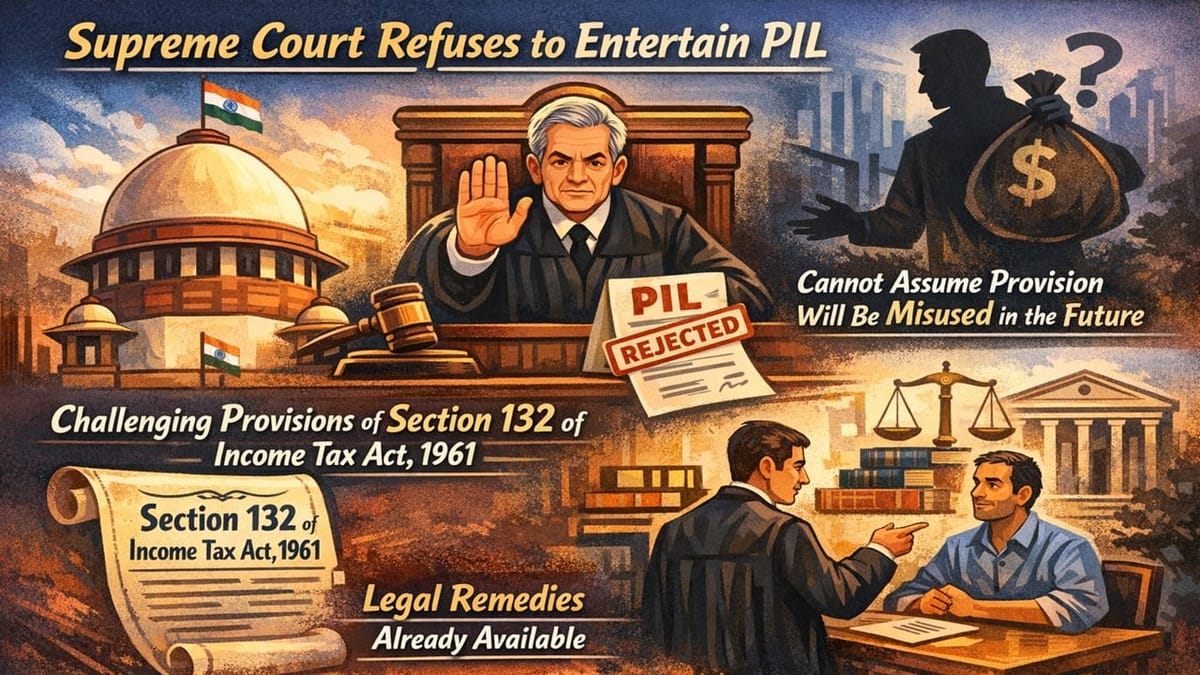

SC Denies Considering PIL Challenging Search Powers of Tax Authorities; Holds Concerns are Highly Speculative
The Supreme Court of India, in a recent case, has denied accepting a writ petition filed to challenge the provisions of Section 132 of the Income Tax Act, 1961, and its corresponding provisions of Section 245 of the Income Tax Act, 2025 (scheduled to be effective from April 01, 2026). The public interest litigation (PIL) filed by Vishwaprasad Alva was heard by the bench comprising the Honourable Chief Justice of India (CJI) Surya Kant and Justice Joymalya Bagchi.
Section 132 of the Income Tax Act, 1961, authorises tax authorities to conduct “search and seizure” operations on premises where they suspect hidden income, assets, or documents. During the hearing, the petitioner drew the attention of the judges to the concern that the provisions of the challenged section can be misused and can be used to harass taxpayers. The petitioner argued that the disputed section unfairly allows tax authorities to have access to phones, emails, cloud data, and other digital records during search operations conducted by them without issuing prior notice.

The petitioner further claimed that the revised provisions of the law have even widened the powers of the tax authorities to conduct searches and surveys without even explaining why they are doing so. The petitioner claimed that these provisions violate Articles 14 and 21 of the Indian Constitution, which underline the rights of equality before the law and protection of life and personal liberty.
The petitioner argued that the revised law gives tax authorities very wide powers to conduct searches and surveys without explaining the reasons for doing so. He said that such powers could affect people’s privacy and that the law does not provide enough safeguards to prevent misuse.

The CJI Kant said that the court cannot assume that a certain provision will be misused in the future, especially when there are already legal remedies available if someone is actually harassed. The court noted that the concern raised by the petitioner is highly speculative in nature, and the expanded powers of tax authorities under the challenged provision have been given to settle serious tax evasion cases. The Court held that sometimes certain provisions under laws initially seem to be capable of misuse. However, such provisions are often meant to deal with large tax evaders, and if problems arise, courts can examine them later.
During the hearing, the petitioner asked the court to withdraw the plea so that he could first approach the Union government for seeking clarification on the challenged provisions. The court has accepted the withdrawal and allowed the petitioner to seek the requested clarification.
Diary Number: 979/2026

In case of any Doubt regarding Membership you can mail us at [email protected]
Join Studycafe's WhatsApp Group or Telegram Channel for Latest Updates on Government Job, Sarkari Naukri, Private Jobs, Income Tax, GST, Companies Act, Judgements and CA, CS, ICWA, and MUCH MORE!"